
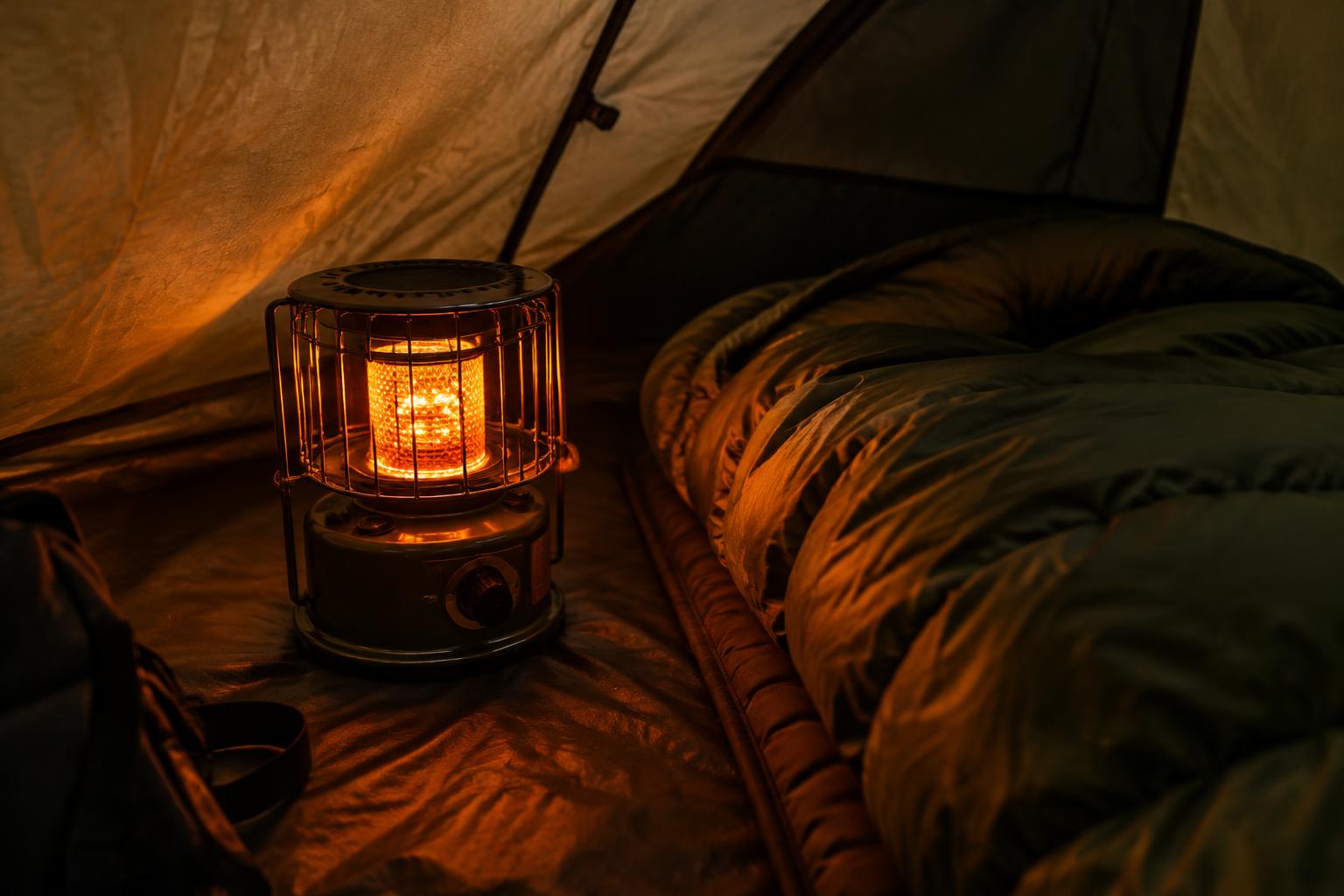
Choosing a best tent heater for camping starts with the exact model’s owner’s manual not the product title or a retailer’s description. This guide compares five Mr. Heater models using published specifications, available manuals, and retailer information. We did not physically test them or measure carbon monoxide (CO), oxygen levels, or heat output. A combustion heater can cause fire or fatal CO poisoning, even when it has safety shutoffs.
Use a heater inside a tent only if the manual supplied with that exact unit explicitly permits it and you can meet every ventilation and clearance requirement. If the manual is unclear, do not use it in a tent. Never operate a heater while sleeping, and use a working battery-powered CO alarm as an additional precaution not as a substitute for ventilation or following the manual.
Quick Verdict
- Best overall: Mr. Heater Portable Buddy (MH9BX). Two settings (4,000 and 9,000 BTU), a 225 sq ft rating, and a manual that allows tent use with ventilation. It suits most 2 to 6 person tents.
- Best budget and best for solo tents: Mr. Heater Little Buddy (MH4B). Lighter, smaller, and usually the lowest-priced of the group, but only 3,800 BTU.
- Best for large tents: Mr. Heater Big Buddy (MH18B). The most heat here, with three settings. It is also the heaviest.
- Also worth a look: the Hunting Buddy for group tents and the Buddy FLEX for windy camps.
What actually separates these five: tent size, how much weight you will carry, and whether the listing you buy is the standard US version.
Read this before you buy
- Check the exact model and regional version. Some US-market versions differ from versions sold in Canada and Massachusetts. Never rely on the model family name alone; read the manual for the exact unit and obey local law.
- Meet every ventilation requirement in the exact manual. A vent opening is not a guarantee against CO poisoning. If you cannot meet the manual’s requirements, do not use the heater in the tent.
- Never run a heater while sleeping or leave it unattended. Turn it off before going to bed or leaving the tent.
- Use a working battery-powered CO alarm. An oxygen depletion sensor (ODS) is not a CO alarm and does not make the heater risk-free.
- Do not use a camp stove or another fuel-burning appliance inside the tent. Follow all appliance and campground rules.
Best Tent Heaters at a Glance
Compare heat output, intended use, published coverage, and our editorial scores before choosing a propane heater for your camping setup.
| Heater | Best for | Heat output | Manufacturer coverage | Tent-use guidance | Our score | Check price |
|---|---|---|---|---|---|---|
|
Mr. Heater Portable Buddy (MH9BX)
Best Overall
|
General car camping | 4,000–9,000 BTU | Up to 225 sq. ft. | Check the exact US manual for approved use and ventilation requirements. | 8.3out of 10 |
Check Price ↗ |
|
Mr. Heater Little Buddy (MH4B)
Best Compact Pick
|
Solo campers and smaller spaces | 3,800 BTU | Up to 95 sq. ft. | Check the exact US manual for approved use and ventilation requirements. | 8.0out of 10 |
Check Price ↗ |
|
Mr. Heater Big Buddy (MH18B)
High Heat Output
|
Larger camping areas | 4,000–18,000 BTU | Up to 450 sq. ft. | Check the exact US manual for approved use and ventilation requirements. | 7.4out of 10 |
Check Price ↗ |
|
Mr. Heater Hunting Buddy (MH12HB)
Base-Camp Option
|
Group camping and base camps | 6,000–12,000 BTU | Up to 300 sq. ft. | Check the exact US manual for approved use and ventilation requirements. | 7.2out of 10 |
Check Price ↗ |
|
Mr. Heater Buddy FLEX (MH11BFLEX)
Accessory Setup
|
Campers considering compatible accessories | Up to 11,000 BTU | Not listed in the specifications reviewed | Verify the exact model’s manual and approved operating conditions. | 6.7out of 10 |
Check Price ↗ |
Important safety note: Manufacturer coverage figures are not guarantees of comfortable or safe heating in every tent. Never assume a heater is approved for an enclosed space based on its output or product listing. Follow the exact model’s manual, clearance and ventilation instructions; use a battery-powered carbon monoxide alarm; and never operate a combustion heater while sleeping. If the manual does not explicitly allow your intended setup, do not use it that way.
Affiliate disclosure: As an Amazon Associate, CampingSaga may earn from qualifying purchases.
Which Heater Fits Your Tent?
Manufacturer coverage ratings are for rooms. Tents lose heat faster, so treat the rating as a ceiling and plan to run the heater on low or medium. Not sure which tent style you have? Compare a dome tent vs cabin tent before you pick.
| Your situation | Best fit | Why |
|---|---|---|
| Solo or 2-person tent, car camping | Little Buddy | Its 95 sq ft rating matches a small tent, and it is the lightest option. |
| 3 to 6 person dome or family tent | Portable Buddy | Two settings let you run low most of the night before bed and use high to warm up. |
| Large cabin-style or multi-room tent | Big Buddy | The 450 sq ft rating and low setting give you room to heat a big space gently. |
| Group tent or base camp, more heat than the Portable Buddy | Hunting Buddy | 12,000 BTU in a package close to the Portable Buddy in size. |
| Windy campsite, awning or porch setup | Buddy FLEX | Built with a wind barrier and pilot shield, plus an accessory rail. |
The 5 Best Tent Heaters for Camping
1. Mr. Heater Portable Buddy (MH9BX): Best Overall
Score: 8.3/10 | Best for: 2 to 6 person tents and car campers who want one proven heater
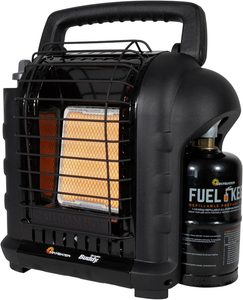
The Portable Buddy is the reference model in this category. Its two settings, 4,000 and 9,000 BTU, let you take the chill off a mid-size tent on low and warm it faster on high. The US manual lists tents among the small recreational enclosures where it can be used indoors, provided the enclosure has a window or roof vent. It runs on a 1 lb cylinder, or on a 20 lb tank with Mr. Heater’s hose and filter, with the larger tank kept outdoors.
At about 10 lbs, this is a car-camping heater, not a backpacking one. Pair it with one of the best car camping tents that has a roof or window vent. A 1 lb cylinder is consumed faster on high than on low; check the manufacturer’s runtime estimate for the exact model and treat it as approximate. Buy spare cylinders, or plan to run it on low.
| Spec | Detail |
|---|---|
| Model | MH9BX |
| Fuel | Propane (1 lb cylinder; 20 lb tank with optional hose and filter) |
| Heat output | 4,000 / 9,000 BTU |
| Manufacturer coverage | Up to 225 sq ft |
| Safety systems | Oxygen depletion sensor (ODS), tip-over shutoff |
| Ignition | Piezo |
| Weight | About 10 lbs |
| Published runtime estimate | Manufacturer listing varies by revision; check the current product page and manual before publishing a number |
| Certification (per manual) | CSA 4.98, gas-fired portable heaters for recreational or commercial use |
| Tent-use wording in US manual | The US manual describes tent use in small recreational enclosures; verify the exact unit manual and local rules |
| Which version to buy | Standard US model. Massachusetts and Canada versions are labeled for outdoor use. |
| Pros | Cons |
|---|---|
| Manual explicitly lists tents, with ventilation | About 10 lbs, too heavy for backpacking |
| Two settings fit most tents | A 1 lb cylinder empties quickly on high |
| ODS and tip-over shutoff built in | Wire guard stays hot after shutoff, per the manual |
| Can run from a 20 lb tank kept outdoors | Hose and filter for the tank are sold separately |
Who should buy it: Car campers with a 2 to 6 person tent that has a vent, and anyone who wants the most widely used option.
Who should skip it: Backpackers, campers in tents with no vent, and anyone hoping to run a heater overnight.

- 4,000 or 9,000 BTU radiant heat for customizable comfort
- Designed and approved for indoor and outdoor use. Indoor use not approved in Canada or Massachusetts.
- Heats spaces up to 225 sq. ft. with efficient radiant warmth
2. Mr. Heater Little Buddy (MH4B): Best Budget and Best for Solo Tents
Score: 8.0/10 | Best for: Solo campers and 1 to 2 person tents
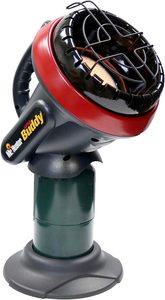
The Little Buddy shares the Portable Buddy’s safety approach in a smaller body. It puts out 3,800 BTU and is rated for up to 95 sq ft, which suits a one or two person tent. It is lighter and easier to pack than the larger models and is usually the lowest-priced Buddy heater. Its heat is focused in a narrow direction; keep people, sleeping bags, clothing, and tent fabric outside the clearance distances in the manual.
The manual specifies a minimum ventilation opening; verify the exact measurement in the manual supplied with your unit before use. It also notes the heater works outdoors but may shut off unexpectedly in certain wind conditions, so do not count on it for open, windy camps. Building a low-cost kit? See our best budget camping gear.
| Spec | Detail |
|---|---|
| Model | MH4B |
| Fuel | Propane (1 lb cylinder) |
| Heat output | 3,800 BTU |
| Manufacturer coverage | Up to 95 sq ft |
| Safety systems | ODS, tip-over shutoff |
| Heat pattern | About 45 degrees, focused |
| Weight | Check the current manufacturer specification for the exact version; lighter than the Portable Buddy |
| Published runtime estimate | Over 5 hours per 1 lb cylinder |
| Certification (per manual) | CSA 4.98, gas-fired portable heaters for recreational or commercial use |
| Tent-use wording in US manual | The US manual describes tent use in small recreational enclosures; verify the exact unit manual and local rules (minimum 4 sq in) |
| Which version to buy | Standard US model, not the Massachusetts version |
| Pros | Cons |
|---|---|
| Lightest and usually lowest-priced option here | 3,800 BTU is supplemental heat in hard cold |
| Same ODS and tip-over protection as larger models | One heat output, so no gentler setting |
| Long burn time from a 1 lb cylinder | Narrow heat spread warms one area, not the whole tent |
| Manual lists tents, with ventilation | Wind can cause nuisance shutoffs outdoors |
Who should buy it: Solo campers, couples in a small tent, and anyone who wants the cheapest heater from a proven line. Who should skip it: Families in 4-person or larger tents, and campers who expect it to be the only warmth on a freezing night.

- Product 1: Indoor-safe portable propane heater for rooms up to 95 square feet. THIS UNIT IS NOT INTENDED FOR GOLF CART U…
- Product 1: Continuous odor-free, 45-degree heating angle. Maximum Elevation (Ft) 7000 Feet. Automatic low oxygen shut-of…
- Product 1: Simple on/off buttons; uses 1-pound disposable propane cylinder (not included). Run time at minimum btu and m…
3. Mr. Heater Big Buddy (MH18B): Best for Large Tents
Score: 7.4/10 | Best for: Large cabin-style tents and very cold nights
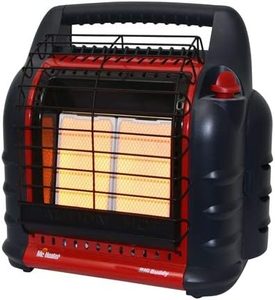
The Big Buddy is the heavy hitter. It offers 4,000, 9,000, or 18,000 BTU and a 450 sq ft rating, and it connects to two 1 lb cylinders, with accessories available for a 20 lb tank. Mr. Heater claims up to 11 hours of coverage on dual cylinders. The US manual lists tents among the small recreational enclosures where it can be used with ventilation.
In a tent, you will rarely want the 18,000 BTU setting. Its real value is the low setting in a big space. Weight is the cost: the manufacturer lists 17.1 lbs.
Check the listing carefully. Mr. Heater notes that it removed the fan on some units, and it also sells a Massachusetts and Canada version labeled for outdoor use. The manual also carries a notice that the heater is not for use in a dwelling home in California.
| Spec | Detail |
|---|---|
| Model | MH18B |
| Fuel | Propane (two 1 lb cylinders; 20 lb tank with accessories) |
| Heat output | 4,000 / 9,000 / 18,000 BTU |
| Manufacturer coverage | Up to 450 sq ft |
| Runtime (manufacturer claim) | Up to 11 hours on dual cylinders |
| Safety systems | ODS, tip-over shutoff |
| Weight | 17.1 lbs (manufacturer) |
| Fan | Removed on some units, so check the listing |
| Tent-use wording in US manual | The US manual describes tent use in small recreational enclosures; verify the exact unit manual and local rules |
| Which version to buy | Standard US model. The Massachusetts and Canada version is labeled outdoor. |
| Pros | Cons |
|---|---|
| Highest output and coverage in this guide | 17.1 lbs and bulky, strictly for car camping |
| Three settings, including a low setting for big spaces | 18,000 BTU is too much for most tents |
| Dual cylinders extend runtime | Fan missing on some units |
| Manual lists tents, with ventilation | Highest price in the group and versions vary |
Who should buy it: Car campers with a large cabin tent, wall tent, or shared shelter in cold weather. Who should skip it: Solo campers, backpackers, and anyone with a tent under about 100 sq ft.

- POWERFUL HEATING CAPACITY: Provides 18,000 BTU output to efficiently warm areas up to 450 sq ft. Ideal for garages, work…
- PORTABLE AND COMPACT: Designed with a convenient carry handle and lightweight build for easy transport. Move the heater …
- ADJUSTABLE HEAT SETTINGS: Features three heat levels—low, medium, and high—allowing precise temperature control. Conserv…
4. Mr. Heater Hunting Buddy (MH12HB): Best for Group Tents and Base Camps
Score: 7.2/10 | Best for: Group tents and cold-weather base camps
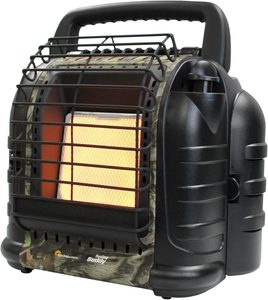
The Hunting Buddy sits between the Portable Buddy and the Big Buddy. It delivers 6,000 or 12,000 BTU, covers up to 300 sq ft by the manufacturer’s rating, and runs on a single 1 lb cylinder. A vendor note says its pulse igniter is designed for quiet starting. Its manual lists tents among the small recreational enclosures where indoor use is allowed with a window or roof vent. It can also use a remote refillable cylinder, but only when that cylinder is outdoors and you use Mr. Heater’s hose.
The trade-off is fuel. At 12,000 BTU, a 1 lb cylinder does not last long, and most tents do not need that much heat. On low it is a reasonable group-tent heater. Used on high in a small tent, it will overheat the space and eat fuel.
| Spec | Detail |
|---|---|
| Model | MH12HB |
| Fuel | Propane (1 lb cylinder; remote cylinder with hose and filter, sold separately, cylinder kept outdoors) |
| Heat output | 6,000 / 12,000 BTU |
| Manufacturer coverage | Up to 300 sq ft |
| Safety systems | ODS, tip-over shutoff |
| Ignition | Pulse igniter (quiet start, per vendor) |
| Weight | Similar to the Portable Buddy (about 9 to 10 lbs) |
| Tent-use wording in US manual | The US manual describes tent use in small recreational enclosures; verify the exact unit manual and local rules |
| Which version to buy | Standard US model, camouflage or standard finish |
| Pros | Cons |
|---|---|
| More heat than the Portable Buddy at a similar weight | 12,000 BTU empties a 1 lb cylinder quickly |
| Quiet start suits early mornings in camp | More output than most tents need |
| Manual lists tents, with ventilation | Low setting (6,000 BTU) is higher than the Portable Buddy’s 4,000 |
| Remote tank option, kept outdoors | Hose and filter for a remote tank are extra |
Who should buy it: Hunting camps, group tents, and large family tents where the Portable Buddy runs out of steam. Who should skip it: Solo and small-tent campers, who will get better runtime from the Little Buddy or Portable Buddy.

- 6,000 or 12,000 BTU per hour
- For use with propane gas
- Heats up to 300 sq ft
5. Mr. Heater Buddy FLEX (MH11BFLEX): Best for Windy Camps
Score: 6.7/10 | Best for: Windy campsites and awning setups where you may add accessories
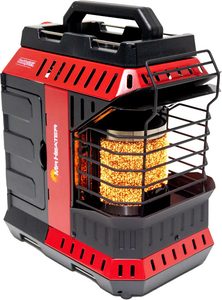
The Buddy FLEX is the newer design. It offers up to 11,000 BTU through an omni-directional mesh burner with a 180 degree radiant spread, plus a wind barrier, pilot shield, integrated storage compartments, and a quick-connect accessory rail. Listings cite a runtime of about 2 hours at maximum and 3.5 hours at minimum. It uses ODS, a tip switch, and a thermal shut-down system.
The US manual describes use in small recreational enclosures; that wording is not a guarantee against CO poisoning or fire. Verify the certification and tent-use language in the manual supplied with the exact unit. The Canadian version of the manual says never to use it in a tent, so buy the US model. Its Cooker accessory is outdoor-only and must never be used in a tent. The FLEX’s strengths are wind resistance and accessories outdoors, so most tent campers will get more value from the Portable Buddy. If wind is your main problem, also look at the best tents for windy conditions.
| Spec | Detail |
|---|---|
| Model | MH11BFLEX |
| Fuel | Propane (1 lb cylinder) |
| Heat output | Up to 11,000 BTU |
| Published runtime | About 2 hours at maximum, 3.5 hours at minimum (retailer listings) |
| Safety systems | Low-oxygen shutoff, tip switch, thermal shut-down system |
| Burner | Omni-directional mesh, 180 degree radiant spread |
| Weight | About 11 lbs |
| Certification (per manual) | ANSI Z21.103-2017, unvented portable gas camp heaters for indoor and outdoor use |
| Tent-use wording in US manual | The US manual describes tent use in small recreational enclosures; verify the exact unit manual and local rules |
| Which version to buy | Standard US model. The Canada manual prohibits tent use. |
| Pros | Cons |
|---|---|
| Wind barrier and pilot shield for exposed sites | Shortest runtime of the five |
| Thermal shut-down system in addition to ODS and tip switch | Costs more than the Portable Buddy |
| Accessory rail for add-ons | Cooker accessory is outdoor-only |
| Manual lists tents (US version), with ventilation | Manuals differ by region, which causes buying mistakes |
Who should buy it: Campers who spend time at exposed sites, use an awning or tent vestibule, and want the accessory system. Who should skip it: Budget buyers and anyone who mainly wants simple overnight tent warmth.

- 11,000 BTU omni-directional radiant heat
- High wind resistance technology
- Variable output control for efficient fuel consumption (6,000-11,000 Btu)
Heaters We Left Out (and Why)
We excluded these categories because their documentation did not support the use case reviewed.
- Electric fan heaters. The Honeywell HHF360V, a popular 1,500-watt model, is a typical example. Its manual says “for residential use only” and “do not use outdoors.” If a heater’s manual does not mention tents or outdoor use, we assume the manufacturer does not support it there.
- Outdoor-only propane heaters. Many low-cost “tent heater” listings, including tank-top and patio-style models, are labeled for outdoor use only on their own product pages. A listing that says “for camping” is not the same as a manual that allows tent use.
- Any heater without a US manual that mentions tents. We did not include products where we could not find tent-use language in the owner’s manual.
How We Rate and Evaluate Tent Heaters
What we did
We compared owner’s manuals, manufacturer product pages, retailer spec listings, and published owner reviews for each model. The manuals decided whether a heater could be recommended for tents at all. Specs and owner feedback shaped the scores.
What we did not do
We did not field-test these heaters, and we did not measure carbon monoxide, oxygen levels, or heat output. Our scores are editorial judgments applied to documented information, not lab results.
Scoring weights
| Criterion | Weight | What we looked at |
|---|---|---|
| Safety documentation and features | 30% | Manual allows tent use, ODS, tip-over shutoff, certifications, version clarity |
| Heat output vs. tent size | 20% | BTU range, manufacturer coverage, whether a low setting exists |
| Runtime and fuel use | 15% | Cylinder setup, published runtime, owner complaints about fuel |
| Portability | 15% | Weight and size for car camping |
| Value | 10% | Relative price tier and what you get |
| Availability and version clarity | 10% | Regional versions, stock issues, listing confusion |
Scores by criterion (0 to 10)
| Product | Safety (30%) | Output (20%) | Runtime (15%) | Portability (15%) | Value (10%) | Availability (10%) | Total |
|---|---|---|---|---|---|---|---|
| Portable Buddy (MH9BX) | 9 | 9 | 7 | 7 | 9 | 8 | 8.3 |
| Little Buddy (MH4B) | 9 | 6 | 7 | 9 | 9 | 8 | 8.0 |
| Big Buddy (MH18B) | 8 | 10 | 8 | 4 | 6 | 6 | 7.4 |
| Hunting Buddy (MH12HB) | 8 | 8 | 5 | 7 | 7 | 7 | 7.2 |
| Buddy FLEX (MH11BFLEX) | 7 | 8 | 5 | 7 | 5 | 7 | 6.7 |
Totals are the weighted average of the six editorial scores, rounded to one decimal place. These are product-fit scores, not safety ratings or measured performance results. Commission rates do not affect scores or order.
Manual check summary
| Model | What the US owner’s manual says about tents | Other conditions we noted |
|---|---|---|
| MH9BX | Safe for indoor use in small recreational enclosures, including tents, with a window or roof vent | Never operate while sleeping; keep objects at least 24 inches in front; do not cook on it |
| MH4B | Same wording, including tents | Minimum 4 sq in vent opening; no other fuel-burning appliances inside |
| MH18B | Same wording, including tents | Not for use in a dwelling home in California; remote cylinder only outdoors with Mr. Heater hose |
| MH12HB | Same wording, including tents | Remote cylinder only outdoors; no other fuel-burning appliances inside |
| MH11BFLEX | Same wording, including tents (US manual) | Canada manual prohibits tent use; Cooker accessory is outdoor-only |
Limits of this review
- Manuals change. Check the manual that ships with the heater you buy.
- Amazon listings can be regional or color variants. Confirm the listing is the standard US model before you order.
- Manufacturer specs and runtime figures are not independently verified.
- Our scores reflect our weighting. A different weighting could reorder the middle of the list.
Why Trust CampingSaga
We publish how we scored, what we read, and what we could not verify. We do not claim hands-on testing we did not do. When manuals conflict across regions, we say so. We state the limits of every review and update this page when manuals or listings change. Our product links are affiliate links, and we explain how that works in the affiliate disclosure.
Tent Heater Safety: The Rules That Matter
No combustion heater is risk-free in a tent. Propane heaters consume oxygen and can produce carbon monoxide; hot surfaces can ignite or melt tent fabric. The manual for the exact unit and applicable local rules take priority over this summary. For broader risks beyond heaters, read is tent camping safe.
- Check the exact manual first. Use a heater in a tent only when the manual for that exact model and regional version explicitly permits it. If the wording is unclear or conflicts with local rules, do not use it in a tent.
- Meet the specified ventilation and clearance requirements. Ventilation does not eliminate CO risk, and a tent opening is not a substitute for following the manual.
- Use a battery-powered CO alarm inside the tent, away from the heater. Test it before the trip. Headache, dizziness, or nausea are reasons to shut the heater off and get fresh air at once.
- Never run the heater while you sleep. Warm the tent first, then turn the heater off.
- Keep a clear zone. The Portable Buddy manual says to keep objects at least 24 inches from the front of the heater. Keep sleeping bags, clothes, and tent walls well back.
- Use a level, stable surface, and place the heater where nobody can kick it. The tip-over switch is a backup, not a plan.
- Do not cook or warm food on the heater, and do not run a camp stove or another fuel-burning appliance in the same tent. If you need to cook, do it outside and see our best camping stoves.
- Connect and inspect fuel supplies exactly as the manual directs. Keep bulk cylinders outside the tent where required, check connections for leaks with soapy water, and shut off/disconnect fuel as directed when the heater is not in use.
- Follow local rules. Campgrounds, public lands, and organized groups can restrict heaters in tents. Some states restrict specific models.
Tent Heater Buying Guide
Fuel type
All five picks burn propane from 1 lb cylinders, and most can connect to a 20 lb tank with a hose and filter, with the big tank kept outdoors. Propane works in cold weather better than butane, which loses pressure near freezing. For the stove version of this debate, see propane vs butane camp stove. Electric heaters need power and were left out because their manuals do not support tent use.
Match output to your tent
| Tent type | What you need | Heater to consider |
|---|---|---|
| 1 to 2 person | Low output, light weight | Little Buddy |
| 3 to 6 person | Two settings, flexible output | Portable Buddy |
| Large cabin or multi-room | Big volume, low setting | Big Buddy or Hunting Buddy |
| Windy or open-front setups | Wind resistance | Buddy FLEX |
Oversizing is a real risk. A heater that is too strong for a small tent drives you to open the vent wider or shut it off, and it burns fuel faster. Pick the smallest heater that gets your tent comfortable on low or medium. Not sure your tent is the right size? Learn how to choose the best camping tent.
Runtime and cylinders
Runtime varies substantially by model, heat setting, ambient temperature, and cylinder conditions. Treat published runtime as an estimate, not a guarantee. Store spare cylinders upright and in the location required by their label and local rules, away from heat, flame, and ignition sources. Never warm a cylinder with a heater, flame, or other artificial heat source.
Safety features and certifications
Look for an ODS and tip-over shutoff, but also confirm the manual allows tent use. A heater can have both features and still be labeled outdoor-only.
Weight and portability
The Little Buddy is the lightest. The Portable Buddy and Hunting Buddy weigh about 10 lbs, the Buddy FLEX about 11 lbs, and the Big Buddy 17.1 lbs. None of these is a backpacking heater.
Regional versions and rules
Massachusetts and Canada versions of some Buddy heaters carry outdoor-only labeling, and the Big Buddy manual carries a California notice. Always match the heater to your local rules.
Common Buying Mistakes
- Buying a heater that is labeled for outdoor use only. Read the product page and the manual, not just the title.
- Buying the wrong regional version. The Massachusetts and Canada models carry different labels.
- Oversizing. More BTU is not better in a small tent.
- Skipping the CO alarm. The ODS does not replace it.
- Using a tent with no vent. The manuals do not allow it.
- Underbuying cylinders. High settings use a 1 lb cylinder fast.
Maintenance and Care
- Check cylinder and hose connections with soapy water every time you connect them.
- Disconnect the cylinder when the heater is not in use. Store cylinders outdoors, away from heat.
- Do not use a heater that has been under water.
- Never clean the pilot with a needle or wire, which can damage the part that controls gas flow.
- If you use a hose, replace the fuel filter annually.
- Let the wire guard cool before packing the heater.
Alternatives to a Tent Heater
Good insulation does more than a heater overnight. Start with our guides on how to stay warm while camping and the comfortable way to sleep in a tent.
- A cold-rated sleeping bag and an insulated pad. Since you should not run a heater while you sleep, these carry you through the night. See the best sleeping bags for cold weather.
- A sleeping pad with a higher R-value. Ground cold is a major source of heat loss.
- Hot water bottles. A filled bottle in your bag helps for hours, with no combustion.
- A smaller or better-insulated tent. Less air volume is easier to warm.
- A hot tent with a stove. Tents built for stoves have a stove jack and a different safety design. This is a separate category from the heaters in this guide. See what is hot tent camping for the basics.
Choosing the Best Tent Heater for Your Camping Style
Choosing the best tent heater starts with the size of your tent, the weather, your camping style, and whether you are car camping or camping and backpacking. The best tent heater for camping is not automatically the most powerful heater on the market. A portable tent heater may be practical at an established camping spot, but a heater is not a substitute for a suitable sleeping bag, insulated pad, or shelter designed for cold-weather camping. If you camp in winter regularly, see the best 4-season tents for winter camping.
Before buying a camping heater, compare the heater for camping by output, weight, fuel supply, and the exact owner’s manual. The Portable Buddy is a popular heater buddy option for car camping; the Little Buddy is a compact heater for a smaller tent; the Big Buddy suits a large tent only when its output can be used appropriately. The Hunting Buddy is another propane heater option, while the Buddy FLEX is designed with wind-related features. These are propane-powered gas heaters, not electric heaters, and the versions and instructions can differ by market.
Tent Heater Types: Propane, Electric, and Butane
The main types of camping heaters available include propane heaters, electric heaters, and butane heaters. Each type has different limitations:
- Propane heater: Propane heaters are common for portable camping because they do not need electric power. Use propane only when the specific model’s manual explicitly allows the intended setting, and follow its ventilation and clearance instructions.
- Electric heater: An electric tent heater requires a suitable power source and outdoor-rated equipment. Do not run a household space heater inside a tent unless the manufacturer explicitly approves that use. A standard electric heater or ceramic heater can create fire and electrical hazards in an unsuitable setting. If you are planning around power at camp, see the best portable power stations for camping, and remember that a power source does not make a heater tent-safe.
- Butane heater: Butane heaters can lose performance in cold conditions, and their tent-use permission varies by model. Do not assume a butane heater is safe to use in a tent just because it is sold as portable camping gear.
There is no universal answer to whether propane and electric heaters are better: it depends on the manufacturer’s permitted use and the available power. Do not run a space heater, electric camping heater, or propane heater inside a tent unless its manual explicitly permits that use. If a manual does not clearly support use in a tent, do not use the heater there.
Match the Heater to Your Tent Size
The square footage of your tent is only a starting point. Manufacturer coverage figures generally describe room-sized spaces, not a promise that the same heater will heat the tent comfortably. Check the size of your tent, the expected low temperature, wind exposure, and whether the heater can be operated at a suitable low setting. A small tent may need less output than a large tent, and too much heat can make a confined space uncomfortable.
To heat your tent more efficiently, reduce heat loss first: use a properly rated sleeping bag, an insulated sleeping pad, dry layers, and a shelter suited to the conditions. A heater for your camping trip should be selected for pre-bed warming, not overnight operation. If you need heat while sleeping, choose safe passive insulation instead of planning to leave a combustion heater running.
Safety Checks Before You Use a Tent Heater
Heaters can be dangerous when used in an enclosed space without the ventilation required by the manufacturer. Before you use a tent heater, check the manual and the model label, keep the specified clearance from fabric and gear, use a stable level surface, and keep the required vent open. Propane combustion also adds moisture to the air, so read how to stop tent condensation too. Use a battery-powered carbon monoxide alarm; an oxygen depletion sensor is not a carbon monoxide alarm.
Look for heaters whose manuals clearly state whether they may be used in a tent. The words “portable camping,” “camping heater,” and “heater for your tent” in a product listing are not proof of approval. If a product page claims that a heater is perfect for camping, confirm that the owner’s manual supports the intended use. Do not choose a heater based on marketing claims alone.
Before each camping trip, inspect the heater, cylinder, hose, and fittings. Connect cylinders outside the tent, check connections with soapy water, and store spare cylinders upright according to their labels and away from heat or ignition sources. Never warm a cylinder, use a leaking appliance, or use a heater with damaged parts. Keep fuel-burning appliances out of the tent unless the exact appliance manual explicitly permits the intended use. Add spare cylinders and a CO alarm to your camping checklist for beginners.
Quick Answers for Campers
- What are the best camping heaters for tents? Start with models whose current manual explicitly allows tent use, then compare output, weight, runtime, and ventilation requirements.
- What is the best camping heater for a car-camping trip? The Portable Buddy is our overall pick for campers whose tent and conditions meet the manual’s requirements.
- Can a heater make your cold-weather camping trip comfortable? It may warm a shelter before bed, but a suitable sleeping bag and pad are essential overnight.
- What should I look for when choosing the best camping heater? Confirm permitted use first, then compare output, fuel, portability, clearances, and regional model restrictions.
- Can you use a heater inside a tent? Only when the exact model’s manual explicitly allows it and all listed ventilation and clearance requirements are followed.
- Should you use a propane tank inside the tent? No. Any remote refillable cylinder must remain outside the tent and be connected only with manufacturer-approved equipment, as specified by the manual.
- Is a portable heater always suitable for camping? No. A portable heater may be designed for a patio, workshop, or outdoor-only use rather than an enclosed tent.
- Does a higher BTU rating mean a better heater? No. The right output depends on the shelter and conditions; an oversized heater can be uncomfortable and waste fuel.
Frequently Asked Questions
Are tent heaters safe?
No combustion heater is risk-free in a tent. Carbon monoxide poisoning and fire are serious hazards. Use a model inside a tent only when the exact owner’s manual explicitly permits that use and you can follow every ventilation, clearance, and operating instruction. Never run it while sleeping or unattended. A battery-powered CO alarm is an additional precaution, not a guarantee of safety.
What should I check before using a heater in a tent?
Start with the owner’s manual for the exact model and regional version. It must explicitly permit the intended use, and you must be able to follow its ventilation, clearance, fuel, and operating instructions. An ODS or tip-over shutoff does not eliminate carbon-monoxide or fire risk. If the manual prohibits tent use or is unclear, do not use that heater in a tent.
Can you use a propane heater in a tent?
Only if the manual says so. Mr. Heater’s US-market Buddy manuals allow use in small recreational enclosures, including tents, with a window or roof vent. Massachusetts and Canada versions say never use them in an enclosed space such as a tent. Many cheap propane heaters are labeled outdoor only.
Do you need a CO alarm with a tent heater?
Yes. Carbon monoxide has no smell, and the oxygen depletion sensor is not a CO alarm. Use a battery-powered alarm inside the tent, test it before the trip, and treat headache, dizziness, or nausea as a reason to shut the heater off and get fresh air immediately.
Can you sleep with a heater on in a tent?
No. Mr. Heater’s Portable Buddy manual says to never operate the heater while sleeping, and we apply that rule to every heater in this guide. Warm the tent before bed, turn the heater off, and rely on a warm sleeping bag and insulated pad overnight.
How many BTUs do you need to heat a tent?
Match output to the tent and plan to run it on low or medium. Manufacturer coverage ratings are 95 sq ft for the Little Buddy, 225 for the Portable Buddy, 300 for the Hunting Buddy, and 450 for the Big Buddy. Those figures are for rooms, and tents lose heat faster, so treat them as ceilings.
Can you use an electric heater in a tent?
We do not recommend it. The Honeywell HHF360V manual, for example, says residential use only and do not use outdoors, and many utility heaters carry similar warnings. If a heater’s manual does not mention tents or outdoor use, assume the manufacturer does not support it.
How long does a 1 lb propane cylinder last?
It depends on the setting. The manufacturer’s current Portable Buddy product page lists up to about 3 hours on high and 5.4 hours on low; actual runtime varies by conditions and may be lower. Buddy FLEX listings cite about 2 hours at maximum output. Bring spare cylinders, and expect shorter runs in cold weather.
How do you heat a tent without electricity?
Use a tent-approved propane heater such as the Mr. Heater Portable Buddy, or a tent designed for a stove if you want a hot tent. Also reduce heat loss with an insulated pad, a cold-rated sleeping bag, and a smaller tent. Because you should not run a heater while asleep, your bag and pad carry you through the night.
What is the best heater for a 4-person tent?
For most 4-person tents, the Mr. Heater Portable Buddy is the best fit. Its 4,000 and 9,000 BTU settings give you room to run on low, and its manual allows tent use with ventilation. Step up to the Hunting Buddy or Big Buddy only for very large tents or cabin-style shelters.
Affiliate Disclosure
CampingSaga is a participant in the Amazon Services LLC Associates Program. If you click an Amazon link on this page and buy, we may earn a commission at no extra cost to you. Commissions do not change our scores, rankings, or safety warnings, and prices on Amazon change, so check the current listing before you buy.
Conclusion
For car campers comparing these models, the Portable Buddy (MH9BX) is our top-rated option on the published rubric because it combines two heat settings with a manageable size. The Little Buddy is smaller, while the Big Buddy offers more output at a substantial weight penalty. These rankings are editorial comparisons, not safety certifications or results from hands-on testing.
Before buying or operating any model, verify the exact unit’s manual, regional version, local rules, ventilation requirements, and clearances. Never operate a heater while sleeping or unattended. If the manual does not explicitly permit use in your intended setting, do not use it there.
Ready to buy? Check current prices and confirm you are on the standard US listing:
1 thought on “Best Tent Heater for Camping: 5 Safe Picks for 2026”