
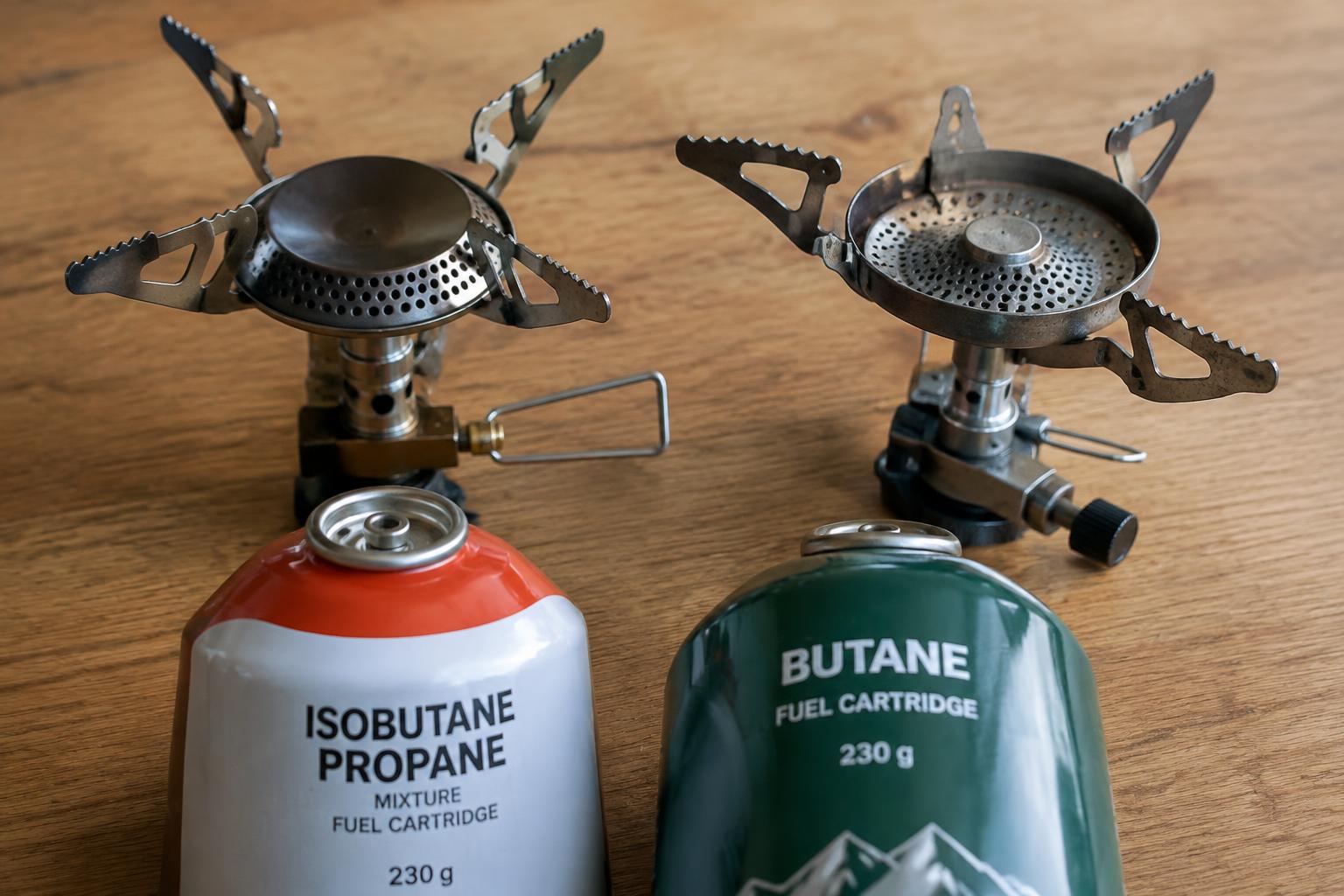
Choose propane for cold weather, car camping, and cooking for groups. Choose an isobutane-propane blend canister for backpacking and three-season trips. Choose pure butane only for mild-weather, tabletop cooking.
Most people who search “butane stove” are really asking about the small threaded canisters used with backpacking stoves. Those canisters are rarely pure butane. They are usually a blend of isobutane and propane, and that blend is the reason they work better in the cold than a pure butane canister does. Choosing between propane vs butane camp stove comes down to temperature, weight, and the stove you own.
Quick Verdict
- Quick rule: Choose propane if you camp in cold weather or cook for groups. Choose butane only for mild-weather tabletop cooking.
- Cold weather: Propane, or a propane-rich blend canister. Propane performs better in cold weather, and pure butane is the weakest choice near freezing.
- Ultralight backpacking: Isobutane-propane blend canister with a compact canister stove.
- Car camping and groups: Propane. Cylinders are cheap per ounce and work with two-burner stoves.
- Budget: Propane usually costs the least per ounce. Work out your own cost using the method below.
- Mild-weather tabletop cooking: A pure butane cassette stove works, if you stay within its temperature limits.
- Availability: Propane is the easiest to find. Blends are common at outdoor retailers. Pure butane cassettes are less widely stocked.
Safety First
Never use a portable camp stove inside a tent, vehicle, camper, or enclosed RV. Propane, butane, and blend-canister stoves all produce carbon monoxide, which you can’t see or smell and which can kill. Cook outdoors with good airflow, and never use a stove to heat a shelter.
Butane vs Propane Camp Stove: What You’re Really Choosing Between
There are three common fuel setups, not two. Knowing which one a stove uses saves you from buying the wrong fuel type. The best camp stove fuel depends on your camping style, the stove design, the expected temperature, and whether weight or fuel cost matters most. No one fuel wins every trip, and the right fuel is the one that matches your stove and your conditions.
| Setup | Typical container | Typical use | Cold-weather behavior |
|---|---|---|---|
| Propane | Steel cylinder (1 lb disposable or 20 lb refillable) | Car camping, groups, RV, emergency | Best of the three |
| Isobutane-propane blend | Small threaded canister | Backpacking, three-season trips | Good, but weakens as the canister cools and empties |
| Pure butane | Cassette-style canister | Tabletop and mild-weather cooking | Weakest. Check your stove’s manual for its minimum temperature |
The blend ratio varies by brand, so check the canister label if cold performance matters to you. For a quick propane vs butane camp stove decision, compare the fuel source and connection first; never assume two portable camping stoves use interchangeable canisters. Whether you choose butane or propane, the stove and canister must be designed to work together.
Difference Between Butane and Propane (and Where Isobutane Fits)
A canister stove needs the liquid fuel inside to boil off into gas. How easily that happens depends on the fuel’s boiling point.
| Fuel | Approximate boiling point |
|---|---|
| Propane | −44°F (−42°C) |
| Isobutane | 11°F (−12°C) |
| Normal butane | 31°F (−1°C) |
Values are rounded. Confirm against the NIST Chemistry WebBook or the fuel maker’s data sheet.
Butane isn’t “liquefied” by the cold. It is already a liquid inside the canister. Butane struggles when temperatures drop toward freezing because it vaporizes too slowly, so pressure falls and the flame weakens. Propane has a much lower boiling point than butane, and its ability to maintain fuel pressure in the cold is why it’s the choice for winter camping.
Isobutane is not “modified butane.” It is an isomer of butane: the same chemical formula, arranged differently. That arrangement gives it a lower boiling point, which is why backpacking canisters use it.
A fuel’s boiling point is a useful guide to cold-weather performance, but it is not an exact operating-temperature limit. As fuel boils off, the canister cools itself and its internal pressure can fall enough to weaken the flame, so a stove that starts fine at 40°F can sputter after a few minutes of hard burning. Performance also depends on the fuel blend, stove design, and operating conditions.
Heat Output and Fuel Efficiency: The Burner Sets the Power
Propane and butane hold roughly the same energy per pound, about 21,000 BTU, though published figures vary slightly by source. The BTU rating on a stove describes the burner, not the fuel.
That means you shouldn’t pick a fuel for “more power.” Pick it for how it behaves in your conditions and how it fits your stove. In other words, propane vs butane is mainly a question of fuel pressure, temperature, portability, and the cooking system, not simply which fuel sounds more powerful. Each fuel will perform best in different conditions.
What this means for you: If a stove is rated 10,000 BTU per hour, it delivers about that with either fuel in good conditions. The difference shows up when it’s cold.
Propane vs Butane Camping Stoves: Head-to-Head Comparison
| Factor | Propane | Isobutane-propane blend | Pure butane |
|---|---|---|---|
| Cold-weather performance | Strongest | Good, drops as canister cools and empties | Weakest |
| Energy per pound | Roughly equal | Roughly equal | Roughly equal |
| Weight and packaging | Heavier cylinder relative to the fuel inside | Lightest packaging for backpacking | Compact, tabletop-oriented |
| Cost per ounce | Usually lowest | Usually higher than propane | Varies by brand and retailer |
| Availability | Hardware, big-box, and outdoor stores | Outdoor retailers and online | Less widely stocked in many US stores |
| Refilling | 1 lb disposable cylinders: never refill. 20 lb tanks: designed for refill or exchange | Single-use: never refill | Single-use: never refill |
| Stove connection | Cylinder threads or hose and regulator | Threaded canister valve | Cassette-style connection |
Propane is generally cheaper per ounce and widely available at camping stores, hardware stores, and big-box retailers. Blend canisters cost more per ounce but save carry weight, and pure butane cassettes are the hardest to find locally.
Butane Camp Stove Performance: Why Blends Slow Down in the Cold
In a blend, propane vaporizes first because it has the lower boiling point. As the canister empties, the remaining mix leans more toward isobutane, and cold performance drops. If a stove runs well at the start of a canister and weakens later in the cold, this is a likely reason.
As temperatures fall, propane becomes the more dependable gas, and propane stoves perform better in cold weather than a butane camp stove running on a pure butane canister. Some stoves also list a minimum operating temperature in the manual, so check yours. Actual stove performance still depends on the canister blend, regulator, and manufacturer temperature limits.
Propane Cylinder vs Backpacking Canister: How to Compare Cost and Fuel Efficiency
Use this formula:
- Cost per ounce = price ÷ ounces of fuel in the container.
- Fuel burned per hour = from your stove’s manual (many list grams or ounces per hour at full output).
- Cost per hour = cost per ounce × ounces burned per hour.
Worked example (an estimate, not a measured result; prices are illustrative, not current):
This is a rough calculation from a stove’s rated output and an approximate fuel energy value of about 21,000 BTU per pound. Real stoves burn more or less than this depending on the stove, flame setting, wind, temperature, and pot efficiency. If your manual lists a burn rate, use that instead.
A burner rated at 10,000 BTU per hour would use an estimated 7.6 oz of fuel per hour at full output (10,000 ÷ 21,000 ≈ 0.48 lb).
- Fuel at $0.30 per oz → an estimated $2.30 per hour at full output.
- Fuel at $1.10 per oz → an estimated $8.40 per hour at full output.
Real cooking rarely uses full output for a full hour, and simmering uses less fuel. Plug in current prices from your own store, and treat your result as an estimate too. This is a more useful way to compare fuel efficiency than judging by container price alone, especially when comparing a 1 lb propane cylinder with a small backpacking canister. When comparing a butane camp stove with a propane model, check how much fuel each burns per hour, not just the container price.
Propane or Butane Camp Stove? Which Fuel Fits Your Camping Style
| If your trip looks like this… | Choose | Why |
|---|---|---|
| Weekend car camping, cooking for 3+ people | Propane | Two-burner stoves, low cost per ounce, easy to find |
| 2-4 day backpacking trip, mild to cool weather | Isobutane-propane blend | Light stove and canister, simple to use |
| Winter camping or cold, high-elevation trips | Propane, a propane-rich blend, or a liquid-fuel stove | Better vaporization when cold |
| Van, RV, or emergency preparedness | Propane | Widely available and easy to store and exchange |
| Tailgate or mild-weather tabletop cooking | Pure butane cassette stove | Compact, as long as you stay within its limits |
Car Camping: Propane Camp Stove Setup
A propane camp stove with a cylinder and two burners is the standard setup. Weight doesn’t matter at the car, so you get low fuel cost and easy tank exchanges. Propane is the more versatile fuel across car camping, RV, and emergency use, and a propane system suits every camping trip where you drive to the site.
Backpacking Stove Fuel for Three Seasons
A compact canister stove with a blend canister is the practical choice for most three-season camping and backpacking trips. It makes for a compact camping setup, and blends perform best in mild to cool conditions. Pure butane cassette stoves are generally better suited to tabletop cooking than a trail setup, where low weight and compact fuel storage matter. Choose the right fuel for the lowest temperature you expect, not the average.
Winter Camping: Choosing the Right Fuel in Cold Weather
This is where the common advice to “just use propane” falls short. A 1 lb propane cylinder is heavy to carry. Propane is the preferred choice for winter camping when weight isn’t a concern. For winter camping, choose the fuel system that matches the temperature and the stove’s approved setup. For winter backpacking, your realistic options are:
- A propane-rich blend canister.
- A liquid-fuel stove, which doesn’t depend on canister pressure.
- A canister stove designed for inverted canister use or with a regulator, only if the manufacturer approves it.
Cold canister tips:
- Follow your stove and canister manufacturer’s instructions for cold-weather use. If they don’t cover warming a canister, don’t improvise.
- Insulate the canister from the cold: set it on an insulated pad, not directly on snow or ice.
- Keep a canister in a sleeping bag or clothing only if the manufacturer says that’s acceptable. Don’t assume every canister is safe there, and never store a damaged or leaking canister that way.
- Never warm a canister with a flame, a stove, a campfire, a heater, or any other direct heat. Overheating a canister can cause dangerous pressure buildup.
Tailgate and Tabletop Cooking: Portable Stove Options
A pure butane cassette stove works as a portable stove for tailgating, picnics, and mild-weather camping or outdoor cooking. Treat it as a tabletop stove. It’s compact, but it’s the weakest option as temperatures approach freezing. In a butane camping stove vs propane comparison, the butane unit wins on size and propane wins on cold-weather reliability. Check the manual for the minimum operating temperature before you rely on it.
Van, RV, and Emergency Use: Fuel Availability and Storage
Propane is easy to find, store, and exchange, which makes fuel availability a real advantage for emergency kits. But portable camp stoves, whether propane, butane, or canister models, must never be used inside a van, car, camper, tent, or enclosed RV, even with windows or vents open. Cook outside with good airflow.
Built-in RV appliances are designed and vented for indoor use. Follow the RV maker’s instructions for them, and keep working carbon monoxide and propane detectors.
Altitude, Wind, and Stove Performance
Altitude mostly changes cooking time, not fuel choice. Water boils at a lower temperature higher up, so food can take longer to cook. High places are also usually colder, which is where fuel choice starts to matter.
Wind matters more than fuel type. The best camping stove for windy weather has a wind-resistant burner design, and it still needs a properly used windscreen. Never wrap a windscreen tightly around a stove with a canister attached.
Fuel and Stove Compatibility: Butane and Propane Stoves Aren’t Interchangeable
Use the fuel and connection your stove was designed for. These are different systems:
- Threaded backpacking canisters connect to canister stoves with a matching valve.
- Disposable 1 lb propane cylinders use a different thread and connect to propane stoves, or to stoves approved for a hose and adapter.
- Butane cassettes lock into cassette-style stoves.
Propane and butane stoves are built for different pressures, valves, and regulators. Some stoves are sold as dual fuel, but only use two fuels if the manufacturer approves both. Adapters exist, but don’t use one unless the stove manufacturer approves it. Fuels run at different pressures, and a mismatch can cause leaks or fire. A propane cylinder, threaded backpacking canister, and butane cassette are different systems; the stove and fuel must be designed to work together. When in doubt, read the manual.
How to Connect and Store a Fuel Canister Safely
Connecting a Canister
- Make sure the stove is off and the control valve is fully closed.
- Inspect the canister valve and stove O-ring for cracks, dirt, or damage.
- Thread the canister on straight, hand-tight only. Don’t force it.
- Check for leaks outdoors with soapy water on the connection. Bubbles mean a leak. Do not test with a flame.
- Light the stove away from your face, clothing, and anything flammable.
- After cooking, close the valve and let everything cool. Disconnect as your manual directs.
Camping Stove Fuel Storage
Follow the temperature limits printed on your canister. Many labels warn against exposure above about 120°F (49°C), but your label rules.
- Don’t leave fuel in a closed, parked vehicle in summer.
- Keep canisters out of direct sun and away from heat sources.
- Store in a ventilated place, away from living areas and ignition sources.
- Don’t use dented, rusted, or leaking canisters.
Safety Warnings
- Carbon monoxide: When butane burns, and when propane burns, it produces carbon monoxide, which you can’t see or smell. Never use a portable camp stove inside a tent, vehicle, camper shell, or enclosed RV, even with doors, windows, or vents open, and never use a stove to heat a shelter. See the CDC’s carbon monoxide guidance and the CPSC for details.
- Leaks: If you smell gas, turn off the valve, move away from ignition sources, and don’t use the stove until you’ve found the cause.
- Windscreens: Don’t wrap a windscreen tightly around a stove with a canister attached. Trapped heat can overheat the canister. Follow your stove manual on windscreen use.
- Never leave a lit stove unattended. Check local fire restrictions before you cook.
- Disposal: Only dispose of completely empty canisters. Don’t puncture, crush, or burn them. Rules differ by area, so check your local recycling or household hazardous waste program. If any fuel may remain, treat the canister as hazardous waste.
Common Mistakes with Butane and Propane Camping Stoves (and Fixes)
| Mistake | Fix |
|---|---|
| Cooking inside a tent, vehicle, or enclosed RV to stay warm or dry | Never. Cook outdoors with good airflow. |
| Assuming a “butane stove” means a backpacking canister stove | Check the label. Most backpacking canisters are isobutane-propane blends. |
| Choosing fuel by BTU instead of conditions | Choose by temperature, weight, and stove type. The burner sets the power. |
| Using an unprepared canister below freezing | Follow your stove maker’s cold-weather instructions, insulate the canister from the ground, and consider a propane-rich blend or liquid-fuel stove. Never use direct heat or flame. |
| Wrapping a windscreen fully around a canister stove | Use the windscreen only as your manual allows. |
| Leaving fuel in a hot car | Keep fuel in a shaded, ventilated place and follow the label’s temperature limits. |
| Using adapters the stove maker doesn’t approve | Use only approved fuel and connections. |
| Refilling disposable cylinders or canisters | Never refill disposable propane cylinders or single-use backpacking canisters. Refill only containers specifically designed and approved for refilling. |
| Packing only one canister on a longer trip | Estimate fuel use from the manual and bring a margin. |
Pre-Trip Camp Stove and Fuel Checklist
- Fuel type matches my stove (check the label and manual)
- Canister is full or I know how much is left
- Spare canister or cylinder packed, with a margin for cold and wind
- O-rings and connections inspected
- Lighter and backup ignition
- Windscreen (used as the manual allows)
- Stable, level cooking surface plan
- Soapy water for a leak check
- Cold trip: plan cold-weather fuel handling per the manufacturer’s instructions, never direct heat or flame
- Plan to cook outdoors only, never in a tent, vehicle, or enclosed RV
- Local fire restrictions checked
- Plan for disposing of empty canisters
FAQ
Which fuel is better for camp cooking, propane or butane?
Neither wins everywhere. Propane is better for cold weather, car camping, and groups because it vaporizes in freezing temperatures and costs little per ounce. Isobutane-propane blend canisters suit backpacking because the stoves are light and compact. Pure butane works for mild-weather, tabletop cooking.
Can you use a butane stove in cold weather?
Pure butane stoves perform poorly near freezing because butane boils at about 31°F, and the canister cools as it burns, so pressure drops and the flame weakens. Check your manual for its minimum temperature. For cold trips, use propane or a propane-rich blend, and follow your manufacturer’s cold-weather guidance.
Is isobutane the same as butane?
No. Isobutane and normal butane share the same chemical formula but have different molecular structures, so they behave differently. Isobutane boils at about 11°F versus about 31°F for normal butane, which is why backpacking canisters use it, usually mixed with propane. Check the label for the exact blend.
Can I use propane in a butane camp stove?
Not unless the stove manufacturer says so. Propane runs at much higher pressure, and butane stoves use different valves, regulators, and canister connections. Forcing a connection or using an unapproved adapter can cause leaks or fire. Buy fuel that matches your stove, and read the manual before using any adapter.
Butane stove vs propane stove: which is safer?
Neither is inherently safer. Both are flammable and both produce carbon monoxide when burned. Safety comes from how you use them: cook outdoors with ventilation, check seals and O-rings, keep canisters away from heat, and follow your stove’s manual. Never use a portable stove inside a tent, vehicle, or enclosed RV.
How do I keep a fuel canister working in the cold?
Choose a blend with plenty of propane and follow your stove manufacturer’s cold-weather instructions. Insulate the canister from the ground with a pad, not snow, and keep it sheltered from wind. Keep it in a jacket or sleeping bag only if the manufacturer allows. Never warm a canister with a flame or any direct heat source.
Can I refill a camping fuel canister?
Never refill disposable propane cylinders or single-use backpacking canisters. They are built for one use, and refilling can damage valves, overfill the container, and cause leaks or fires. Refill only containers specifically designed and approved for refilling, such as large propane tanks, at approved stations.
How do I dispose of an empty fuel canister?
Make sure it is completely empty, then check your local recycling or household hazardous waste rules, which vary. Don’t puncture, crush, or burn it in a campfire. If any fuel might remain, treat it as hazardous waste. Many programs accept fully empty canisters, but confirm first.
How long does a 1 lb propane cylinder or fuel canister last?
It depends on your stove’s burn rate, how high you run the flame, wind, and temperature. Divide the fuel weight by your stove’s burn rate from the manual for an estimate, then add a margin. Simmering uses far less than boiling, and a properly used windscreen helps. Carry a spare on longer trips.
What’s the best fuel for a backpacking stove?
For most backpackers, an isobutane-propane blend canister is the best choice. The canisters are compact, the stoves are light, and the blend vaporizes at lower temperatures than pure butane. In deep cold, consider a liquid-fuel stove or a regulated canister stove, and follow the manufacturer’s cold-weather guidance.
Conclusion: Choosing the Right Fuel for Your Camp Stove
For a propane vs butane camp stove decision, match the fuel to your conditions, not to a BTU number. Neither fuel is the right choice for every camper; the preferred option depends on your camping trip, weather, cooking needs, and whether you are car camping or backpacking. Propane is the answer for cold weather, car camping, and groups. A blend canister is the answer for backpacking. Pure butane fits mild-weather tabletop cooking. Whatever you choose, use the fuel and connection your stove was designed for, cook outdoors, and keep canisters away from heat. Choose the right fuel for your stove and your trip, and you get the setup that actually makes camping easier.
Next step: Before you buy fuel or a stove, check your stove’s manual for the fuel type, connection, and temperature limits it was designed for. When choosing the right camping stove, start with the fuel it’s built to use. Then use the cost method above to compare your real options.
Sources and Further Reading
- NIST Chemistry WebBook: physical properties of propane, butane, and isobutane, including boiling points.
- CDC: Carbon Monoxide: carbon monoxide poisoning and prevention.
- U.S. Consumer Product Safety Commission: consumer guidance on gas appliances and carbon monoxide.
- Stove and fuel manufacturers’ manuals and safety pages, such as MSR, Jetboil, Coleman, and Camp Chef: storage limits, windscreen warnings, compatibility, and refill policies for specific products.
- Leave No Trace: general guidance on minimizing campfire and waste impact.
Always follow your own stove’s and canister’s manual first. It is the authority for your equipment.
How This Guide Was Researched
This guide to portable camping stoves and their fuels is research-based, not a hands-on test report. We did not run lab tests or field tests for this article, and we don’t rate individual stoves here.
- Physical properties come from published reference data, such as the NIST Chemistry WebBook.
- Safety and storage guidance comes from manufacturer documentation and public safety agencies.
- Where figures vary by source or brand (blend ratios, energy values, temperature limits), we say so and send you to the product label or manual.
- The cost example is an estimate. Its prices are illustrative and its fuel-use figure is calculated, not measured. Check current prices at your retailer and your stove’s manual.
We update this page when guidance or product information changes. Spotted an error? Send a correction through the CampingSaga contact page and we’ll review it.
About the Author
Ricky Thorne writes camp cooking and gear guides for CampingSaga. This article follows CampingSaga’s editorial approach: answer the question first, state where information is uncertain, and don’t present research as personal testing.

1 thought on “Propane vs Butane Camp Stove: Which Fuel Should You Pick?”