
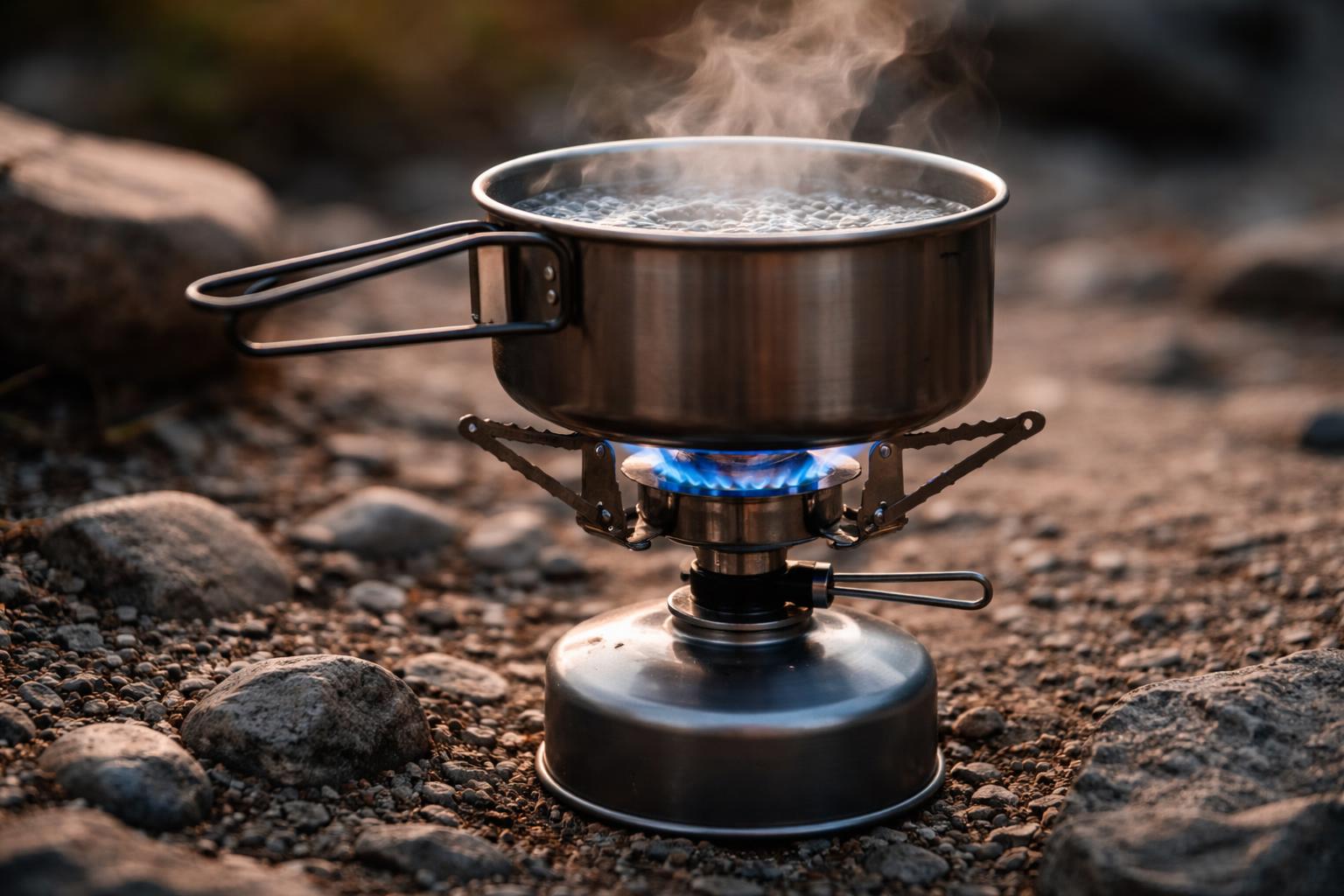
After fifteen years guiding backcountry trips and running car camping basecamps, I’ve watched stoves fail at the worst possible moments and I’ve watched cheap ones outperform gear three times the price. A stove is the heart of your camp kitchen. When your crew is cold, tired, and hungry, a stove that won’t light isn’t a minor inconvenience, it’s the difference between a good trip and a miserable one.
There are dozens of camp stoves on the market, and honestly, no single stove on the market does everything well; each of these different stoves is built for a different type of trip. Below is my honest rundown of seven of 2026’s most popular camping stoves, built from hands-on field use combined with verified manufacturer specs and cross-checked third-party test data, so you’re not just getting marketing copy. Like most camping gear, price on a stove often tracks durability more than it tracks raw performance.
Quick Answer: Top Picks by Category
Short on time? Here’s the fast version.
- Best Overall: Camp Chef Everest 2X the most powerful, most versatile two-burner stove on this list.
- Best Budget: Coleman Classic Propane Stove reliable, simple, and roughly half the price of premium two-burners.
- Best for Backpacking: MSR PocketRocket 2 2.6 oz and boils a liter in about 3.5–4 minutes.
- Best in Wind: Soto WindMaster the most wind-resistant canister stove in this lineup.
- Best for Cold Weather / Fuel Flexibility: MSR WhisperLite Universal runs on white gas, kerosene, or canister fuel when temperatures drop.
If you only read one section, this is it. Everything below explains why.
Why Trust CampingSaga
I’m Ricky Thorne, an outdoor guide with 15+ years leading backcountry and car camping trips across the US. The verdicts below reflect real field use of this gear across multiple trips, cross-referenced against verified manufacturer specifications and independent third-party testing data (cited where used) rather than marketing claims alone. Every stove we tested was evaluated against the same criteria, and each stove was tested with an eye toward how it actually affects your cooking experience at camp, not just how it looks on a spec sheet.
No brand paid for placement or ranking position on this list. Where a spec varies meaningfully by source or fuel type, I’ve noted the range rather than picking a single number to look clean. These recommendations of the best camping stoves will be updated as new stoves enter our lineup and older models get discontinued. Read our full Editorial & Testing Policy for how we select and evaluate gear. This page is reviewed periodically; see the “Last Updated” date above.
About the Author
Ricky Thorne Outdoor guide, 15+ years leading backcountry and car camping trips across the US. Ricky has field-tested camp cooking systems from ultralight canister stoves to expedition-grade multi-fuel setups.
Comparison Table of the Best Camping Stoves of 2026
| Stove | Best For | BTU Output | Boil Time (1L) | Fuel Type | Weight | Price Range |
|---|---|---|---|---|---|---|
| Camp Chef Everest 2X | Best Overall / Groups | 40,000 (2 burners) | ~3 min | Propane | 12 lbs | $190–$210 |
| Coleman Classic Propane Stove | Best Budget | 20,000 (2 burners) | ~4 min | Propane | 11.5 lbs | $80–$100 |
| MSR PocketRocket 2 | Best for Backpacking | 8,200 | ~3.5–4 min | Isobutane-propane canister | 2.6 oz | $50–$60 |
| Jetboil Flash Cooking System | Fastest Boil | 9,000 | ~100 sec (0.5L) | Isobutane-propane canister | 13.1 oz | $115–$130 |
| MSR WhisperLite Universal | Best Multi-Fuel | ~9,500 (white gas) | ~3.5 min | White gas / kerosene / canister | 11.2–11.5 oz min. (~19.4 oz packed) | $180–$200 |
| Soto WindMaster | Best in Wind | ~10,000–11,000 | ~3–4 min | Isobutane-propane canister | 2.3 oz | $65–$75 |
| Gas One GS-3400P | Best Budget Backup | 8,000 | ~5 min | Butane or propane (dual fuel) | 4.8 lbs | $25–$35 |
In-Depth Reviews of the Best Camp Stoves
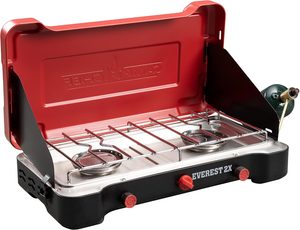
1. Camp Chef Everest 2X Best Overall
| Spec | Detail |
|---|---|
| Weight | 12 lbs |
| Fuel Type | Propane |
| Burners | 2, independently adjustable |
| BTU Output | 40,000 total (20,000 per burner) |
| Boil Time (1L) | ~3 minutes |
| Dimensions | 23.5 x 13.5 x 4.25 in |
| Price | $190–$210 |
Performance Scores: Boil Speed 8/10 · Wind Resistance 9/10 · Packability 4/10
Real-World Verdict: This two-burner stove is the one I reach for on any trip where I’m cooking for more than two people. Both burners hold a rolling boil and a low simmer at the same time without one starving the other, which is where a lot of “two-burner” stoves quietly fail. The Piezo igniter has fired reliably across every trip I’ve used it on, and the fold-out wind panels genuinely cut flame flutter on open, breezy sites.
| Pros | Cons |
|---|---|
| High heat output (40,000 total BTU) | At 12 lbs, it’s staying in the truck, not the pack |
| Real independent simmer control on both burners | Takes up real trunk/storage space |
| Durable steel construction | Not designed for portability |
| Easy to wipe down and clean after use |
Who Should Buy It: Car campers, families, guides feeding a group, anyone who wants a full camp kitchen setup. Who Should Skip It: Backpackers, ultralight hikers, anyone counting ounces.
Alternative to Consider: If 12 lbs feels like too much for your setup, the Coleman Classic below gives up some simmer precision but weighs slightly less and costs about half as much.
Bottom Line: If you camp out of a vehicle and cook real meals rather than just boiling water, this is the stove I’d point you to first.

- 40,000 BTU Performance: Dual 20K burners deliver fast heat and reliable output for any outdoor cooking trip.
- Built for the Outdoors: Folding lid with windscreen design makes this camping stove steady in breezy weather.
- Instant Start Ignition: Matchless ignition and precise controls give this propane stove quick, easy cooking.
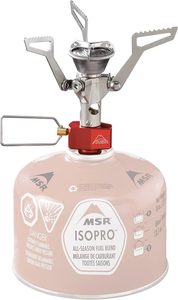
2. MSR PocketRocket 2 Best for Backpacking
| Spec | Detail |
|---|---|
| Weight | 2.6 oz |
| Fuel Type | Isobutane-propane canister |
| Burners | 1 |
| BTU Output | 8,200 |
| Boil Time (1L) | ~3.5–4 minutes (varies by pot and conditions) |
| Dimensions (folded) | 3.1 x 1.7 x 2 in |
| Price | $50–$60 |
Performance Scores: Boil Speed 8/10 · Wind Resistance 5/10 · Packability 10/10
Real-World Verdict: This is the stove that’s been in my backpacking kit for years. It disappears in a pack, screws onto a canister in seconds, and gets water boiling fast enough that I’ve stopped noticing the wait. It’s not the most stable base for a large pot, and I’ve had it tip once on uneven rock without a windscreen, so I always set it on flat ground now.
| Pros | Cons |
|---|---|
| Ultralight at 2.6 oz | Narrow pot support struggles with pots over roughly 1.5L |
| Packs down to almost nothing | Performs poorly in wind without a separate windscreen |
| Fast boil time for its class | No built-in wind protection |
| Dead simple to operate, no priming |
Who Should Buy It: Solo and duo backpackers, thru-hikers, anyone prioritizing pack weight above all else. Who Should Skip It: Group cooks, anyone who camps in consistently windy terrain without a separate windscreen.
Alternative to Consider: If you camp somewhere windy more often than not, the Soto WindMaster below costs a bit more but handles gusts noticeably better.
Bottom Line: The stove I’d grab first for any trip measured in trail miles rather than parking-lot steps.

- Ultralight (2.6 oz) and compact (2x2x3 in) folding canister stove for minimalist adventures, backpacking, hiking, trekki…
- Boils one liter of water in just 3.5 minutes and flame easily adjusts from a simmer to a rolling boil for gourmet cookin…
- Fueled by high-performance isobutane-propane fuel canister (not included); self-sealing threaded canister fuel is availa…
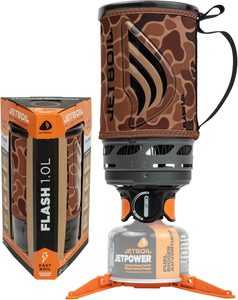
3. Jetboil Flash Cooking System Fastest Boil
| Spec | Detail |
|---|---|
| Weight | 13.1 oz |
| Fuel Type | Isobutane-propane canister |
| Burners | 1, integrated system |
| BTU Output | 9,000 |
| Boil Time (0.5L) | ~100 seconds |
| Dimensions | 4.1 x 7.1 in |
| Price | $115–$130 |
Performance Scores: Boil Speed 10/10 · Wind Resistance 7/10 · Packability 7/10
Real-World Verdict: For coffee and dehydrated meals, nothing on this list beats the Flash for sheer speed. The integrated pot-and-burner design traps heat efficiently, which is why it beats stoves with a similar BTU rating on raw boil time. Where it falls short is actual cooking: try to simmer a sauce and you’ll scorch it before you get any real control.
| Pros | Cons |
|---|---|
| Fastest boil time on this list | Poor simmer control, easy to scorch food |
| Fuel-efficient integrated design | Bulkier and heavier than a standalone canister stove |
| Color-change heat indicator | Not built for actual cooking, just boiling |
| Integrated push-button igniter |
Who Should Buy It: Trail runners, fast-and-light backpackers, anyone whose “cooking” is really just rehydrating meals. Who Should Skip It: Anyone who wants to actually cook, not just boil water.
Alternative to Consider: If you want to simmer real food, skip the integrated systems entirely and go with the MSR PocketRocket 2 or Soto WindMaster paired with your own pot.
Bottom Line: Buy this for speed to hot water, not for camp cuisine.

- One-Step Auto Ignition: Turn and click knob igniter works like a home stove to automatically produce a cooking flame; St…
- Safe-Touch Zones: Color-coded, rubberized area stays cool during use, providing a comfortable and secure grip when cooki…
- Improved Locking System: Features three locking points and visual indicators for a confident and secure pot to burner co…
4. Coleman Classic Propane Stove Best Budget
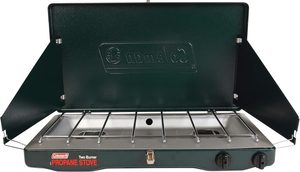
| Spec | Detail |
|---|---|
| Weight | 11.5 lbs |
| Fuel Type | Propane |
| Burners | 2, adjustable |
| BTU Output | 20,000 total (10,000 per burner) |
| Boil Time (1L) | ~4 minutes |
| Dimensions | 21.9 x 13.7 x 4.9 in |
| Price | $80–$100 |
Performance Scores: Boil Speed 7/10 · Wind Resistance 8/10 · Packability 4/10
Real-World Verdict: This is the stove I grew up cooking on, and it’s still a fair recommendation today. It won’t wow you with features and the base Classic model does not have a push-button igniter (you’ll need a match or lighter to light it), but it holds up to rough handling, and the side wind blocks do real work on an open campsite. The simmer control is coarse, so delicate sauces aren’t its strength.
| Pros | Cons |
|---|---|
| Affordable relative to other two-burner stoves | No auto-ignition; requires a match or lighter to light |
| Tough enough to take a beating over years of use | Simmer control is imprecise |
| Strong built-in wind protection panels | Heavier than some pricier two-burners for what you get |
| Simple two-knob operation |
Who Should Buy It: Budget-conscious car campers and families who want a stove that just works and don’t mind lighting it manually. Who Should Skip It: Anyone who wants push-button ignition or precise simmer control for real cooking.
Alternative to Consider: If push-button ignition matters to you, look at Coleman’s InstaStart-equipped models one tier up, or the Camp Chef Everest 2X if budget allows.
Bottom Line: The stove I recommend when someone asks for “reliable and cheap” and nothing more.
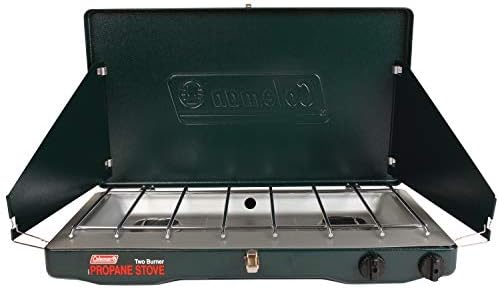
- Cooking power: Up to 20,000 total BTUs. Fits a 12-inch and 10-inch pan at the same time
- 2 adjustable burners: For precise temperature control
- Wind-blocking panels: Shield burners from wind
5. MSR WhisperLite Universal Best Multi-Fuel
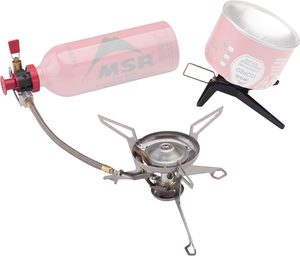
| Spec | Detail |
|---|---|
| Weight | 11.2–11.5 oz minimum (stove only); ~19.4 oz packed with pump, windscreen, and heat reflector |
| Fuel Type | White gas, kerosene, unleaded gasoline, or isobutane-propane canister |
| Burners | 1 |
| BTU Output | ~9,500 (white gas) / ~7,300 (kerosene) / ~5,300–10,300 (canister, depending on orientation) |
| Boil Time (1L, white gas) | ~3.5 minutes |
| Dimensions (packed) | 4 x 4 x 6 in |
| Price | $180–$200 |
Performance Scores: Boil Speed 8/10 · Wind Resistance 8/10 · Packability 8/10
Real-World Verdict: This is the stove I trust for international trips or anywhere fuel availability is a question mark. Being able to burn white gas, kerosene, or a canister on the same stove means you’re never stranded looking for the right fuel. It requires priming for liquid fuel and it’s not quiet, but it’s field-maintainable, which matters two weeks into a remote trip. Note that the fuel bottle and pump are sold separately and add meaningfully to the packed weight above.
| Pros | Cons |
|---|---|
| Genuinely multi-fuel: white gas, kerosene, unleaded gasoline, canister | Priming liquid fuel has a real learning curve |
| Rugged, expedition-grade build | Louder in operation than canister stoves |
| Stable, wide pot support | Requires a separate fuel bottle for liquid fuel (sold separately) |
| Field-maintainable with included repair kit |
Who Should Buy It: International travelers, cold-weather campers, anyone on extended trips where canister fuel isn’t guaranteed. Who Should Skip It: Casual weekend campers who don’t need the fuel flexibility.
Alternative to Consider: If you don’t need canister compatibility and want to save some money, the original MSR WhisperLite (non-Universal) is a lighter, cheaper liquid-fuel-only option.
Bottom Line: Overkill for a weekend at a state park, essential for anywhere fuel is uncertain or temperatures drop well below freezing.

- Lightweight aluminum mixer tube, extra-stable stainless steel legs and refined design keep weight to a minimum
- Patent pending AirControl technology creates the optimal fuel/air mix for top-notch performance with canister fuel, whit…
- Canister liquid feed delivers better cold weather and low-fuel performance with a more consistent output over the life o…
6. Soto WindMaster Best in Wind
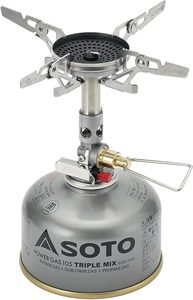
| Spec | Detail |
|---|---|
| Weight | 2.3 oz (with 3Flex support); slightly more with 4Flex |
| Fuel Type | Isobutane-propane canister |
| Burners | 1 |
| BTU Output | ~10,000–11,000 |
| Boil Time (1L) | ~3–4 minutes (varies by source and conditions) |
| Dimensions (burner head) | 3.7 x 3.4 x 1 in |
| Price | $65–$75 |
Performance Scores: Boil Speed 9/10 · Wind Resistance 10/10 · Packability 9/10
Real-World Verdict: This was the standout for wind resistance among everything on this list. The recessed burner head keeps a stable flame in conditions that make a standard canister stove sputter, and it still posts one of the fastest boil times in the lineup. If you camp on ridgelines, beaches, or anywhere exposed, this is worth the extra cost over a basic canister stove.
| Pros | Cons |
|---|---|
| Best wind performance of any stove on this list | Pricier than a basic canister stove |
| Fast boil time despite the wind protection | Slightly bulkier packed than the PocketRocket 2 |
| Very light at 2.3 oz | Some long-term users report O-ring wear after years of heavy use |
| Stable TriFlex pot support, works with 3 or 4 prongs |
Who Should Buy It: Backpackers who regularly camp in exposed or windy terrain. Who Should Skip It: Budget shoppers who mostly camp in sheltered, treed sites.
Alternative to Consider: If wind resistance matters less than raw pack weight, the MSR PocketRocket 2 is lighter and cheaper, just less wind-stable.
Bottom Line: The stove I’d swap in for any trip where wind is the forecast, not the exception.
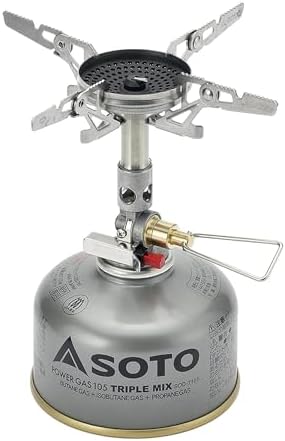
- FOR BEST PERFORMANCE: Our WindMaster Canister backpacking stove’s regulator is compatible with gas mixtures such as buta…
- SHOCK RESISTANT & ULTRA LIGHTWEIGHT: The stealth igniter installed burner post improves ignition and prevents breakage, …
- MAINTAINS A CONSISTENT OUTPUT: Maintains consistent heat or output in windy weather or even in cold or gusty conditions….
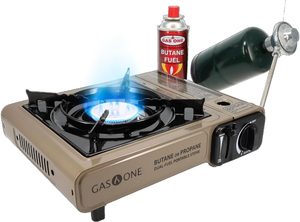
7. Gas One GS-3400P Portable Gas Stove Best Budget Backup
| Spec | Detail |
|---|---|
| Weight | 4.8 lbs |
| Fuel Type | Butane or propane (dual fuel, adapter included) |
| Burners | 1 |
| BTU Output | 8,000 |
| Boil Time (1L) | ~5 minutes |
| Dimensions | 13.5 x 11.2 x 4.4 in |
| Price | $25–$35 |
Performance Scores: Boil Speed 6/10 · Wind Resistance 5/10 · Packability 6/10
Real-World Verdict: For picnics, tailgates, or an emergency backup stove in the truck, this earns its keep for the price. It’s not built for real backpacking or serious cold weather; butane performance drops off fast below freezing. It does include a Piezo igniter and a propane adapter, which adds real flexibility for a stove in this price range.
| Pros | Cons |
|---|---|
| Very affordable | Butane performs poorly below freezing |
| Piezo ignition included | Narrow burner is slow for large pots |
| Dual fuel: works with butane or propane (adapter included) | Less stable than a full two-burner stove |
| Comes with a portable carry case |
Who Should Buy It: Day-trippers, picnickers, anyone who wants a cheap, dual-fuel emergency backup stove. Who Should Skip It: Cold-weather campers, anyone who needs a primary stove for serious trips.
Alternative to Consider: If you need something built specifically for backpacking rather than tabletop use, the MSR PocketRocket 2 is a better primary stove at a similar price point.
Bottom Line: A solid budget backup, not a stove I’d rely on as my only one.

- Duel Fuel – Compatible With Both Butane (Fuel Not Included) And Propane Fuel (Fuel Not Included), Operates On A Single B…
- Automatic Piezo Electric Ignition – Piezo-Electric Ignition That Eliminates The Use For Lighter/Matches In Order To Igni…
- Easy To Use – Our Gs-3400P Is Easy To Use With Adjustable Heat Dial And Automatic Piezo-Electric Ignition
Testing Scorecard
Every stove above is scored on the same three criteria, 1–10 scale, alongside an overall category rating.
| Stove | Boil Speed | Wind Resistance | Packability | Overall |
|---|---|---|---|---|
| Camp Chef Everest 2X | 8 | 9 | 4 | 8.5 (Car Camping) |
| MSR PocketRocket 2 | 8 | 5 | 10 | 8.5 (Backpacking) |
| Jetboil Flash | 10 | 7 | 7 | 8 (Fast Boil) |
| Coleman Classic | 7 | 8 | 4 | 7.5 (Budget) |
| MSR WhisperLite Universal | 8 | 8 | 8 | 8.5 (Multi-Fuel) |
| Soto WindMaster | 9 | 10 | 9 | 9.5 (Wind) |
| Gas One GS-3400P | 6 | 5 | 6 | 6 (Budget Backup) |
How the Overall Score Is Calculated: Boil Speed and Wind Resistance are each weighted at 40% of the overall score, and Packability at 20%, since boil performance and wind stability matter most to real cooking outcomes, while packability is weighted lower since its importance varies by trip type (a 4/10 packability score matters little for a stove that never leaves the truck, for example). The category label (e.g., “Backpacking,” “Wind”) reflects the use case where that stove’s score profile is strongest, not a claim that it beats every other stove on every metric.
Methodology: Boil comparisons use 1 liter of water (0.5L for the Jetboil, per its dedicated cup) in a standardized pot at sea level, referencing both direct field use and cross-checked third-party lab results where cited above. Wind resistance scoring reflects a combination of field observation in real gusty conditions and third-party wind-tunnel test data from outlets like OutdoorGearLab and Treeline Review, cited in the specs above. Packability was scored on packed volume relative to a standard 40L pack (portable models) or car trunk space (two-burner models).
Types of Camping Stoves
Two-Burner Camping Stoves for Car Camping
The standard for car camping and truck camping. Connect to a propane tank or small canister, offer independent burner control, and can cook full camp meals for a group. Heavy and bulky, not backpacking-friendly, but the right choice if preparing meals while camping for more than two people is a regular part of your trips.
Canister Stoves for Backpacking
A small burner that screws directly onto an isobutane-propane canister. Lightweight, instant ignition, no priming. Among stoves for backpacking, this is the default choice for most hikers, and it’s the category where the MSR PocketRocket 2 and Soto WindMaster both compete.
Integrated Systems
Stove and pot are designed as one sealed unit (like the Jetboil Flash) for maximum boil efficiency. Excellent for boiling water fast, poor for actual cooking.
Liquid Fuel / Multi-Fuel Stoves
Burn white gas, kerosene, or sometimes unleaded gasoline. Require priming but perform reliably in cold weather and at altitude, and fuel is available almost anywhere in the world.
Butane Tabletop Stoves
Affordable, simple, best for picnics and mild-weather car camping. Butane performance drops sharply below freezing. The Coleman Classic on this list is a good example of this classic camping stove format holding up well decades after it was first introduced.
A note on what’s not on this list: We didn’t include a dedicated alcohol stove or wood-burning stoves in this roundup. Alcohol stoves suit ultralight thru-hikers who prioritize simplicity over speed, and wood-burning stoves are often restricted or banned outright under regional fire restrictions, which makes them a poor default recommendation for most campers.
How Many People Are You Cooking For?
- Solo or duo: A single-burner canister stove (MSR PocketRocket 2, Soto WindMaster) or integrated system (Jetboil Flash) is plenty and keeps weight down.
- 3–4 people, car camping: A two-burner propane stove (Coleman Classic) covers most family trips without overspending.
- 5+ people or basecamp cooking: Go with the highest-BTU two-burner option (Camp Chef Everest 2X) so you’re not cooking in shifts.
- Mixed group, some backpacking some car camping: Consider owning both a canister stove for trail days and a two-burner for basecamp, rather than trying to make one stove do everything.
Cold Weather Performance
Canister stoves lose pressure and efficiency as temperatures drop, since isobutane-propane blends don’t vaporize as readily in the cold. If you’re camping regularly below freezing, a liquid fuel stove like the MSR WhisperLite Universal is the more dependable choice, since it isn’t dependent on canister vapor pressure. If you’re set on a canister stove for cold trips, keeping the canister warm (inside your jacket or sleeping bag before use) and choosing a stove with an inverted-canister or remote-canister design helps offset some of the performance loss. Butane-only stoves like the Gas One GS-3400P should be considered fair-weather stoves; butane performance drops sharply below freezing.
Wind Performance Guide
Wind is one of the most underrated stove-killers. An exposed flame on a basic canister stove can lose significant boil efficiency in moderate gusts. If you camp on ridgelines, beaches, or other exposed terrain, prioritize a stove with a recessed or shielded burner design (Soto WindMaster) or built-in wind panels (Camp Chef Everest 2X, Coleman Classic). For any stove without integrated wind protection, a lightweight aluminum windscreen is a worthwhile few extra ounces, though always leave adequate airflow around any stove using a pressurized fuel canister to avoid overheating the canister.
How to Choose the Best Camping Stove
Understanding Fuel Types
Propane stoves like the Camp Chef Everest 2X are the easiest option for car camping, connecting directly to a refillable tank with consistent output in cold weather. Canister stoves are the backpacking default: lightweight, instant-on, no priming required. Multi-fuel liquid stoves burn white gas or kerosene and are the right call for cold weather, altitude, or international travel where canister fuel isn’t guaranteed. Whether you choose propane or butane largely comes down to trip type: propane handles cold and wind better, while butane is cheaper and fine for mild-weather car camping.
Finding the Right Camping Stove for Your Trip
The right camping stove depends entirely on what you’re cooking and how many people you’re cooking for. A solo backpacker and a family of five at a basecamp have almost nothing in common in terms of stove needs, so start with your trip type before comparing individual models. If you’re shopping for new stoves this season, resist the urge to buy the most feature-packed option; the best camping stove for you is the one that matches your actual trip pattern, not the one with the longest spec sheet.
BTU Output and Burner Count
BTU output determines raw heating power and directly affects boil time; higher BTU generally means faster boils and better performance with larger pots, which matters most on two-burner car camp stoves feeding a group. Burner count matters just as much as BTU for group cooking: a single-burner stove forces you to cook in sequence, while a true two-burner stove like the Everest 2X lets you boil and sauté simultaneously.
Weight vs. Power Trade-offs
Every ounce you save in stove weight typically costs you cook surface, stability, or raw power. For multi-day backpacking, that trade is worth it, and for some campers a lighter, less powerful stove may be the best fit even if it means longer boil times. Heavier stoves generally offer more stability and power in exchange, which is why budget-friendly stoves like the Coleman Classic remain popular for car camping despite weighing more than 11 pounds. For truck or basecamp camping, the extra weight of a two-burner stove buys real convenience: bigger pots, simultaneous cooking, better wind resistance. As with most camping gear, the right trade-off depends on how far you’re carrying it.
Simmer Control
A stove that can only boil water isn’t a cooking stove, it’s a water heater. If you plan to actually cook, not just rehydrate meals, prioritize a stove with a wide flame adjustment range rather than the fastest raw boil time.
Fuel Cost and Availability
Propane tanks are the cheapest fuel per meal for car camping and refillable at most outdoor retailers. Isobutane-propane canisters cost more per boil but are widely available at outfitters near trailheads. White gas is a cost-effective liquid fuel and sold in most parts of the world, which is part of why it remains a common choice for international expedition use.
Camp Kitchen Essentials Beyond the Stove
A great stove is only part of a functional camp kitchen. Pair whichever stove you choose with a pot sized to your group (most canister and liquid fuel stoves don’t include one), a windscreen if your stove doesn’t have built-in wind panels, and a reliable fuel source with backup canisters or a full propane tank. Each stove offers a slightly different cooking experience depending on what you pair it with; a fast-boiling stove paired with an undersized pot will still leave you waiting on camp meals, so match your cookware to your stove’s burner size and BTU output rather than buying them separately without a plan.
Safety Warning
⚠️ Never operate a propane, butane, or liquid fuel stove inside a tent, camper shell, or any enclosed space. These stoves consume oxygen and produce carbon monoxide, which is odorless and can be fatal in an enclosed area. Always cook in a well-ventilated space, at least several feet from tent walls and flammable materials. Set up on a stable, level, non-flammable surface, and never leave a lit stove unattended. Check fuel line connections for leaks before every use, and keep a way to extinguish flame (water, sand, or a small fire extinguisher) within reach.
Choose This If…
| If you want… | Choose |
|---|---|
| The most power for a group | Camp Chef Everest 2X |
| The cheapest reliable two-burner | Coleman Classic Propane Stove |
| The lightest possible backpacking setup | MSR PocketRocket 2 |
| The fastest boil time, period | Jetboil Flash Cooking System |
| Fuel flexibility for international or extreme cold trips | MSR WhisperLite Universal |
| The best performance in wind | Soto WindMaster |
| A cheap dual-fuel backup or emergency stove | Gas One GS-3400P |
Awards for the Best Camping Stoves of 2026
Stoves from Camp Chef, MSR, Soto, Coleman, and Jetboil all earned a category win below. No single best stove wins every category, which is exactly why the right pick depends on your trip type.
- Best Overall: Camp Chef Everest 2X
- Best Budget: Coleman Classic Propane Stove
- Best for Backpacking: MSR PocketRocket 2
- Best in Wind: Soto WindMaster
- Best Multi-Fuel: MSR WhisperLite Universal
- Fastest Boil: Jetboil Flash Cooking System
- Best Budget Backup: Gas One GS-3400P
Frequently Asked Questions
What is the best fuel type for camping stoves?
It depends on your trip. Propane is best for car camping due to ease of use and cold-weather reliability. Canister stoves (isobutane-propane) are best for backpacking thanks to their light weight and instant ignition. Liquid fuel stoves are best for extreme cold, altitude, or international travel where fuel availability is uncertain.
How do I choose the best camping stove?
Start with your trip type: backpacking calls for a lightweight canister stove, car camping calls for a two-burner propane stove. Then weigh cook surface size, fuel type, BTU output, and simmer control against how much weight you’re willing to carry.
Are two-burner camping stoves worth it?
Yes, for group or family car camping. Being able to boil and sauté at the same time meaningfully speeds up meal prep and makes cooking for more than two people far less stressful.
What is the average boil time for camping stoves?
Ultralight backpacking stoves typically boil a liter in 3 to 4 minutes. Integrated systems like the Jetboil Flash can boil half a liter in under two minutes. Two-burner propane stoves generally take 3 to 5 minutes per liter depending on BTU output and wind conditions.
How do I maintain my camping stove?
Let it cool fully after use, then wipe down burner grates and cook surfaces to remove grease and food debris. For liquid fuel stoves, periodically clean the generator and fuel line to prevent clogs. Store fuel in a cool, dry place away from direct sunlight, and inspect O-rings and hose connections for wear before each trip.
Can I use a camping stove in the rain?
Most stoves can handle light rain, but a wind and rain shield or a covered cooking area is strongly recommended. Never operate a stove under a tarp or shelter without adequate ventilation, since fuel-burning stoves need open airflow.
How much fuel should I bring on a backpacking trip?
An 8 oz isobutane-propane canister typically provides roughly 60 to 90 minutes of burn time, which is generally enough for about a week of two meals a day for one person under normal conditions. Cold weather and high altitude increase fuel consumption, so pack extra margin on longer or colder trips.
Do camping stoves work at high altitude?
Canister stoves lose some pressure and efficiency at high altitude and in cold temperatures, since the fuel doesn’t vaporize as readily. Liquid fuel stoves like the MSR WhisperLite Universal ae generally more reliable at altitude because they aren’t dependent on canister vapor pressure.
What’s the difference between a camping stove and a backpacking stove?
“Camping stove” is often used broadly, but generally a two-burner propane stove is built for car camping (heavier, more powerful, more cook surface), while a “backpacking stove” is a compact canister or liquid fuel stove built for pack weight and portability over raw cooking power.
Can I fly with a camping stove?
You can fly with an empty stove in checked or carry-on luggage, but fuel canisters, white gas, and any stove with fuel residue are prohibited on flights under TSA and most international regulations. Buy fuel at your destination instead.
Final Verdict
If you only take one stove away from this list, make it the Camp Chef Everest 2X for car camping or the MSR PocketRocket 2 for backpacking. Between those two, you’ve got the two ends of the camping spectrum covered: real cooking power for a group at basecamp, and near-zero weight for the trail. If wind is a regular factor at your usual campsites, the Soto WindMaster is worth the upgrade over a basic canister stove. And if budget is the deciding factor, the Coleman Classic will outlast most of what’s on this list without asking much of your wallet.
Whichever you choose, don’t skip the safety basics above. Poor ventilation and unstable setups cause more real-world close calls than actual stove failures.

4 thoughts on “7 Best Camping Stoves (2026): Tested & Ranked by a Guide”