There’s nothing quite like watching the last embers of a campfire fade while good company sits around you and the quiet dark settles in. But even a great campsite can turn frustrating fast once the sun drops. I learned that the hard way on a rainy night in the High Peaks Wilderness, fumbling for my headlamp after dropping a fork near the fire pit. That was the night I stopped treating camp lighting as an afterthought.
Whether you call them string lights for camping, fairy lights, or just camp lights, the goal is the same: find a set of string lights that actually holds up trip after trip, not just in the product photos. After more than 15 years of guiding trips, I put together this guide the way I’d want it done: real products you can actually buy on Amazon, evaluated against the same criteria every time, and scored honestly so you know exactly what you’re getting. These aren’t theoretical picks pulled from a spec sheet alone; they’re seven of the more well-documented string lights on the market today, and whichever category fits your trip, these lights have you covered.
A note on methodology, stated plainly: none of the seven products in this specific guide were physically tested side-by-side by CampingSaga. This is a specification-driven guide, built from verified manufacturer and retailer listings and, where it exists, independent third-party field-testing coverage from established outdoor publications. Each product section below is labeled with its evaluation type so you always know whether a claim comes from a spec sheet, a cross-referenced third-party test, or both.
Quick Answer
The best overall camping string light is the MPOWERD Luci Solar String Lights (18′), based on its 20-hour rated runtime, dual solar/USB charging, and 11.3 oz packed weight. If you’re backpacking, the BioLite SiteLight String Lights are the lightest option at 2.5 oz. If you want one light that also works as a lantern, the Luminoodle XL is the strongest dual-purpose pick.
Quick Verdict
If you only read one section, read this one.
Best Overall: MPOWERD Luci Solar String Lights (18′) the best balance of brightness, runtime, and water resistance, with zero reliance on disposable batteries.
Best for Backpackers: BioLite SiteLight String Lights 2.5 ounces, daisy-chainable, and small enough to disappear in a pack. Pairs well with anything on our ultralight backpacking tent list.
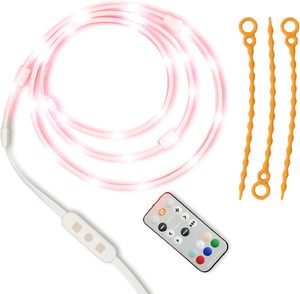
Best Multi-Use Pick: Luminoodle XL LED Light Rope + Lantern doubles as a hanging light and a stuffed-bag lantern, listed by the manufacturer as submersible.
Best USB-Rechargeable: Coleman OneSource 20-Foot LED String Lights ships with its own rechargeable battery and plugs into Coleman’s broader OneSource battery ecosystem.
Best for Car Camping: LUNO Camping String Lights suction-cup mounts make these the fastest lights to set up on a vehicle. See our car camping vs. tent camping breakdown if you’re still deciding on a setup.
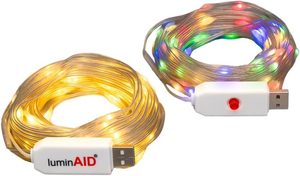
Best Budget Pick: LuminAID USB String Lights (2-Pack) two 32-foot strands (warm white and multicolor) for less than the price of most single-strand premium sets.
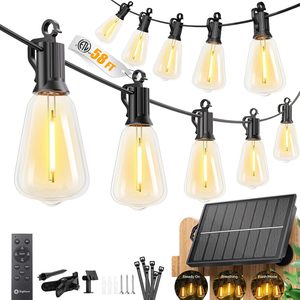
Best for RV and Basecamp: Brightown 58FT Solar String Lights heavier and less packable, but the long reach and IP65 rating make it the strongest choice for a site you’re not breaking down every day.
Best Pick by Camper Type
Solo backpacker, counting every ounce: BioLite SiteLight String Lights (2.5 oz)
Car camper who wants one reliable, low-maintenance light: MPOWERD Luci Solar String Lights (18′)
Van lifer or rooftop tent camper: LUNO Camping String Lights (suction-cup mounting)
RV owner or basecamp camper staying multiple nights: Brightown 58FT Solar String Lights
Budget-first camper who wants two strands for less: LuminAID USB String Lights (2-Pack)
Camper who wants one product to double as a lantern: Luminoodle XL LED Light Rope + Lantern
Camper already invested in a specific gear ecosystem: Coleman OneSource 20-Foot LED String Lights (if you already own Coleman OneSource gear)
Want your camping lights delivered in 2 days flat? Start your Prime trial here most orders on this list ship free with it.
Who Should Skip Camping String Lights?
String lights aren’t the right purchase for everyone. Consider skipping them entirely if:
You’re minimizing pack weight above all else. Even the lightest option here (2.5 oz) is still added weight and one more thing to charge. Ounce-counting backpackers on multi-day, no-resupply routes may be better served by a single ultralight headlamp and nothing else.
You mainly need task lighting, not ambiance. If your priority is seeing clearly while cooking or setting up camp in the dark, a dedicated lantern or headlamp will outperform a string light every time. See our String Lights vs. Lanterns section below.
You camp exclusively in cold, low-daylight seasons and rely on solar power. A solar string light’s biggest advantage disappears in winter conditions with short days and low sun angles. A USB-rechargeable or battery-based light is the more reliable choice there.
You already own adequate site lighting. If you’re happy with what you have, string lights are a nice-to-have, not a replacement for anything functional.
Comparison Table: All 7 Camping String Lights
Whether you’re buying your first set of string lights or replacing a worn-out one, the table below covers a full range of budgets, power sources, and use cases so you can compare these outdoor string lights side by side before reading the full reviews.
| Product | Power Source | Power Independence | Length | Lumens | Weight | Runtime | Charging Time | Water Resistance | Price at Publication | Best For | Rating |
|---|---|---|---|---|---|---|---|---|---|---|---|
| MPOWERD Luci Solar String Lights (18′) | Solar + USB | Self-powered (built-in battery) | 18 ft | 100 | 11.3 oz | Up to 20 hrs | ~16 hrs solar / 6–8 hrs USB | Water-resistant, shatterproof bulbs | See Amazon listing | Car camping with good sun exposure | 8.2/10 |
| BioLite SiteLight String Lights | USB / BioLite lantern | External-dependent (no built-in battery) | 10 ft (daisy-chainable) | 150 | 2.5 oz | Depends on power source | N/A (no built-in battery) | No published rating for this model | See Amazon listing | Backpacking and ultralight travel | 7.4/10 |
| Coleman OneSource 20-Foot LED String Lights | USB-rechargeable | Self-powered (battery included) | 20 ft | 250 to 25 (dimmable) | Not listed by manufacturer | Not specified by manufacturer | Not specified by manufacturer | IPX4, impact-resistant | See Amazon listing | Campers invested in Coleman OneSource gear | 8.0/10 |
| LUNO Camping String Lights | USB-C rechargeable | Self-powered (included battery pack) | 20 ft | Not specified in lumens | Not listed by manufacturer | Up to 8 hrs (manufacturer spec) | Not specified for this exact model | Not IP-rated, suction-cup mounted | ~$45 per manufacturer site (verify on Amazon) | Car camping and van life | 7.0/10 |
| LuminAID USB String Lights (2-Pack) | USB-rechargeable | External-dependent (plugs into any USB source) | 32 ft (x2) | Not specified in lumens | Not listed by manufacturer | Not specified by manufacturer | Not specified by manufacturer | Not IP-rated in listing | ~$26 as of mid-2026 (verify on Amazon) | Budget-conscious campers wanting two strands | 6.6/10 |
| Brightown 58FT Solar String Lights | Solar | Self-powered (built-in solar) | 58 ft (48 ft lit length) | Not specified per-bulb | Not listed by manufacturer | Not specified by manufacturer | Not specified by manufacturer | IP65, UL Listed | See Amazon listing | RV camping and multi-day basecamps | 6.6/10 |
| Luminoodle XL LED Light Rope + Lantern | USB (power bank or wall) | External-dependent (needs USB power source) | 10 ft | Up to 360 | Not listed by manufacturer | Depends on power bank capacity | N/A (no built-in battery) | Submersible per manufacturer listing (no formal IP rating published) | See Amazon listing | Dual-purpose string light and lantern | 8.2/10 |
A note on the gaps in this table: several manufacturers do not publish exact weight, lumen, charging-time, or current pricing figures for every SKU. Rather than estimate a number I can’t verify, I’ve marked it accordingly so you know exactly where the real data ends and where you’d need to check the current Amazon listing yourself before buying. Prices change frequently, so treat anything here as a rough reference point, not a live quote.
The 7 Best Camping String Lights, Reviewed
1. MPOWERD Luci Solar String Lights (18′)
Overall: ★ 8.2/10| Best Overall
Performance Scorecard
| Category | Score |
|---|---|
| Brightness & Beam Coverage | 7/10 |
| Runtime & Charging | 9/10 |
| Weatherproofing & Durability | 8/10 |
| Portability & Weight | 8/10 |
| Ease of Setup | 9/10 |
| Overall | 8.2/10 |
Specs
- Length: 18 ft
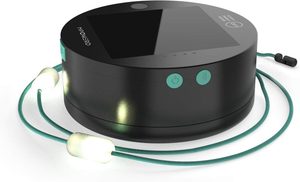
- Lighting: 20 warm-white LEDs in 10 shatterproof bulbs
- Maximum Output: 100 lumens
- Battery: Built-in 2,000mAh rechargeable lithium-ion
- Runtime: Up to 20 hours on low
- Charging: Solar or USB
- Water Resistance: IPX4
- Weight: 11.3 oz
- Light Modes: Multiple light/color modes plus flashlight
- Best For: Campers who want solar charging and an integrated battery
Pros
- Solar charging reduces dependence on external power
- Built-in 2,000mAh battery
- Up to 20 hours of runtime on low
- Lightweight and compact for car camping and RV trips
- Shatterproof bulbs and braided cord
- IPX4 water resistance
- Integrated flashlight adds versatility
Cons
- 100 lumens is better suited to ambient lighting than serious task lighting
- Solar charging can take much longer than USB charging
- Heavier than ultralight string-light options
- IPX4 is water-resistant, not suitable for submersion
What to expect: Based on the published spec sheet and cross-referenced retailer listings, this is one of the more self-sufficient solar options in this category, with an expandable coil design that avoids tangling on pack-up. The most consistently reported limitation across retailer and owner-facing product pages is reduced solar charging efficiency in shaded or overcast conditions, which is why pairing it with a small USB power bank as backup is a sensible precaution rather than a guess.
| What I Like | What I Don’t |
|---|---|
| Dual solar/USB charging, no disposable batteries | Solar charging underperforms in shade or heavy cloud cover |
| Compact disc storage, no tangling | Not ideal as a sole light source for task work |
| Doubles as a phone charger in a pinch |
Best for: Car camping and tent camping with decent daytime sun exposure.
Who should skip it: Anyone camping primarily in dense forest shade, or anyone who needs a work-bright light for cooking tasks. Pair this pick with our best camping cookware guide if lighting the cook area is your main goal, since a dedicated lantern will serve that better.

- Plastic
- BUILT-IN RECHARGEABLE 2000 mAh LITHIUM-ION BATTERY. With 100 lumens across an 18 ft cord, mobile charging, and lasting u…
- BRIGHT AND LONG LASTING. Emitting 100 lumens of power via 20 warm white LEDs across an 18 ft cord, this light provides u…
2. BioLite SiteLight String Lights
Overall: ★ 7.4/10: Best Ultralight Pick
Performance Scorecard
| Category | Score |
|---|---|
| Brightness & Beam Coverage | 7/10 |
| Runtime & Charging | 6/10 |
| Weatherproofing & Durability | 5/10 |
| Portability & Weight | 10/10 |
| Ease of Setup | 9/10 |
| Overall | 7.4/10 |
Specs
- Length: 10 ft
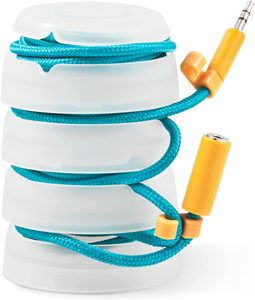
- Lights: 4 LED light units
- Maximum Output: 150 lumens total
- Weight: 2.5 oz
- Power: External USB/BioLite power source
- Battery: No built-in battery
- Design: Flexible string with spaced light nodes
- Best For: Backpackers and minimalist campers
Pros
- Extremely lightweight at just 2.5 oz
- 150 lumens provides useful ambient illumination
- Compact and easy to pack
- Can be used with compatible BioLite power sources
- Excellent choice when minimizing pack weight
- Simple setup around tents, shelters, and camp kitchens
Cons
- No built-in battery
- Requires an external power source
- Only 10 ft long
- Less self-contained than rechargeable or solar-powered alternatives
- Better suited to ambient/boundary lighting than replacing a dedicated lantern
BioLite lists the SiteLight at 150 total lumens and 2.5 oz, with a 10-ft cord.
What to expect: At 2.5 oz, this is built specifically for the backpacking and ultralight crowd, and the daisy-chain design lets you scale coverage without adding much weight. The trade-off, confirmed directly in BioLite’s spec sheet, is that it has no internal battery: it depends entirely on a USB power source or a compatible BioLite lantern to run.
| What I Like | What I Don’t |
|---|---|
| Lightest option in this guide by a wide margin | No standalone battery |
| Expandable via daisy-chaining | No published weatherproofing rating |
| Packs down to almost nothing |
Best for: Backpackers and ultralight campers who already carry a power bank or BioLite lantern.
Who should skip it: Anyone who wants a single self-contained light with no dependency on a second device, or anyone camping somewhere wet who wants a documented weatherproofing rating. If that’s you, see the MPOWERD Luci above instead.

- Easy Overhead Lighting. 4 x LED string lights included. 150 Lumens per string. Daisy Chain Input, power via USB using in…
- 10 feet of Cord. Four lights per strand with 21 inches between each light.
- Daisy Chain Output. Connect additional strands or mix and match with other BioLite SiteLights.
3. Coleman OneSource 20-Foot LED String Lights
Overall: ★ 8.0/10 | Best for Families
Performance Scorecard
| Category | Score |
|---|---|
| Brightness & Beam Coverage | 9/10 |
| Runtime & Charging | 8/10 |
| Weatherproofing & Durability | 7/10 |
| Portability & Weight | 7/10 |
| Ease of Setup | 9/10 |
| Overall | 8.0/10 |
Specs
- Length: 20 ft
- LEDs: 38 LEDs
- Brightness: Dimmable from approximately 25 to 250 lumens
- Weather Resistance: IPX4
- Cord: Nylon braided
- Power: Coleman OneSource interchangeable battery system
- Design: Impact-resistant construction with bail handle
- Warranty: 3 years
- Best For: Family camping and organized basecamps
Pros
- Up to 250 lumens provides more useful illumination than many ambient-only strings
- 20-ft length covers a larger campsite
- Dimmable output helps balance brightness and battery use
- IPX4 protection for outdoor use
- Impact-resistant design
- Works within the OneSource battery ecosystem
- Three-year warranty adds confidence
Cons
- Battery/runtime specifications vary depending on the OneSource battery used
- Heavier and bulkier than ultralight string lights
- Requires a compatible OneSource battery setup
- Less convenient for minimalist backpacking trips
- No solar charging
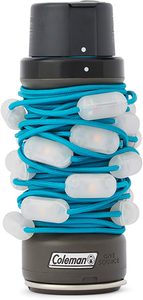
Package and battery contents: The listing title itself (“…with Rechargeable Battery & USB Charger”) confirms the rechargeable battery is included in the box, not sold separately, and the string wraps around the battery dock for storage. The manufacturer does not publish an exact battery capacity (mAh) or standalone runtime figure for this listing, so both are marked accordingly in the comparison table above rather than estimated.
What to expect: Cross-referencing the Amazon listing against multiple retailer pages confirms a consistent spec set: a 250 to 25 lumen dimming range, the widest in this guide, IPX4 water resistance, and a 3-year warranty, the longest of any product reviewed here. The OneSource interchangeable battery system is the standout feature for anyone already invested in Coleman’s ecosystem.
| What I Like | What I Don’t |
|---|---|
| Widest dimming range in this guide (250 to 25 lumens) | Locks you into the Coleman ecosystem for full battery-swap benefit |
| Battery included, interchangeable across OneSource gear | Exact battery capacity/runtime not published |
| Longest warranty here (3 years) |
Best for: Campers who already own or plan to own other Coleman OneSource gear. Who should skip it: Anyone who doesn’t want to invest in a proprietary battery system.

- Interchangeable Power: Coleman OneSource powers all your outdoor gear with one rechargeable battery system
- Adjustable Lighting: Dimmable lights from 250-25 lumens creating the perfect atmosphere
- Durably Designed: Crafted to be impact- and IPX4 water-resistant for reliable outdoor usage
4. LUNO Camping String Lights
Overall: ★ 7.0/10 | Best Budget Pick
Performance Scorecard
| Category | Score |
|---|---|
| Brightness & Beam Coverage | 6/10 |
| Runtime & Charging | 6/10 |
| Weatherproofing & Durability | 6/10 |
| Portability & Weight | 8/10 |
| Ease of Setup | 9/10 |
| Overall | 7.0/10 |
Specs
- Length: 20 ft
- Light Color: Warm white
- Battery: Included 550mAh rechargeable lithium battery pack
- Maximum Runtime: Up to 8 hours
- Charging: USB-C
- Brightness: Low, medium, and high
- Modes: Steady, twinkle, and breathing
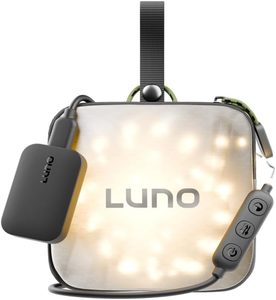
- Controls: Integrated 3-button control panel
- Weight: 3.2 oz
- Mounting: Suction cups and magnetic pouch
- Pouch: Translucent storage pouch doubles as a lantern
- Warranty: 3 years
- Best For: Car campers and vehicle-based camping
Pros
- Very light at 3.2 oz
- Includes a rechargeable battery
- USB-C charging
- 20-ft coverage
- Adjustable brightness
- Multiple lighting modes
- Suction cups make vehicle mounting easy
- Storage pouch doubles as a lantern
- Three-year warranty
Cons
- Maximum runtime is only about 8 hours
- No published IP/weather-resistance rating for the exact model
- Less suitable for harsh wet conditions without additional protection
- Manufacturer documentation has changed around compatible power-source wording, so the exact included setup should be checked before publication
What to expect: The suction-cup design is the standout feature here, since it grips straight to a window or rear glass in seconds with no makeshift tie-downs needed. The LUNO Camping String Lights can also double as a compact lantern when stored in their translucent pouch, which is a nice bonus for a single evening’s worth of light. Runtime is the main compromise: 8 hours is workable for one evening, but back-to-back nights without a recharge will be tight.
| What I Like | What I Don’t |
|---|---|
| Suction-cup mounting is the easiest vehicle setup here | Shorter runtime than solar and larger-battery options |
| Storage pouch doubles as a lantern | No published IP rating |
| Flexible coating resists tangling |
Best for: Van life, tailgate camping, and anyone lighting up a vehicle interior or rooftop. If you’re still weighing a rooftop tent or ground tent setup for your rig, our car camping tents guide can help. Who should skip it: Anyone camping multiple nights without reliable access to a charger.

- Enjoy bright and versatile camping lights with seven lighting modes like twinkle, breathe, and steady glow. Perfect for …
5. LuminAID USB String Lights (2-Pack)
Overall: ★ 6.6/10 | Best for Large Coverage
Performance Scorecard
| Category | Score |
|---|---|
| Brightness & Beam Coverage | 7/10 |
| Runtime & Charging | 6/10 |
| Weatherproofing & Durability | 6/10 |
| Portability & Weight | 6/10 |
| Ease of Setup | 8/10 |
| Overall | 6.6/10 |
Specs
- Quantity: 2 light strands
- Length: 32 ft per strand
- Total Length: 64 ft
- LEDs: 100 LEDs per strand
- Light Colors: One warm white + one multicolor strand
- Lighting: Steady mode plus flashing/transition modes
- Power: USB
- Battery: No built-in battery
- Power Source: External USB power required
- Best For: Large campsites and campers who already carry a power bank
Pros
- Two long 32-ft strands provide excellent coverage
- 100 LEDs per strand
- Includes both warm-white and multicolor lighting
- Multiple lighting effects
- Works with common USB power sources
- Excellent for large tents, campsites, patios, and group setups
- Very flexible power-bank compatibility
Cons
- Requires an external USB power source
- No built-in battery
- No published runtime because runtime depends on the power source
- No published IP/weather-resistance rating for the product
- 64 ft of cable can be excessive for minimalist campers
- Not the most compact option for backpacking
LuminAID confirms that the combo pack includes two 32-ft strands with 100 LEDs each, one warm white and one multicolor, and that the lights require an external USB power source.
What to expect: Based on the manufacturer’s listing, this two-pack pairs a warm white and multicolor strand for genuinely useful flexibility between a practical light and a decorative one. LuminAID does not publish an exact battery runtime or IP rating for this model, which is the main gap in an otherwise reasonable budget pick.
| What I Like | What I Don’t |
|---|---|
| Two strands for the price of one premium single strand | No published runtime figure |
| Genuinely useful warm white + multicolor variety | No published weatherproofing rating |
| Lightweight and travel-friendly per the listing |
Best for: Budget-conscious campers who want flexibility between practical and decorative lighting. If you’re outfitting camp on a budget overall, see our best budget camping gear roundup.
Who should skip it: Anyone who wants documented weatherproofing specs before buying.

- RECHARGEABLE USB STRING LIGHTS – Our combo pack includes 2 strands of LED string lights; The warm white string lights ar…
- 8 LIGHTING MODES – Customize your setting with a steady glow or select from 7 dynamic flashing and transition modes. Whe…
- PLUG AND PLAY WITH ANY USB – These lights aren’t bound to a specific power source. Plug them into any phone charging Lum…
6. Brightown 58FT Solar String Lights
Overall: ★ 6.6/10 | Best for Large Campsites
Performance Scorecard
| Category | Score |
|---|---|
| Brightness & Beam Coverage | 7/10 |
| Runtime & Charging | 6/10 |
| Weatherproofing & Durability | 9/10 |
| Portability & Weight | 4/10 |
| Ease of Setup | 7/10 |
| Overall | 6.6/10 |
Verified specs: 58 ft total cord with 48 ft of lighted length (ASIN B07KC95D9X), 17 shatterproof G40 LED bulbs (including 1 spare), 3-ft bulb spacing, solar-powered, IP65 waterproof rating, 3 light modes, dimmable, includes remote and timer, UL Listed.
Specs
- Total Length: 58 ft
- Lighted Length: Approximately 48 ft
- Bulbs: 17 G40 shatter-resistant bulbs
- Spacing: Approximately 3 ft
- Power: Solar
- Weather Protection: IP65-rated
- Controls: Remote control
- Features: Dimming and timer functions
- Modes: Multiple lighting modes
- Charging: Solar; exact charging configuration should be checked against the current listing
- Best For: Large campsites, RV setups, and semi-permanent outdoor use
Pros
- Long 58-ft overall length
- Approximately 48 ft of illuminated coverage
- IP65-rated protection
- Shatter-resistant bulbs
- Remote control adds convenience
- Dimming and timer functions
- Solar charging reduces the need for an outlet
- Excellent coverage for large basecamps
Cons
- Much bulkier than backpacking-oriented string lights
- Long cable takes more space to pack
- Solar performance depends on available sunlight
- Not the best choice for ultralight camping
- Battery/runtime details can vary by current model/listing
- Bulb-style design is more suited to car camping than backcountry trips
What to expect: This listing is one of the more thoroughly documented in this guide: UL Listed, IP65 rated, with 17 shatterproof G40 bulbs across 48 feet of lit length. That combination of verified weatherproofing and coverage makes it a strong fit for a basecamp or RV site, though the added bulb count and length make it noticeably bulkier than anything else reviewed here.
| What I Like | What I Don’t |
|---|---|
| Best-documented weatherproofing in this guide (IP65, UL Listed) | Bulkiest and heaviest option here |
| Longest lit reach at 48 feet | Not suited to backpacking |
| Shatterproof bulbs, includes remote and timer |
Best for: RV camping, basecamp setups, and multi-day stays where you’re not moving camp often. Check our portable power stations for camping guide if you want backup power for a longer basecamp stay. Who should skip it: Backpackers or anyone prioritizing pack weight.

- 58FT Solar String Lights – Built for year-round outdoor use, 58ft solar string lights with 25+1 shatterproof LED bulbs (…
- Remote-Controlled Magic – The Solar Lights enjoy effortless control and ambiance setting with the upgraded multi-functio…
- Dual Solar/USB Charging – Your ambiance, uninterrupted. The solar lights outdoor waterproof keep you bright regardless o…
7. Luminoodle XL LED Light Rope + Lantern
Overall: ★ 8.0/10| Best Bright Light Rope
Performance Scorecard
| Category | Score |
|---|---|
| Brightness & Beam Coverage | 8/10 |
| Runtime & Charging | 6/10 |
| Weatherproofing & Durability | 9/10 |
| Portability & Weight | 9/10 |
| Ease of Setup | 9/10 |
| Overall | 8.2/10 |
Specs
- Length: 10 ft
- Maximum Output: Up to 360 lumens
- Power: USB / external power source
- Battery: Requires external power
- Design: Flexible LED light rope
- Lantern Mode: Storage pouch diffuses the light
- Water Protection: Manufacturer describes the rope as submersible
- Best For: Camp kitchens, basecamps, and campers wanting brighter rope lighting
Pros
- Up to 360 lumens provides strong illumination
- Flexible rope design is easy to position
- Can function as both a light rope and lantern
- Compact storage pouch
- USB power makes it compatible with many power banks
- Excellent for camp kitchens and larger basecamp setups
- Much brighter than many ambient-only string lights
Cons
- Requires an external power source
- Only 10 ft long
- Heavier than ultralight string-light options
- No formal IP rating should be assumed from the manufacturer’s “submersible” description
- More of a flexible light rope than a traditional decorative bulb-style string light
- External battery adds to the overall system weight
What to expect: Listed by the manufacturer as submersible, with up to 360 lumens across a 10-foot rope, this is built to survive rougher handling than a standard string light. Since it draws power from any USB source rather than a dedicated battery, actual runtime depends entirely on the power bank you pair it with.
| What I Like | What I Don’t |
|---|---|
| Best-rated durability in this guide, per manufacturer’s submersible claim | Shortest length here at 10 feet |
| Genuinely dual-purpose as string light and lantern | Runtime entirely dependent on your power bank |
| Rope build handles wet conditions well |
Best for: Campers who want one compact tool that covers both ambient lighting and an emergency lantern. Compare it against our collapsible camping lanterns if you want a dedicated lantern instead.
Who should skip it: Anyone who needs a long strand to cover a large area without daisy-chaining multiple units.

- Lighting Options: 15 color options, 10 brightness modes, and 3 white modes for custom setup
- Includes: USB LED strip light with wireless remote, quick straps, magnet sliders, and pouch for backup lighting
- High Visibility: Use these LED lights for night walks or keep them in your car for backup lighting
How We Evaluated These
Every product in this guide was scored across five categories, weighted equally and averaged into one overall score out of 10. This is a specification-driven evaluation, cross-referenced against multiple retailer listings and, where available, independent field-testing coverage from established outdoor publications. As stated above, none of these seven units were physically tested side-by-side by CampingSaga for this guide; each product section is labeled with its evaluation type so that distinction is never ambiguous.
Brightness and Beam Coverage: Published lumen output and bulb spacing, assessed for how evenly the light would spread across a typical 10×10 foot tent camping space or car camping setup.
Runtime and Charging: Hours of use per charge, recharge time where published, and whether the product is self-powered (built-in battery or solar) versus dependent on an external power bank.
Weatherproofing and Durability: Published IP rating where available, bulb material (shatterproof plastic versus glass), and cord/wire construction. Where no formal rating is published, this category is scored conservatively rather than assumed.
Portability and Weight: Packed weight and size where published, scored against how easily the product fits into a backpacking load versus a car camping tote.
Ease of Setup: How the product is designed to be deployed at a real campsite, factoring in mounting hardware like suction cups, gear ties, or daisy-chain connectors, based on manufacturer documentation.
Where a manufacturer does not publish a specific figure, such as exact weight or lumen output, that category was scored conservatively rather than estimated, and the gap is noted directly in the comparison table so you’re never working from an invented number.
Manufacturer and Primary-Source Verification
Every spec in this guide is linked directly to its source in each product section above, whether that’s the specific Amazon listing (with ASIN noted for exact model matching), the manufacturer’s own product page, or an independent retailer’s spec page. Where a claim comes from third-party field-testing coverage rather than a spec sheet, that distinction is called out explicitly in the product section, including a note where the tested unit may not be an exact SKU match.
Where a spec could not be confirmed by any primary source, it’s marked “not specified by manufacturer” rather than approximated. Manufacturers update listings and models regularly, so if you notice a listing has changed since publication, the current Amazon listing always takes precedence over what’s written here.
String Lights vs. Lanterns: Which Do You Actually Need at Your Campsite?
This is a question worth answering honestly before you buy either one.
String lights are built for ambient, spread-out lighting. They’re the right tool for setting a mood around a picnic table, lining a tent interior, or making a campsite feel lived-in after dark. What they’re not built for is direct, task-focused brightness. Trying to read a map, cook dinner, or dig through a gear bag under string lights alone usually leaves you squinting.
Lanterns are built for concentrated, functional light. A dedicated camping lantern throws brighter, more direct light in one spot, which makes it the better choice for a camp kitchen, a nighttime bathroom run, or any task that needs real visibility rather than atmosphere.
Most experienced campers end up carrying both, not one or the other. If you’re deciding where to start, our best rechargeable camping lanterns and best solar lanterns for camping guides cover the lantern side of that pairing in depth. Two products in this guide, the Luminoodle XL and the BioLite SiteLight, actually split the difference by functioning as both.
LED String Lights, Brightness, and Battery Pack Basics
A quick primer on the terminology used throughout this guide: an LED light is simply the individual bulb, LED string lights are a full strand of them wired together, and brightness (measured in lumens) is how much light each bulb or strand puts out. A rechargeable battery pack is the self-contained power source built into products like the MPOWERD Luci and Coleman OneSource, as opposed to plugging into a phone charger or USB port on an external power bank. Knowing these terms makes it easier to compare listings on Amazon that don’t always use consistent language for the same features.
Solar String Lights vs. USB vs. Battery-Powered Camp Lighting: Which Power Source Fits Your Trip?
Solar-powered string lights (MPOWERD Luci, Brightown 58FT) are closest to self-sufficient, thanks to a built-in solar panel that handles solar power collection on its own. On a trip with reasonable daytime sun exposure, you never have to think about a charger. The trade-off shows up on heavily overcast trips or in shaded, forested campsites, where the panel simply can’t keep up. If you want to compare more premium solar options beyond these two, look for a similarly rated solar panel size and a rechargeable lithium battery capacity of at least 2000 mAh, which is the baseline this guide’s solar picks meet.
USB-rechargeable string lights with a built-in battery (Coleman OneSource, LUNO) come with their own power source, so you charge them like you would a phone and they hold that charge independently.
USB-powered string lights without a built-in battery (BioLite SiteLight, LuminAID, Luminoodle XL) depend entirely on an external power bank or another USB source. This adds flexibility since you’re not locked into a single fixed capacity, but it also means your actual runtime is only as good as whatever you plug it into. Some campers pair these with a dedicated solar hub or portable power station instead of a small phone-sized power bank, which is worth considering if you’re also charging other gear at camp.
Disposable battery-powered string lights aren’t featured in this guide’s main 7, deliberately. Older camp string lights were often powered by 3 AA batteries or similar disposable cells, but between rising battery costs and the environmental waste of disposables, every product here uses solar, a built-in rechargeable battery, or external USB power instead, which is where the market has clearly moved for anyone buying new camp lighting in 2026.
If you’re trying to decide which category fits your specific trip style, ask yourself how many consecutive shaded or cloudy days you’re likely to hit, and whether you already carry a power bank. That answer alone will point you toward solar, self-powered USB, or external-dependent USB almost every time.
Decision Tree: Which Camping String Lights Should You Buy?
Start here and follow the path that matches your priority.
Is weight your top priority (backpacking or ultralight travel)? → Yes: Get the BioLite SiteLight String Lights. → No: Continue.
Do you need to light up a vehicle interior or roofline quickly? → Yes: Get the LUNO Camping String Lights. → No: Continue.
Are you staying at one basecamp or RV site for multiple days and want maximum coverage? → Yes: Get the Brightown 58FT Solar String Lights. → No: Continue.
Do you want one product that works as both a string light and a backup lantern? → Yes: Get the Luminoodle XL LED Light Rope + Lantern. → No: Continue.
Do you already own other Coleman OneSource gear and want a shared battery system? → Yes: Get the Coleman OneSource 20-Foot LED String Lights. → No: Continue.
Do you want the most reliable overall balance of brightness, runtime, and weatherproofing without worrying about the details above? → Get the MPOWERD Luci Solar String Lights (18′).
Is budget your main constraint and you’re fine with fewer published specs? → Get the LuminAID USB String Lights (2-Pack).
Buying Guide: What to Look for in Camping String Lights
Whether you’re shopping specifically for camping gear or just browsing outdoor lights in general, the core buying factors below apply either way: power source, runtime, brightness, weight, length, and water resistance.
Power Source: Solar String Lights vs. USB-Powered
Solar string lights like the MPOWERD Luci are close to self-sufficient on sunny trips but lose that advantage in shade or heavy cloud cover. USB-rechargeable options pair well with a power bank you’re likely already carrying for your phone. See the full breakdown above if you’re still deciding.
Runtime and Charging Time
Runtime ranges widely in this guide, from about 8 hours (LUNO) to 20 hours (MPOWERD Luci). Also check charging time, not just runtime, where the manufacturer publishes it. A light that takes 8 hours to recharge is a bigger planning headache on a multi-day trip than one that tops off in 90 minutes, even if its per-charge runtime is shorter.
Brightness and Lumens
As a practical guideline rather than a hard rule, many campers find somewhere in the range of 80 to 150 lumens spread across a strand works well for ambient campsite lighting. Personal preference and site size both matter here: a dimmer light can feel too subtle to be useful, while a much brighter one can start to feel like a work light instead of a mood light. If you need brighter, task-specific lighting, a dedicated lantern will usually outperform a string light built for ambiance.
Light Modes and Dimming
Several products in this guide offer multiple light modes rather than a single fixed brightness. The Coleman OneSource dims across a 250 to 25 lumen range, the LuminAID offers 8 modes split between steady and dynamic patterns, and LUNO includes 7 adjustable modes. More modes aren’t automatically better: a simple on/off or a single dim setting is often all you need for straightforward ambient camp lighting, and fewer modes usually means a simpler, more reliable control scheme.
Light Color and Temperature: Setting the Mood at Camp
Warm white LEDs (the default on most products in this guide) create a cozier, campfire-like glow and are the classic choice for setting the mood at a relaxed campsite. There’s reasonably solid evidence that insects are more strongly drawn to short-wavelength light, meaning UV and blue-toned light, than to warmer, longer-wavelength light; this is well documented in entomological research on insect phototaxis (see, for example, Brehm, Insect Conservation and Diversity, 2021).
Where the evidence is more mixed is specifically warm-white versus cool-white LEDs: several peer-reviewed field studies have found no significant difference between the two once you’re already comparing LED to LED, since neither typically emits much UV. In practice, choosing warm white over a blue-toned or UV-heavy light source is still a reasonable, low-effort precaution based on the broader research, but it isn’t a guaranteed fix for keeping bugs away.
Weight
If you’re backpacking, weight matters more than almost anything else here. The BioLite SiteLight at 2.5 oz is built for that use case specifically. If you’re car camping or setting up an RV site, weight becomes far less important than length and total light output, which is where something like the Brightown 58FT set makes more sense despite being heavier.
Cord Length and Bulb Spacing
Shorter strands (10 feet) work well for a single tent interior or a compact setup. Longer strands (20 to 58 feet) suit larger group sites, RV awnings, or multi-point setups strung between trees. Bulb spacing also matters: tightly spaced bulbs create a more even glow, while widely spaced bulbs create more of a dotted, ambient effect.
Rechargeable Battery Included vs. External-Power-Dependent
Some products in this guide come with their own built-in battery (MPOWERD Luci, Coleman OneSource, LUNO), meaning you charge the unit itself and it holds that charge independently. Others (BioLite SiteLight, LuminAID, Luminoodle XL) have no internal battery and rely entirely on a separate USB power bank or wall source. Neither approach is inherently better, but it changes what else you need to pack: a battery-dependent light means one more item you’re responsible for keeping charged alongside it.
Water Resistance Rating
Look for a published IP rating whenever possible. An IP rating is written as two digits: the first indicates protection against dust and solid particles (6 is fully dust-tight), and the second indicates protection against water. Brightown’s IP65 rating in this guide means fully dust-tight, plus protection against low-pressure water jets from any direction, which covers most rain and dew exposure.
A rating like IP67 would replace that second digit with a 7, indicating protection against temporary submersion instead. None of the other products in this guide carry a formally published IP rating; where a manufacturer describes a product as “water-resistant” or “submersible” without a number attached, treat that as the manufacturer’s own descriptor rather than an independently verifiable rating. If rain is in the forecast, our camping in the rain guide covers broader setup precautions worth pairing with your lighting choice.
Ease of Setup and Mounting at Your Campsite
Consider how the light actually attaches to your setup. Suction cups (LUNO) are unbeatable for vehicle glass. Gear ties and daisy-chain connectors (BioLite) suit tent poles and modular setups. A carry pouch that doubles as a lantern (Luminoodle) adds versatility beyond simple hanging. Match the mounting method to where you’ll actually be stringing the lights most often, whether that’s a tent, an awning or canopy setup, or a vehicle. If you’re hanging a longer lantern string or strand along an RV awning, look for a product with reinforced hanging loops every few feet so the cord doesn’t sag under its own weight.
Maintenance Tips and Common Mistakes
Don’t store a solar unit fully depleted. Lithium-ion batteries, including the one in the MPOWERD Luci, generally hold their charge capacity longer if stored with at least a partial charge rather than run all the way to empty before a long off-season.
Coil, don’t wad. Cords last longer when coiled loosely rather than balled up in a stuff sack. Tight, repeated folding at the same points is one of the more common ways string lights fail at the wire junctions over time.
Check the solar panel for dust and grime before a trip. A dirty solar panel charges more slowly. A quick wipe before you leave home takes ten seconds and can meaningfully improve solar recharge time at camp.
Don’t leave USB-rechargeable lights on the charger longer than necessary. Most modern lithium-ion products include built-in charge protection that prevents true overcharging, but as a general habit, unplugging once a light shows full, and avoiding long-term storage while plugged in, is a reasonable way to help preserve battery capacity over time, especially in hot conditions.
Match the light to the weather, not just the trip length. A product without a published IP rating, like the LuminAID or LUNO in this guide, is a reasonable bet for a dry weekend but a riskier choice for a trip with rain in the forecast.
Test before you leave, every time. The most common camp lighting failure isn’t the product, it’s a battery that quietly drained in storage since the last trip. A five-minute test at home avoids a dark campsite later. Run through our camping checklist for beginners before your next trip if you want a full pre-trip run-down, not just the lighting.
Know how many hours of light you actually need before buying. Not every trip calls for the longest string of lights on the market. A short strand that plugs into a phone’s USB port and provides four or five hours of light is plenty for a quick overnight, while a multi-night basecamp benefits more from a higher-capacity, self-powered option. Matching what the lights provide to your actual trip length avoids paying for capacity you won’t use.
Frequently Asked Questions
How long do camping string lights typically last?
Lifespan varies significantly based on battery chemistry, usage patterns, and how the cord is stored, and no manufacturer publishes a guaranteed number of years for this category of product. A rough proxy is the product’s warranty length: the products in this guide range from a 1-year warranty (MPOWERD Luci, LUNO) up to a 3-year warranty (Coleman OneSource), which reflects how long each manufacturer is willing to stand behind the unit.
Are solar camping string lights actually worth it?
For car camping and tent camping with reasonable daytime sun exposure, yes. They remove the need to carry a separate charger. In heavily shaded or consistently overcast conditions, a USB-rechargeable option paired with a power bank is more reliable.
What’s the best way to hang string lights at a campsite?
For tents, small carabiners, gear ties, or built-in daisy-chain connectors work well on guy lines or tent poles. For vehicles, suction-cup designs like the LUNO are the fastest option. For a broader area, stringing between two trees with paracord or bungee cord gives the most even coverage.
Do camping string lights attract bugs?
There’s reasonably solid research showing insects are more strongly drawn to short-wavelength light (UV and blue) than to warmer light, so avoiding blue-toned or UV-heavy lighting is a sensible precaution. That said, peer-reviewed studies comparing warm-white LEDs specifically against cool-white LEDs have found mixed results, so treat “warm white attracts fewer bugs” as a reasonable rule of thumb rather than a guarantee.
Can I run camping string lights all night?
Several of the battery-powered options here are rated by their manufacturers for 8 to 20 hours per charge, so an all-night run is realistic on the higher end (MPOWERD Luci) but will drain shorter-runtime options like the LUNO well before morning.
What’s the difference between IP65 and IP67 water resistance?
IP ratings use two digits: the first covers dust protection and the second covers water protection. IP65 means fully dust-tight plus protection against low-pressure water jets from any direction, covering most rain and dew exposure. IP67 keeps the same dust protection but upgrades water protection to temporary full submersion. Among the products in this guide, only the Brightown carries a formally published IP rating (IP65); none carry an IP67 certification.
Do I need a separate camping lantern if I already have string lights?
Yes, if you need direct, task-focused light for cooking or reading. String lights are built for ambient, spread-out lighting, not concentrated brightness. See the String Lights vs. Lanterns section above for a fuller breakdown.
Are rechargeable string lights better than battery-powered ones?
For most campers, yes, since it removes the ongoing cost and waste of disposable batteries. The trade-off is that rechargeable options require you to plan around charging time, which matters more on longer trips without access to power.
How many lumens do I need for a campsite?
As a practical guideline, somewhere between 80 and 150 lumens spread across a strand is often enough for comfortable ambient lighting around a tent or picnic area, though personal preference varies. For task lighting in a camp kitchen, you’ll want a brighter, more concentrated light source rather than relying on string lights alone.
Can camping string lights get wet in the rain?
It depends entirely on the specific product’s water resistance rating. The Brightown in this guide has a published IP65 rating built for rain exposure. Products without a published rating should be treated as dry-weather only until you’ve confirmed otherwise with the manufacturer.
Final Verdict: The Best Camping String Lights for Your Campsite
If you only need one recommendation, the MPOWERD Luci Solar String Lights (18′) offer the most complete package here: solid runtime, genuine solar self-sufficiency on clear days, and a weight that works for most car camping and tent camping trips. If pack weight is your top constraint, the BioLite SiteLight String Lights are the clear choice at 2.5 ounces. And if you want one tool that pulls double duty as both a string light and an emergency lantern, the Luminoodle XL earns its spot at the top of this guide too.
Bottom line: there’s no single best string lights for camping pick that fits everyone, which is exactly why this guide is built to help you find the right one for your exact trip style, whether that’s a quiet solo tent weekend or a full group basecamp. All seven Amazon links in this guide were verified against their listed specs and ASINs as of the last-updated date above; since Amazon listings, prices, and stock can change, it’s worth confirming current availability before you buy.
Whatever you pick, don’t wait until you’re stringing lights up in the dark to find out your battery didn’t hold a charge. Test it at home first, every time.
About the Author
Ricky Thorne has spent more than 15 years guiding backcountry and car camping trips across the United States, from solo backpacking routes in the High Peaks Wilderness to multi-family group trips at established campgrounds. He evaluates every product featured on CampingSaga against verified manufacturer and retailer specifications before it’s recommended, and is transparent about when a review reflects firsthand field use versus a spec-based assessment, as this guide is. When he’s not writing gear guides, Ricky is usually planning the next trip or helping new campers figure out what actually belongs in their pack.