
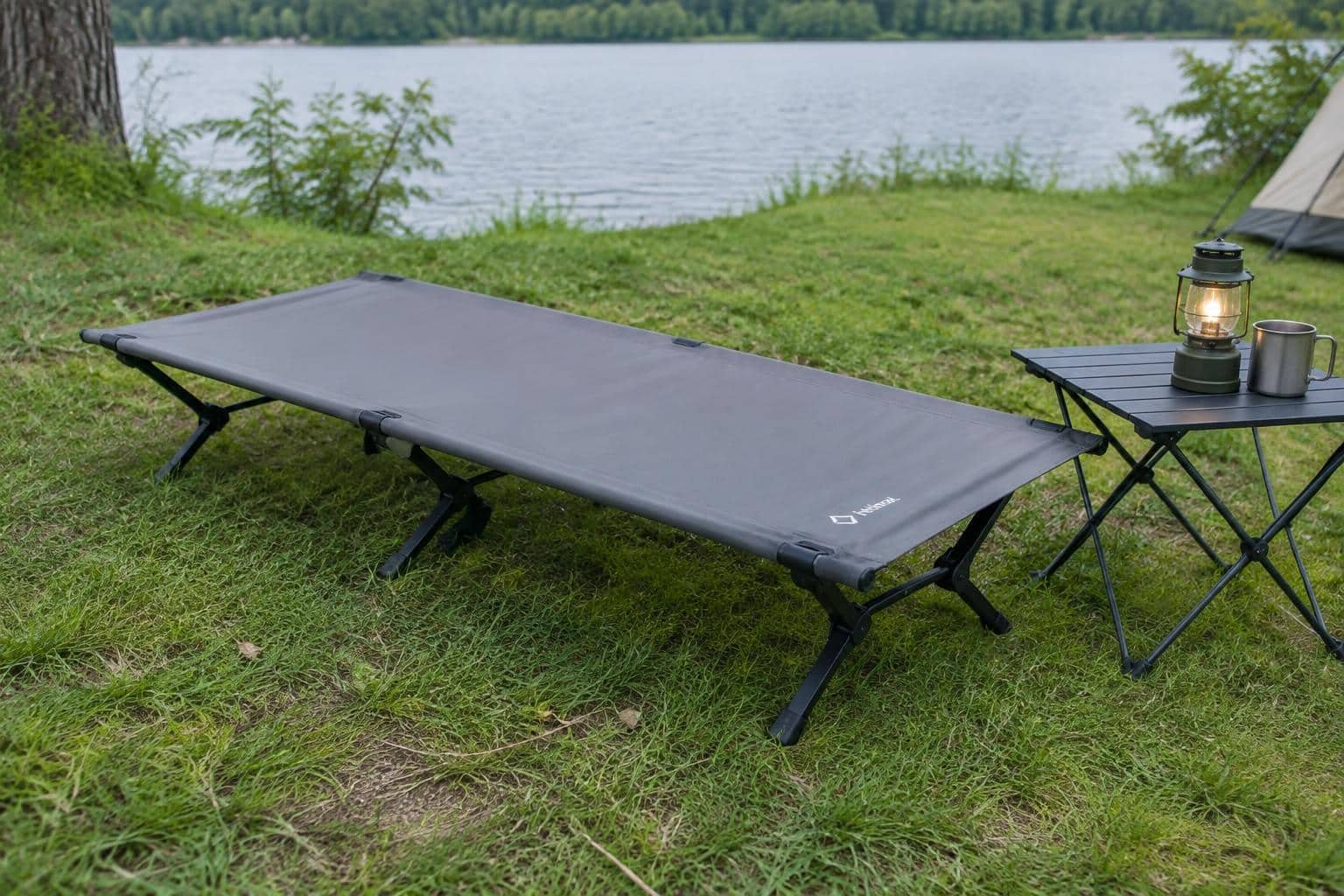
A camp cot is worth carrying when it gets you off hard ground without making your camping gear too heavy or bulky. The wrong camp cot can be too short for tall sleepers, too narrow for side sleepers, or awkward to fit inside a camping tent. The best camping cot depends on where you camp, how much sleep area you need, and whether you carry your gear beyond the car park.
This guide compares seven popular folding camping cots for different needs, from a cushioned vehicle-based bed to a packable option for short carries and backpacking. We cover seven models, chosen to span budget, capacity, width and weight. We reviewed manufacturer specifications, retailer listings, construction, sleeping dimensions, portability, setup, and published warranty information.
Ratings below are editorial judgments based on published information, not laboratory measurements or first-hand results. Think of this as research to help you find the best cots for your trip, not a verdict from nights spent on each one. It is a fresh look at the best camping cots of 2026 as models and specifications change.
Affiliate disclosure: CampingSaga may earn a commission from qualifying purchases made through links in this article, at no additional cost to you. As an Amazon Associate, we earn from qualifying purchases. Affiliate relationships do not determine the ratings or order of recommendations. Product availability, seller, and prices can change; confirm the exact model on the retailer page before buying.
Quick Verdict: The 7 Best Camping Cots for Comfortable Sleep in 2026
The best camping cot depends on your sleeping comfort, weight capacity, available space, and camping style. After comparing comfort features, portability, setup, and published specifications, these are our top picks for different camping needs.
- Best Overall for Car Camping: Coleman ComfortSmart Deluxe (4.3/5) A comfort-focused choice featuring coil suspension and an included foam mattress pad. Its 300 lb weight capacity and bulky design make it better suited to vehicle-based camping than lightweight trips.
- Best Budget Camping Cot: Trailhead II (3.8/5) A straightforward steel-frame cot for occasional campers who want an elevated sleeping surface without spending much. Assembly may require extra effort, but it offers a practical entry point for budget-conscious buyers.
- Best Heavy-Duty Camping Cot: TETON Sports Outfitter XXL (4.1/5) With a published 600 lb weight capacity and a generously sized sleeping surface, this cot is a strong option for campers who prioritize space and load capacity. Its heavier frame and larger packed size are the main trade-offs.
- Best Extra-Wide Camping Cot: EVER ADVANCED Extra Wide XXL (3.8/5) Its approximately 42-inch-wide sleeping platform provides extra room for sleepers who find standard camping cots too restrictive. It is best suited to campers who prioritize sleeping space over portability.
- Best Easy-to-Use Design: Byer of Maine EasyCot (4.0/5) A practical option with a 31-inch-wide sleeping surface and a straightforward setup. It suits campers who value simplicity and a comfortable amount of room without unnecessary complexity.
- Best Value Lightweight Cot: MARCHWAY Ultralight (3.7/5) Weighing approximately 4.8 lb, this cot is a compelling choice for campers who need to keep their gear relatively light. Its narrower, lower-profile design makes it better suited to portability-focused trips than spacious car-camping setups.
- Best Premium Lightweight Cot: Helinox Cot One Convertible (4.1/5) A premium option for campers who want a lightweight, packable sleeping system without giving up the convenience of a raised bed. Its higher price makes the most sense for buyers who prioritize portability and compact storage.
Our recommendation: Choose the Coleman ComfortSmart Deluxe for comfort-focused car camping, the TETON Sports Outfitter XXL for higher weight capacity, or the MARCHWAY Ultralight when reducing pack weight matters most. If you are outfitting your campsite on a tighter budget, explore our best budget camping gear guide for more affordable essentials.
Comparison Table: Best Folding Camping Cots of 2026
| Cot | Editorial rating | Published capacity | Approx. product weight | Approx. open size (L × W × H) | Best for |
|---|---|---|---|---|---|
| Coleman ComfortSmart Deluxe | 4.3/5 | 300 lb | Listings vary; roughly 17–21 lb | About 80 × 30 × 15 in | Cushioned car camping |
| Coleman Trailhead II | 3.8/5 | 300 lb | About 18–21.5 lb | About 73 × 35 × 17 in for the commonly listed version | Budget and occasional use |
| TETON Sports Outfitter XXL | 4.1/5 | 600 lb | About 26 lb listed | About 85–86 × 40–45 × 19 in overall; sleeping surface about 80 × 35.5 in | High capacity and width |
| EVER ADVANCED Extra Wide XXL | 3.8/5 | 550 lb | About 26.6 lb | 84.3 × 41.9 × 19.7 in | Extra-wide sleeping space |
| Byer of Maine EasyCot | 4.0/5 | 330 lb | About 21 lb | 78 × 31 × 18 in | Simple setup and camp/home use |
| MARCHWAY Ultralight | 3.7/5 | About 275 lb; verify current version | About 4.8 lb | About 74.8 × 27.4 × 6.5 in | Lightweight travel and short carries |
| Helinox Cot One Convertible | 4.1/5 | 320 lb | About 4 lb 14 oz packed | About 75 × 27 × 6.5 in without optional leg extensions | Premium lightweight use |
Important specification note: Retailers sometimes mix overall dimensions, sleeping-surface dimensions, older models, bundles, and different versions. Figures above are approximate and should be confirmed against the exact current product page. Price tiers are intentionally omitted because live prices have not been verified.
How to read the table
- Capacity: the manufacturer’s stated maximum load. Follow the model’s instructions and do not treat a rating as permission for jumping or concentrated edge-loading.
- Product weight and packed size: these determine whether the camp cot is practical for a trunk, truck bed, or backpack.
- Open size: compare the actual sleep surface with your height and sleeping position, and compare the full frame footprint with your tent floor. If you are around 6 feet tall or more, length matters most.
- Height: taller cots are easier to get on and off but require more tent clearance; low cots can save weight and fit in low shelters.
How We Evaluated These Camp Cots
No one at CampingSaga slept on these cots for this article. We reviewed manufacturer pages, major retailer specifications, available warranty information, and published independent reviews where relevant. We did not conduct laboratory tests or hands-on durability tests. Where source specifications disagree, this guide flags the uncertainty rather than presenting one number as universally correct.
Rating criteria and weights
- Comfort (25%): sleeping surface, suspension or padding, width, length, and height.
- Durability and frame (20%): frame design, fabric construction, repairability information, and warranty terms. Warranty length alone does not prove durability.
- Capacity and fit (20%): published load rating and suitability for different body sizes.
- Value (15%): features relative to the product’s general market position; prices fluctuate and were not used as live price claims.
- Portability (10%): weight and packed dimensions.
- Setup (10%): apparent assembly complexity and number of parts.
Each criterion is scored from 1 to 5, multiplied by its weighting, and added. The total is rounded to one decimal. These are editorial scores, not measured performance. Car camping is the default use case, so portability carries less weight than comfort and fit.
| Cot | Comfort (25%) | Durability (20%) | Capacity and fit (20%) | Value (15%) | Portability (10%) | Setup (10%) | Weighted total |
|---|---|---|---|---|---|---|---|
| ComfortSmart Deluxe | 4.9 | 4.3 | 4.2 | 4.4 | 2.8 | 4.3 | 4.3 |
| Trailhead II | 3.6 | 4.1 | 3.4 | 5.0 | 3.0 | 3.2 | 3.8 |
| TETON Outfitter XXL | 4.4 | 4.6 | 5.0 | 3.6 | 1.8 | 3.8 | 4.1 |
| EVER ADVANCED Extra Wide XXL | 4.0 | 3.8 | 4.6 | 4.0 | 1.7 | 3.2 | 3.8 |
| Byer of Maine EasyCot | 4.3 | 4.3 | 3.8 | 3.8 | 2.4 | 4.5 | 4.0 |
| MARCHWAY Ultralight | 3.2 | 3.4 | 3.1 | 4.4 | 5.0 | 4.2 | 3.7 |
| Helinox Cot One | 4.6 | 4.8 | 3.5 | 2.2 | 4.9 | 4.4 | 4.1 |
The 7 Best Camping Cots of 2026, Individually Reviewed
1. Coleman ComfortSmart Deluxe: Best Overall Camping Cot for Car Camping
Top pick for car camping | Rating: 4.3/5
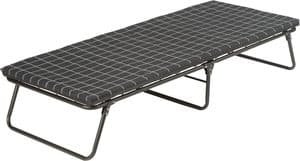
The ComfortSmart Deluxe is a strong choice if comfort matters more than pack weight. Its coil suspension and included foam pad are designed to create a more bed-like surface than a basic taut-fabric camp cot. The commonly listed model is about 80 inches long and 30 inches wide, but confirm dimensions and maximum user height on the exact listing.
Key specifications
- Published capacity: 300 lb.
- Commonly listed open size: about 80 × 30 × 15 in.
- Product weight: retailer listings vary, roughly 17–21 lb.
- Construction: steel frame, coil suspension, and covered foam pad.
- Warranty: verify the current terms for the exact model and seller.
Pros
- Included pad and suspension prioritize a comfortable cot experience.
- Longer sleeping surface than many compact cots.
- Suitable for vehicle-based camping and occasional guest use.
Cons
- Too heavy and bulky for backpacking.
- 300 lb capacity is lower than the TETON and EVER ADVANCED models.
- A foam pad does not automatically provide enough insulation for cold conditions.
Best for: family camping trips and campers who value cushioning over low weight.
Skip it if: you need a high-capacity camp cot, have limited tent space, or carry your sleep system on a trail.

- Weight Capacity: 300 lbs, fits campers up to 6 ft 6 in
- Dimensions: 80″ L x 30″ W x 15″ H (unfolded)
- Weight: 24.7 lbs
- Frame: Strong folding steel frame
- Comfort: ComfortSmart coil suspension with thick foam pad for a bed-like feel
- Warranty: 1-year limited
Price and availability may change. We may earn a commission from qualifying purchases at no extra cost to you.
2. Coleman Trailhead II: Best Budget Cot for Occasional Campers
Budget pick | Rating: 3.8/5
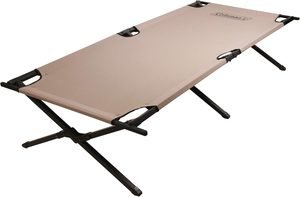
The Trailhead II is a basic steel cross-bar camp cot for occasional campers who want to get off the ground without paying for a padded or lightweight design. Coleman lists a 300 lb capacity and dimensions around 73 × 35 × 17 inches for the current commonly listed version. Retail listings can differ, so check the model number and specifications before ordering.
Key specifications
- Published capacity: 300 lb.
- Commonly listed open size: about 73 × 35 × 17 in.
- Weight: about 21.5 lb in the maker’s listing; some retailers show lower figures.
- Construction: steel cross-bar frame and polyester fabric.
- Warranty: a one-year limited warranty is listed for this product family; confirm current terms.
Pros
- Simple design for occasional use.
- No integrated electronics or pump to maintain.
- Suitable for camping from your vehicle and for guest use.
Cons
- Cross-bar tensioning can take effort, particularly on a new cot.
- No built-in padding or suspension.
- Too heavy for most backpacking trips.
Best for: a first cot, occasional camping, or a spare bed.
Skip it if: you need a padded surface, a lightweight camp cot, or more capacity than 300 lb.

- Weight Capacity: 300 lbs, max user height 6 ft 2 in
- Dimensions: 73″ L x 35″ W x 17″ H (unfolded)
- Weight: 21.5 lbs
- Frame: Strong cross-bar steel frame, easy to assemble
- Material: Polyester cot, steel frame (Beige)
- Storage: Folds to fit in most car trunks
- Warranty: 1-year limited
Price and availability may change. We may earn a commission from qualifying purchases at no extra cost to you.
3. TETON Sports Outfitter XXL: Best for High Capacity
Best for high capacity and a wide sleeping surface | Rating: 4.1/5
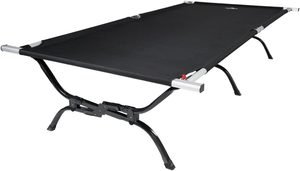
The TETON Sports Outfitter XXL is designed for campers who need a large sleeping platform and a high published capacity. TETON lists a 600 lb capacity, while the commonly listed sleep surface is around 80 × 35.5 inches. It weighs about 26 lb, so it is best for base camps rather than hiking.
Key specifications
- Published capacity: 600 lb.
- Sleeping surface: about 80 × 35.5 in; overall dimensions are larger.
- Product weight: about 26 lb listed; OutdoorGearLab measured a test unit at 23.7 lb.
- Frame: aluminum top frame with steel legs and a polyester canvas surface, according to product information.
- Warranty: a limited lifetime warranty is described for eligible original-owner purchases; review current exclusions and terms.
Pros
- Highest published capacity in this comparison.
- Wide sleeping surface and long overall frame.
- Pivot-arm design is intended to ease tensioning the final end bar.
- Manufacturer lists replacement parts for some components.
Cons
- Heavy and bulky when packed.
- Needs a large tent footprint.
- No pad is included with the standard cot.
Best for: larger sleepers, tall campers, and base-camp users who prioritize space and capacity. For more oversized options, see our guide to heavy-duty camping cots.
Skip it if: you have a small tent or need to carry your camp cot far from your vehicle.

- PATENTED PIVOT ARM REVOLUTION: Cot setup just became child’s play; The pivot arm is a built-in lever that eliminates wre…
- STRONG AND STURDY: Reinforced steel S-leg assembly strengthens the cot and provides stability; Portable folding cot make…
- SLEEP BETTER OUTDOORS: This heavy-duty camping cot keeps you off cold, rocky ground for a more comfortable night’s sleep…
4. EVER ADVANCED Extra Wide XXL: Best Extra-Wide Pick
Best extra-wide option | Rating: 3.8/5
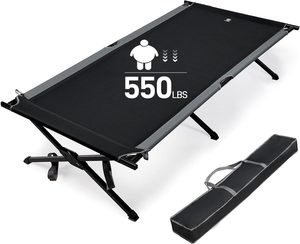
The EVER ADVANCED Extra Wide XXL is for sleepers who feel cramped on a standard 25–30-inch cot. The manufacturer’s listed size is 84.3 × 41.9 × 19.7 inches, with a 550 lb capacity. Its width is the main advantage; the trade-off is a large, heavy package.
Key specifications
- Published capacity: 550 lb.
- Open dimensions: 84.3 × 41.9 × 19.7 in according to the cited product listing.
- Weight: about 26.6 lb.
- Folded dimensions listed for this model: about 48.6 × 4.9 × 9.1 in.
- Warranty: current terms were not sufficiently clear in the sources reviewed; verify with the seller or manufacturer.
Pros
- Extra-wide sleeping surface.
- High published capacity.
- Useful for camping from a vehicle and for temporary indoor sleeping.
Cons
- Heavy and long when packed.
- Requires a roomy tent.
- Warranty terms and exact listing details need checking before purchase.
Best for: side sleepers and campers who want significantly more width than a standard camp cot. For more choices, see our guide to camping cots for side sleepers.
Skip it if: you have a small tent, limited vehicle storage, or need a backpacking cot.

- EXTRA WIDE: The open dimensions of the ultra wide cot are 84.3″L x41.9”W x19.7″H, folded dimensions are 48.6″L x4.9″W x…
- HIGH WEIGHT CAPACITY: It supports up to 550 lbs making it perfect for personal comfort and for family cuddling; Reinforc…
- EASY SETUP: The oversize cot is assembled and folded into the carry bag and the only parts you need to put together are …
5. Byer of Maine EasyCot (Byer of Maine Easy Cot): Best Simple Design
Best simple design | Rating: 4.0/5
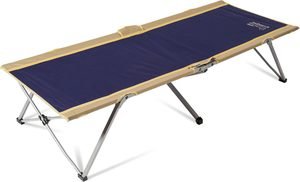
The Byer of Maine EasyCot, sometimes written as the Byer of Maine Easy Cot, is a simple camp cot for campers who want a relatively wide surface without assembling a pole-frame system. The commonly listed model has a 78 × 31-inch sleeping surface, an 18-inch height, and a 330 lb capacity. At about 21 lb, it suits camping from your vehicle rather than hiking.
Key specifications
- Published capacity: 330 lb.
- Sleeping surface and open dimensions commonly listed: about 78 × 31 × 18 in.
- Weight: about 21 lb.
- Construction: welded steel legs and reinforced polyester fabric, according to product listings.
- Packed dimensions and current warranty: verify on the exact model listing.
Pros
- Straightforward folding design.
- Wider than many compact backpacking cots.
- Useful for campsites and occasional guest use.
Cons
- Too heavy for most backpacking trips.
- No included sleeping pad.
- Packed shape can be bulky.
Best for: campers who value simple setup and a 31-inch-wide surface.
Skip it if: low packed weight or a very wide XXL sleeping surface is your priority.

- COMFORTABLE CAMPING SLEEP SYSTEM – Enjoy a better night’s rest outdoors with the Byer of Maine Easy Cot. The durable pol…
- HEAVY-DUTY STABILITY & SUPPORT – Built for reliable performance in the outdoors, this folding camping cot features a wel…
- SPACIOUS XL DESIGN FOR ADULTS – Measuring 78″ L x 31″ W x 18″ H, this extra-large camping cot provides plenty of room fo…
6. MARCHWAY Ultralight: Best Value Lightweight Cot
Best value | Rating: 3.7/5
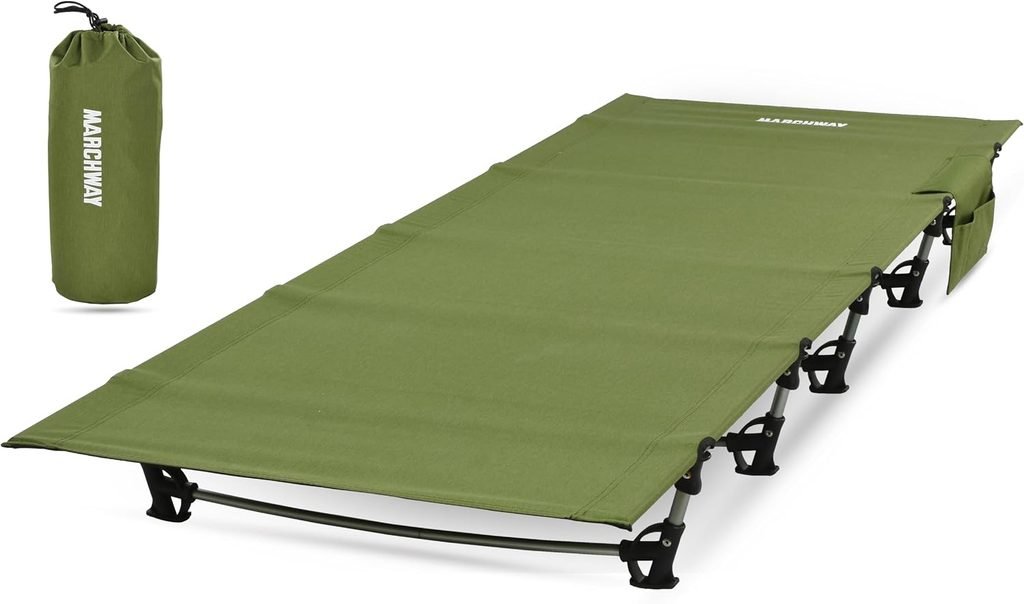
The MARCHWAY Ultralight uses a pole-and-leg frame to keep weight and packed size down compared with steel-frame models. Common listings put it at about 4.8 lb, with an open size around 74.8 × 27.4 × 6.5 inches and a capacity around 275 lb. Verify the capacity and dimensions on the exact version being sold. Among packable cots, it is the budget-friendly way into ultralight cot territory.
Key specifications
- Published capacity: commonly listed around 275 lb; confirm current listing.
- Open dimensions: about 74.8 × 27.4 × 6.5 in.
- Weight: about 4.8 lb.
- Frame: lightweight pole-and-leg system; confirm fabric and materials on the current listing.
- Packed dimensions: verify on the exact listing.
Pros
- Much lighter than steel-frame camp cots.
- Packs into a compact bag.
- More practical for short carries, bike trips, and some backpacking setups than full-size models.
Cons
- Narrower and lower than car-camping models.
- Pole-based assembly takes practice.
- Still heavier than many sleeping pads.
Best for: campers who want a packable option at a lower price tier than premium ultralight models.
Skip it if: you need an extra-wide platform, high load rating, or the simplest possible setup.
- Nylon
- Ultralight & Highly Portable: Weighing only 4.9 pounds, this cot packs into a compact 15.7” x 6.9” stuff sack. It fits e…
- Quick & Simple Setup: Stop wrestling with clumsy gear. Our intuitive, foldable shock-cord pole system makes assembly str…
7. Helinox Cot One Convertible: Best Premium Pick
Best premium lightweight option | Rating: 4.1/5
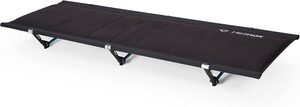
This premium portable cot is built around a lightweight frame and a lever-lock tensioning system. The maker lists a 320 lb capacity and a sleeping surface around 75 × 27 inches. The cot sits low in its standard configuration; optional leg extensions may be sold separately, so check what is included in the listing. Shoppers sometimes confuse it with the Helinox Lite Cot, a related model we did not review, so confirm the exact name before buying.
Key specifications
- Published capacity: 320 lb.
- Sleeping surface: about 75 × 27 in.
- Packed weight: about 4 lb 14 oz.
- Packed dimensions vary by source; commonly listed around 21–23 × 6.5 × 6.5 in.
- Frame: DAC aluminum alloy; fabric specifications should be checked against the current model.
- Warranty: a five-year warranty is listed for eligible products; confirm current coverage and regional terms.
Pros
- Compact packed size and low weight for a cot.
- Lever-lock system is designed to tension the fabric.
- Published capacity of 320 lb.
- Manufacturer warranty is longer than many basic cot warranties.
Cons
- Expensive compared with budget pole-frame cots.
- Narrow and relatively short compared with oversized models.
- Sits low unless compatible optional legs are purchased.
- Needs a suitable pad or insulation in cold conditions.
Best for: campers who carry their camp cot often and want a premium packable design.
Skip it if: you mainly car camp, need an extra-wide sleeping surface, or are on a tight budget.

- Insulated camping cot is lightweight, compact, and portable, offering maximum surface tension and a warm 2.5-inch thick …
- Holds up to 320 pounds with proprietary aluminum alloy legs and frame; cot cover and zippered carrying case made from 60…
- Quick setup with a single internal bungee cord that self assembles the poles; height of 7 inches, or 15 inches with leg …
How to Choose the Best Camping Cots for Comfortable Sleep
When you start camping cot buying, look for cots that fit your tent and your body before you compare anything else. Whether you are purchasing a camping cot for tent camping with the family or for a quiet weekend of comfortable camping at a favorite camping spot, the same questions apply. Most camping cots are designed around a trade-off between sleeping space and pack weight, and the camping cots on the market range from basic steel frames to luxury camping setups with thick padding. A quality camping cot does not have to be the most expensive one, and quality camping gear is mostly about fit, tension and sturdy locking points.
Below are the cots we recommend for each situation. The best overall cot for you is the one that fits your tent floor, your height and your carry distance. The right option for car camping is usually wide and padded, and our guide to the best car camping tents can help you plan the rest of the setup, while lightweight camping cots like the MARCHWAY and Helinox suit people who walk in.
Pole-frame style cots reward practice, and a cot like the Byer EasyCot favors quick setup. A cot also needs clearance for your gear, and if a cot comes with a foam pad you should still check how it handles cold nights. Cots for comfortable sleep tend to combine width, a taut surface and a bit of padding, so use this guide to find the best cots for your own sleeping style and choose the best fit rather than the biggest number on a spec sheet.
Who Should Buy a Camp Cot? Best Cots by Camper Type and Our Favorite Camping Cot Picks
- Car and family campers: consider the ComfortSmart Deluxe for padding or the Byer EasyCot for a simple, wider surface.
- Occasional campers on a budget: the Trailhead II is a basic option if its setup and dimensions suit you.
- Tall or larger sleepers: compare the TETON Outfitter XXL and EVER ADVANCED Extra Wide XXL, checking actual sleeping dimensions as well as capacity.
- Campers who carry their cot: compare the MARCHWAY and Helinox, but weigh the complete sleep system against a sleeping pad.
- Who should skip a cot: ultralight hikers, people in very small tents, and campers who already sleep comfortably on a suitable insulated pad.
Camp Cot Buying Guide
Weight capacity and sleeper height
Use the manufacturer’s stated capacity and follow the instructions. Choosing a cot rated 50 lb above your body weight is sometimes used as a rule of thumb, but it is not a universal safety standard. Also account for bedding or gear only if the manufacturer says how the rating should be applied. For height, check the maker’s maximum user height; when that is not provided, compare your height with the actual sleeping-surface length and allow room to move.
Sleeping-surface dimensions
Do not confuse overall frame dimensions with the area you can sleep on. A camp cot around 26–27 inches wide may feel restrictive to some side sleepers, while a 35–42-inch surface gives more room. Measure your tent floor and account for doors, gear, and room to move around the cot.
Frame and fabric
Steel frames tend to be heavier; lightweight aluminum designs generally cost more. Fabric type and denier alone do not guarantee durability. Check construction details, replacement-part availability, care instructions, and warranty exclusions rather than treating any single specification as proof of quality.
Setup method
Cross-bar designs can require effort to tension. Pole-frame models need several parts assembled. Practice your camp setup at home before a trip, especially if you expect to build it in the dark or in poor weather.
Packed size and weight
Check the complete packed weight and the bag’s length, not just its volume. A long bag may be awkward in a small car or tent. For longer hikes, compare the cot’s weight with one of the best ultralight sleeping pads, which provides both support and insulation. Heavy cots are too heavy for most trail use, which is why cots like the Helinox exist.
Camp Cot vs. Sleeping Pad vs. Air Mattress
A camping cot provides a raised, flat surface above uneven ground and makes sitting at the edge easier, but it is often heavier and bulkier. A sleeping pad is generally lighter and can provide more reliable insulation. A camping air mattress can feel plush for family trips but needs inflation and can leak. Some campers put a sleeping pad on top of the cot for extra warmth and cushioning. Sleeping on the ground is the lightest option, but a raised cot can be a more comfortable sleep setup for sore backs and stiff knees.
Staying Warm: Sleeping Pad and Sleeping Bag Pairings for Comfortable Sleep
A camp cot does not provide much insulation by itself, and air moving underneath can increase heat loss. Use a sleeping pad suitable for the expected temperatures and your overall sleep system, along with a sleeping bag matched to the forecast (see how to choose a sleeping bag and the best sleeping bags for cold weather). For more ideas, read how to stay warm while camping. There is no single R-value that is right for every person and condition; use gear appropriate for the conditions and your own cold tolerance.
Common Camp Cot Buying Mistakes
- Choosing by capacity alone: a cot can have a high rating but still be too short or narrow.
- Skipping tent measurements: compare length, width, and height with your tent floor and ceiling.
- Ignoring insulation: a cot alone may feel cold in cool weather.
- Buying ultralight when you only car camp: a heavier model may provide more space or padding for less money.
- Trusting one retailer’s specs: listings can mix models or contain errors; check the exact version.
- Not practicing setup: assemble and fold the cot at home before your trip.
- Assuming a long warranty proves durability: read coverage, exclusions, and regional limitations.
Camp Cot Care and Maintenance
- Wipe the frame and fabric, then let both dry fully before storage.
- Store the cot in a dry place and follow the manufacturer’s care instructions.
- Inspect hinges, rivets, locking points, frame tubes, and stitching before trips.
- Follow the assembly sequence and do not force parts that do not align.
- Stay within the published capacity and avoid dropping heavily onto the cot.
- Stop using a cot if a frame tube is bent or fabric is torn near a load-bearing seam.
- Add a camp chair to your kit if you want somewhere to sit while the cot stays set up for sleeping; see the best camping chairs.
Alternatives to a Camp Cot
- Insulated sleeping pad: usually the better pick when weight and warmth are priorities on the trail.
- Air mattress or camping mattress: worth considering for family trips where weight is less important and a pump is available.
- Hammock: see the best camping hammocks; a hammock can work well where suitable trees and appropriate suspension points are available; use insulation underneath in cool conditions.
Why Trust CampingSaga?
- Clear about the method: this is a research-based comparison, not a claim of hands-on testing, and we do not list any of these as cots we tested.
- Transparent scoring: the criteria, weights, and individual scores are shown above.
- Trade-offs included: every recommendation lists reasons not to buy it.
- Affiliate disclosure: qualifying purchases may earn CampingSaga a commission; affiliate relationships do not determine the ratings.
- Corrections: if you find a specification that appears outdated, contact CampingSaga through the site’s contact page and include the product and source.
Sources and Product Verification
These pages can help you check manufacturer specifications and published reviews. Product pages, model availability, and warranty terms may change.
- Coleman ComfortSmart Deluxe: Coleman product page
- Coleman Trailhead II: Coleman product page
- TETON Sports Outfitter XXL: TETON Sports product page and OutdoorGearLab review
- EVER ADVANCED Extra Wide XXL: manufacturer listing
- Byer of Maine EasyCot: manufacturer product page
- Helinox Cot One: Helinox product page and T3 review
- MARCHWAY Ultralight: Amazon.com listing
Folding Cots FAQ’s
What is the best camp cot for car camping?
The ComfortSmart Deluxe is our top pick for campsite use if cushioning matters most. It has coil suspension and an included foam pad. The Trailhead II is a more basic budget alternative, while the Byer EasyCot offers a simple design and a wider-than-compact-cot surface.
Which cot has the highest weight capacity?
The TETON Sports Outfitter XXL is listed at 600 lb, followed by the EVER ADVANCED Extra Wide XXL at 550 lb. Confirm the capacity on the exact model and follow the manufacturer’s setup and use instructions.
What is the best camping cot for tall sleepers?
The TETON Outfitter XXL has an overall length of roughly 85–86 inches, and the EVER ADVANCED is listed at 84.3 inches. The ComfortSmart Deluxe is commonly listed at 80 inches. Check usable sleeping-surface length and the manufacturer’s maximum-user-height guidance before buying.
Are camp cots comfortable?
They can be, but comfort depends on width, length, surface tension, padding, and sleeping position. A cot with an included pad may feel more cushioned, while basic fabric cots feel firmer. Add a suitable sleeping pad if you need more cushioning or insulation, and pair it with one of the 7 best camping pillows. More ideas are in our guide to a comfortable way to sleep in a tent.
Can I use a lightweight cot for backpacking?
The MARCHWAY and Helinox are the most portable options in this guide, at around 4.8–4.9 lb. Even those weigh more than many sleeping pads, so consider whether the raised sleeping surface is worth the extra pack weight. The heavier steel-frame models are intended mainly for car camping.
How do I stay warm on a camping cot?
Use an insulated sleeping pad and a sleeping bag appropriate for the expected temperature. The cot fabric itself provides little insulation, and air underneath can increase heat loss. Choose the complete sleep system for the forecast rather than relying on a universal R-value recommendation.
How much room does a camp cot need for tent camping?
Measure the cot’s full open footprint and leave space for the door, gear, and movement. A cot around 42 inches wide needs a large tent. Also check the cot height against the tent’s wall slope and peak height.
How much weight capacity do I need?
Follow the manufacturer’s capacity limit and use instructions. A rule of thumb such as choosing a cot rated 50 lb above your body weight is not a universal safety standard. Compare capacity, sleeping-surface size, and the exact model together.
Final Verdict: Which Camp Cot Should You Buy?
For most campers who want cushioning, the ComfortSmart Deluxe is the top camping cot in this comparison. If budget is the priority, consider the Trailhead II, our top budget pick. For high capacity and a wider platform, compare the TETON Outfitter XXL with the EVER ADVANCED Extra Wide XXL. The Byer EasyCot is a simple camp-to-home option. If you carry your cot, compare the MARCHWAY Ultralight with the premium Helinox.
Before ordering, confirm the exact model, current seller, sleeping dimensions, load capacity, packed size, warranty, and return policy. Amazon search results can contain similar-looking models and third-party sellers, so choose the product detail page carefully. Packing for your first trip? Use our camping checklist for beginners.
- Weight Capacity: 300 lbs, fits campers up to 6 ft 6 in
- Dimensions: 80″ L x 30″ W x 15″ H (unfolded)
- Weight: 24.7 lbs
- Frame: Strong folding steel frame
- Comfort: ComfortSmart coil suspension with thick foam pad for a bed-like feel
- Warranty: 1-year limited
Price and availability may change. We may earn a commission from qualifying purchases at no extra cost to you.



1 thought on “Best Folding Camping Cots of 2026: 7 Picks Worth Buying”