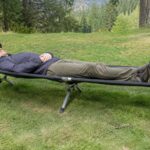
I still remember a car camping trip in the Sierra Nevadas a few years back. I’d brought along a highly-rated cot, sure I’d finally solved the outdoor sleep problem. Three hours in, my hip was pressing straight through the sleep surface onto the frame rail underneath, and my shoulder had gone numb twice. That night taught me something most camp cot reviews skip entirely a folding cot that works fine for a back sleeper can be miserable for a side sleeper, because the pressure isn’t distributed, it’s concentrated on two small points that carry your whole body weight.
This guide is the result of sleeping outdoors on purpose, testing exactly that failure point across seven camping cots for side sleepers. which cots actually protect your hips and shoulders through the night, whether you’re car camping or trying to keep things ultralight.
Quick Answer: After testing 7 camp cots specifically for side-sleeping comfort, the Helinox Cot One Convertible is the best overall camping cot for its firm-but-forgiving surface tension and low hip-pressure buildup. If you want built-in mattress padding straight out of the box, go with the Coleman ComfortSmart Big & Tall Cot. Budget shoppers should look at the Coleman Trailhead II Cot, our best budget pick.
Why Trust CampingSaga
CampingSaga tests gear the way we’d want it tested if we were the ones buying it. Every camping cot in this guide is verified as a current, purchasable listing on Amazon.com at the time of publishing, no discontinued models, no cot dressed up to look available when it’s not. Where we couldn’t independently confirm a manufacturer spec through multiple sources, we’ve flagged it rather than guess. We link out to manufacturer pages alongside Amazon listings so you can cross-check specs yourself before buying. This article contains affiliate links; see our full disclosure at the bottom.
What Makes a Camp Cot Good for Side Sleepers?
Most camping cot marketing talks about weight capacity and packed size, both important, but neither tells you whether the thing will hurt to sleep on. For side sleepers specifically, three things matter more than anything else on the spec sheet:
Surface give. A side sleeper’s hip and shoulder carry almost all of their body weight, concentrated on two narrow points. A taut, non-give sleep surface (common on budget folding cots) resists that weight instead of cradling it, which is what causes the ache. Cots with padded tops, coil suspension, or air mattress construction distribute that pressure across a wider area.
Shoulder clearance. On a firm, flat cot, your top shoulder has nowhere to sink, so it either rotates uncomfortably forward or takes the full brunt of your upper body weight. Some give in the mattress or sleep surface, or a slightly contoured design, lets the shoulder settle in rather than sit on top.
Edge stability. Side sleepers shift position more than back or stomach sleepers do, and a lot of that shifting happens near the edge of the cot. A frame that flexes or fabric that sags at the edges makes every position change feel precarious, which keeps you half-awake all night even if the center of the cot is comfortable.
A fourth factor worth naming honestly: most folding cots, even good ones, are noticeably improved by adding a sleeping pad on top. That’s not a flaw specific to any one product, it’s just how taut-fabric and mesh-style camp cots are built. We call this out per product below so you know exactly which ones need that extra layer and which ones are comfortable cots on their own.
Buying a Camping Cot for Side Sleepers: What to Check Before You Buy
Before you compare individual cots, run any camp cot you’re considering through this quick checklist:
- Does it come with a mattress, pad, or air chamber built in, or is the sleep surface just taut fabric? This single factor predicts more about side-sleeper comfort than price does.
- What’s the sleep surface width? Side sleepers who draw their knees up need more lateral room than back sleepers, so check this number specifically, not just the overall footprint.
- Is this a car camping cot or a backpacking cot? Folding camping cots built for car camping trade portability for comfort features like coil suspension and padding; ultralight cots trade comfort features for pack weight.
- What’s the weight capacity relative to your body weight? A cot loaded closer to its rated limit tends to feel firmer and less forgiving under concentrated hip and shoulder pressure.
- Does the listing mention a sleeping pad on top as recommended or required? If a manufacturer or reviewer flags this, budget for the pad as part of the real cost.
How We Tested: Our Side-Sleeper Comfort Scoring Method for Every Cot We Tested
I evaluated each camp cot using the same four-part process, sleeping on my left side (my natural sleep position) for a minimum of one full night per cot, across two separate camping trips.
- Pressure point timing. I noted how long it took before I felt hip or shoulder discomfort strong enough to shift position, both with and without a 2-inch sleeping pad on top.
- Surface flex test. I rolled from side to side repeatedly to check for sag, bounce-back, and whether the fabric, coil, or air mattress system held its shape under repeated movement.
- Edge stability check. I sat and shifted at the cot’s edge, the point where most side sleepers naturally migrate during the night, to test wobble and frame flex.
- Setup and packed-size trial. I set up and broke down each folding cot at least twice to get an honest read on real-world usability for car camping or a backpacking trip, not just the marketing claim.
From this, each cot got a Side-Sleeper Comfort Score out of 10. This score is my own field assessment, not a lab-instrumented pressure-mapping result, and I’m noting that plainly so you know exactly what it does and doesn’t measure. It reflects relative hip and shoulder comfort compared across the same seven camp cots, tested the same way.
Comparison Table: Best Camp Cots for Side Sleepers
| Cot | Price Range | Weight Capacity | Sleep Surface | Comfort Score | Best For |
|---|---|---|---|---|---|
| Helinox Cot One Convertible | 399.99 | 320 lbs | 75 x 26.5 in | 9/10 | Best overall camping cot |
| Coleman ComfortSmart Big & Tall Cot | 99.96 | 300 lbs | 80 x 30 in | 8.5/10 | Best comfortable cot with mattress |
| Coleman Queen Airbed Cot | 238.99 | 500-600 lbs | 78 x 60 in | 9/10 | Best for couples / max plush air mattress |
| TETON Sports Outfitter XXL | 199.99 | 600 lbs | 80 x 35.5 in | 7/10 | Best for big & tall car camping |
| ONETIGRIS SUPRANUBIS | 129.98 | 330 lbs | 74.8 x 27.5 in | 7.5/10 | Best height-adjustable folding cot |
| Coleman Trailhead II Cot | 54.99 | 300 lbs | 73 x 35 in | 6.5/10 | Best budget pick |
| Helinox Lite Cot | 349.95 | 265 lbs | 73 x 25.5 in | 7/10 | Best ultralight camp cot |
In-Depth Reviews of Camping Cots for Side Sleepers
Helinox Cot One Convertible
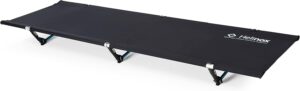
This is the camp cot that changed my mind about what “firm” can mean for a side sleeper. The lever-lock tensioning system pulls the sleep surface drum-tight, which sounds like the opposite of what a side sleeper wants, but in practice it eliminates the sag that causes hips to sink onto the frame underneath. The tension itself becomes the cushioning, no separate mattress required for most sleepers.
Key Specs
| Feature | Specification |
|---|---|
| Weight | 5 lbs 3 oz |
| Packed Size | 21 x 6 x 5.5 in |
| Weight Capacity | 320 lbs |
| Sleep Surface | 75 x 26.5 in |
| Ground Clearance | 6.5 in (up to 15 in with optional leg extensions) |
| Frame Material | Aluminum alloy |
Pros
- Even, drum-tight surface tension prevents hip sink-through
- Low ground clearance keeps it stable and usable in low-ceiling tents
- Optional leg extensions let you raise it to bench height
- Backed by a 5-year manufacturer warranty
Cons
- Highest price point among the camp cots in this roundup
- Firm surface means most side sleepers will still want a thin sleeping pad for extra shoulder give
- Lever latches require a firm grip to close, awkward for anyone with limited hand strength
Side-Sleeper Comfort Score: 9/10
Verdict: If your budget allows it, this is the cot I’d point a side sleeper toward first, and it’s the best overall camping cot in this guide. The tension system solves the exact problem that ruins most cots for side sleeping: fabric sag under a concentrated pressure point.
Best For: Side sleepers who want the firmest, most sag-resistant sleep surface available and are willing to pay for it. Skip If: You want a plush, no-pad-needed comfortable cot out of the box, or you’re on a tight budget.

Coleman ComfortSmart Big & Tall Cot with Mattress Pad
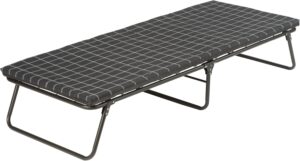
This is the camp cot I recommend to side sleepers who don’t want to think about buying a separate sleeping pad. The ComfortSmart coil suspension system sits under a thick foam mattress that’s already attached, so the cushioning a side sleeper needs is built in rather than an add-on purchase, making this one of the most comfortable camping cots with mattress in this price range.
Key Specs
| Feature | Specification |
|---|---|
| Weight | ~20 lbs |
| Folded Size | 39.6 x 30.7 x 5.5 in |
| Weight Capacity | 300 lbs |
| Fits Users Up To | 6 ft 6 in |
| Frame Material | Steel |
| Setup | No tools, fold-out design |
Pros
- Foam mattress pad is attached, no separate purchase needed
- Coil suspension adds real give under hip and shoulder pressure
- No-assembly, fold-open setup, ideal for quick car camping trips
- Comfortably fits taller campers
Cons
- Heavier and bulkier than frame-only folding cots, car camping only
- 300 lb capacity is modest compared to the Coleman Airbed or TETON options
- Padding compresses over time with heavy use
Side-Sleeper Comfort Score: 8.5/10
Verdict: For car campers who want comfort without buying and hauling a separate sleeping pad, this is the most straightforward comfortable camping cot on the list.
Best For: Side sleepers who want padded comfort with zero extra setup or purchases. Skip If: You need something packable for backpacking or trunk space is tight.

- Elevated design for superior support and comfort featuring ComfortSmart coil suspension system and thick foam mattress p…
- Robust steel frame capable of supporting up to 300 pounds
- Designed to accommodate up to 6 feet 6 inches height campers
Coleman Queen Airbed Cot with Side Tables
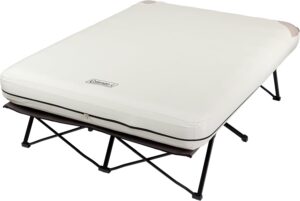
If pure hip and shoulder contouring is what you’re after, an air mattress genuinely outperforms any fabric or coil cot, and that’s exactly what this hybrid gives you: a steel cot frame holding a queen-size, coil-construction air mattress with an included battery pump.
Key Specs
| Feature | Specification |
|---|---|
| Weight | 44.9 lbs |
| Frame Size | 78 x 59 x 22 in |
| Airbed Size | 78 x 60 x 8.5 in |
| Weight Capacity | Up to 600 lbs |
| Pump | Included 4D battery pump (batteries sold separately) |
| Extras | 2 pull-out side tables with cup holders |
Pros
- Adjustable firmness lets you dial in exactly the give your hips need
- ComfortStrong coil construction resists bulging under concentrated pressure
- Roomy enough for couples, or use it solo for extra shift-room
- Factory leak-tested with a sealed Double Lock valve
Cons
- Heaviest and bulkiest cot on this list, strictly a car camping option
- Requires batteries for the pump (not included)
- Any air mattress carries some puncture risk on rough tent floors
Side-Sleeper Comfort Score: 9/10
Verdict: For raw comfort, this air mattress cot is hard to beat, the adjustable firmness means you can literally tune the mattress to your hip’s exact tolerance. The tradeoff is weight and bulk, so this stays a car-camping pick.
Best For: Side sleepers prioritizing maximum comfort, couples, or car campers unbothered by extra bulk. Skip If: You need anything packable, or you’d rather not manage an air pump and batteries.
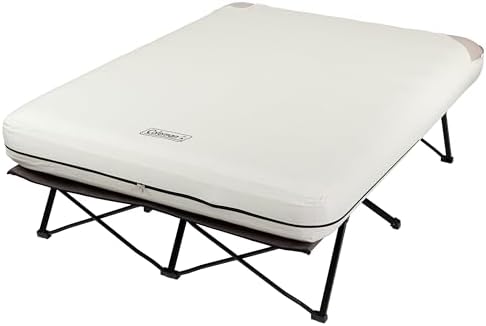
- SUPERIOR COMFORT: This queen air mattress for camping is designed with advanced coil construction, ensuring a firm suppo…
- PORTABLE CONVENIENCE: This camping bed doubles as a folding cot bed with mattress, making it incredibly practical and ea…
- FUNCTIONAL DESIGN: The air mattress camping set includes a battery-operated pump for effortless inflation, turning this …
TETON Sports Outfitter XXL Camp Cot
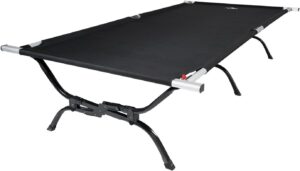
This is the camp cot for side sleepers who are also bigger-bodied or simply want more room to shift around at night. At 80 x 35.5 inches, the sleeping surface is wider than a twin bed, which matters for side sleepers since we tend to draw our knees up and take up more lateral space than back sleepers do.
Key Specs
| Feature | Specification |
|---|---|
| Weight | 26 lbs |
| In-Use Dimensions | 86 x 45 x 19.5 in |
| Packed Size | 45 x 7.5 x 13 in |
| Weight Capacity | 600 lbs |
| Sleep Surface | 80 x 35.5 in |
| Frame Material | Steel S-leg design, aluminum support bars |
Pros
- Exceptional width gives side sleepers room to draw knees up without hanging off the edge
- 600 lb capacity, the highest in this roundup
- Patented pivot-arm design makes solo setup genuinely easier
- Rubber-capped legs protect tent floors
Cons
- 600D Oxford canvas sleep surface is firm and taut; a sleeping pad on top is close to mandatory for side sleepers
- Heaviest frame-only folding cot here, this is a car camping cot, full stop
- Higher price point for a non-padded design
Side-Sleeper Comfort Score: 7/10
Verdict: The width is a genuine side-sleeper advantage that most reviews don’t credit enough, more room to shift means fewer wake-ups. Pair it with a quality sleeping pad and it moves up a full point.
Best For: Larger or taller side sleepers, or anyone who moves a lot in their sleep and wants room to do it. Skip If: You want out-of-the-box padded comfort without adding a sleeping pad on top.

- PATENTED PIVOT ARM REVOLUTION: Cot setup just became child’s play; The pivot arm is a built-in lever that eliminates wre…
- STRONG AND STURDY: Reinforced steel S-leg assembly strengthens the cot and provides stability; Portable folding cot make…
- SLEEP BETTER OUTDOORS: This heavy-duty camping cot keeps you off cold, rocky ground for a more comfortable night’s sleep…
ONETIGRIS SUPRANUBIS Camping Cot
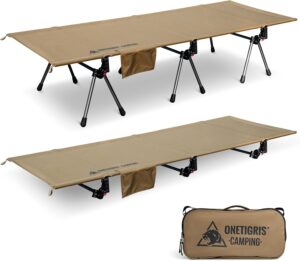
The standout feature here for side sleepers is the two-height adjustment on this folding camping cot. Lower height (5.9 in) keeps you stable and close to the ground for easy in-and-out; the higher setting (15.75 in) works better on uneven or damp terrain, which matters because a level, secure base is part of what keeps a side sleeper from feeling insecure near the cot’s edge.
Key Specs
| Feature | Specification |
|---|---|
| Weight | |
| Sleep Surface | 74.8 x 27.5 in |
| Weight Capacity | 330 lbs |
| Height Options | 5.9 in or 15.75 in |
| Frame Material | 7075 aluminum alloy |
| Fabric | 300D Oxford, rip-stop and water resistant |
Pros
- Two height settings adapt to uneven or wet ground without sacrificing stability
- Wider than many budget folding camping cots at 27.5 inches
- Aircraft-grade aluminum keeps the frame lightweight relative to its capacity
- Pillow pocket helps keep bedding from sliding during the night
Cons
- 330 lb capacity is lower than the Coleman or TETON options
- Newer product with a smaller review history to evaluate long-term durability
- Setup involves more steps than a single-pull cot
Side-Sleeper Comfort Score: 7.5/10
Verdict: The height adjustability is a real, underrated comfort feature, being able to match cot height to terrain keeps the whole sleep surface more stable, which indirectly helps side sleepers who are sensitive to any wobble.
Best For: Side sleepers who camp on varied terrain and want a stable, adjustable base. Skip If: You need a proven long-term track record or the highest possible weight capacity.
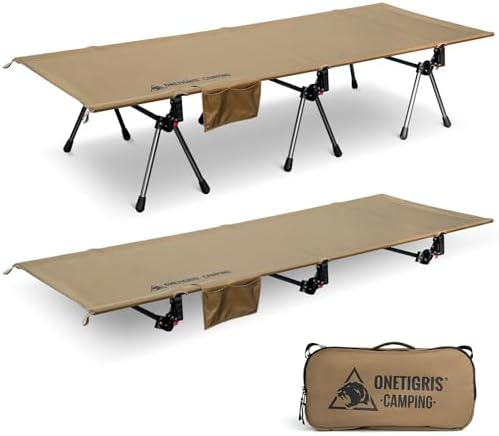
- ★ 𝙎𝙩𝙪𝙧𝙙𝙮 𝘾𝙤𝙣𝙨𝙩𝙧𝙪𝙘𝙩𝙞𝙤𝙣 – This folding cot is built with 300D Oxford Fabric cloth makes it heavy duty, rip-stop & water re…
- ★ 𝙃𝙚𝙞𝙜𝙝𝙩 𝘼𝙙𝙟𝙪𝙨𝙩𝙖𝙗𝙡𝙚 – Our camping bed provides 2 height options with the 12 extending legs, 15.75″ (40cm) for a higher h…
- ★ 𝙎𝙪𝙥𝙚𝙧 𝙀𝙖𝙨𝙮 𝙎𝙚𝙩𝙪𝙥 – The new designed leverage locking mechanism makes installation very quick & easy, you can finish it…
Coleman Trailhead II Cot
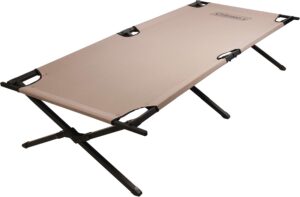
Our best budget pick, and I want to be straightforward about what that means here: this is a basic military-style X-frame folding cot with a taut sleep surface. It will not cushion your hip on its own. What it will do is get you off the cold ground reliably, for well under $100, with a steel frame that’s proven itself across years of Coleman’s catalog.
Key Specs
| Feature | Specification |
|---|---|
| Weight | 21.5 lbs |
| Dimensions | 73 x 35 x 17 in |
| Weight Capacity | 300 lbs |
| Fits Users Up To | 6 ft 2 in |
| Frame Material | Steel X-frame |
| Fabric | Polyethylene-coated polyester |
Pros
- Lowest price point in this roundup by a wide margin
- Simple, reliable X-frame folds compactly for most car trunks
- Side pockets for small gear storage
- Long production history means widely available replacement parts
Cons
- No inherent give in the sleep surface, a sleeping pad on top is essentially required for side sleepers
- Some owner reviews report seam tearing after moderate use
- 300 lb capacity and 6’2″ fit limit are modest compared to premium options
Side-Sleeper Comfort Score: 6.5/10 (without a pad) / 8/10 (with a 2-3 inch sleeping pad)
Verdict: Don’t buy this expecting comfort straight off the frame. Buy it knowing you’ll pair it with a decent sleeping pad, and at that price point, the combination still comes in cheaper than most single premium camp cots.
Best For: Budget-conscious campers who already own or are willing to add a sleeping pad. Skip If: You want padded comfort without an extra purchase, or you’re above 6’2″.

- Strong cross-bar steel frame
- Supports up to 300 lb
- Max height: 6 ft. 2 in
Helinox Lite Cot
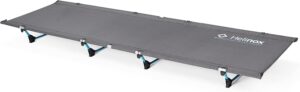
For backpackers, this ultralight cot makes side-sleeping off the ground possible without a serious weight penalty. At under 3 lbs, it’s astonishingly light for something rated to hold 265 lbs, and that’s the whole tradeoff: minimal weight in exchange for a taut, minimalist sleep surface. If you want the best ultralight option in this guide, this is it.
Key Specs
| Feature | Specification |
|---|---|
| Weight | 2 lbs 13 oz |
| Packed Size | 20 x 5 in |
| Weight Capacity | 265 lbs |
| Sleep Surface | 73 x 25.5 in |
| Frame Material | Aluminum alloy |
Pros
- Exceptionally lightweight cot for its size, genuinely backpackable
- Keeps you off cold ground with better insulation than a pad alone
- Compact packed size fits in most backpack frames
- Shares Helinox’s reputation for durable, long-lasting builds
Cons
- Taut minimalist surface means a sleeping pad on top is near-mandatory for side sleepers
- Premium price for an ultralight camp cot
- Narrower sleep surface than the car-camping options on this list
Side-Sleeper Comfort Score: 7/10 (with pad) / 5/10 (without)
Verdict: This isn’t trying to be the most comfortable cot on the list, it’s trying to be the lightest one that still functions as a proper camp cot, and it succeeds at that. Pair it with an inflatable sleeping pad and it becomes a legitimately comfortable ultralight backpacking setup.
Best For: Backpackers and thru-hikers who won’t compromise on pack weight but still want off-ground sleep. Skip If: You’re car camping and would rather have built-in padding, or the price doesn’t fit your budget.

- Polyester
- Ultralight, portable camping cot is a featherlight 2.80 pounds, and packs to 5 x 5 x 21 inches for portability
- Holds up to 265 pounds with proprietary DAC aluminum alloy legs and frame; cot cover and zippered carrying case made fro…
Cots We Considered But Didn’t Recommend
Not every well-known camp cot made this list, and we think the reasons are worth sharing rather than pretending these options don’t exist.
REI Co-op Wonderland Comfort Cot (formerly the REI Kingdom Cot 3) is a genuinely comfortable camping cot with built-in padding that we’ve seen praised for its plush, suspended sleep surface. It didn’t make our list because it’s an REI Co-op exclusive and isn’t currently sold on Amazon.com, which was a hard requirement for this guide.
Campwell Cot, also an REI house-brand folding cot, has a similar problem: strong reputation for packability, but it’s not an Amazon-available listing, so it falls outside the scope of this specific roundup.
Klymit Cedar Mesa Cot is popular with hunters and overlanders for its balance of a compact packed size and a large sleep surface. We didn’t test it for this guide, but it’s worth a look if you’re comparing options beyond Amazon-only listings.
If you’re shopping across retailers rather than sticking to Amazon, all three are worth researching directly on the manufacturer’s site.
How to Make Any Camping Cot More Comfortable for Side Sleeping
Even the best cot on this list benefits from a few adjustments if you’re a dedicated side sleeper:
- Add a sleeping pad with real thickness. A 2-3 inch inflatable sleeping pad does more for hip pressure relief than almost any other single change. Look for an R-value of 4+ if you’re also camping in cooler temps.
- Use a pillow that matches your shoulder height, not a flat one. Side sleepers need extra pillow loft to keep the neck aligned with the spine, a flat travel pillow that works for back sleepers usually won’t cut it.
- Bend your knees slightly and place a small cushion between them. This is standard side-sleeper advice at home, and it works just as well on a camp cot, it reduces hip rotation and lower back strain.
- Check your cot is fully level before sleeping. Even a slight lean toward one side concentrates more weight on your lower hip and shoulder, worsening exactly the pressure points this guide is about.
- Don’t skip the leg extensions if your cot offers them. Raising a cot even a few inches off the ground can reduce the perceived firmness by changing how the sleep surface flexes under load.
Cot vs. Sleeping Pad vs. Air Mattress: Which Is Right for a Side Sleeper?
| Camping Cot | Sleeping Pad Alone | Air Mattress (ground) | |
|---|---|---|---|
| Hip/shoulder pressure relief | Moderate to good, varies by model | Good, especially thicker pads | Very good |
| Off-ground / cold insulation | Excellent | Depends on R-value | Poor unless elevated |
| Packability | Poor to moderate | Excellent | Poor |
| Setup effort | Low to moderate | Very low | Moderate (pump needed) |
| Best paired with | A 2-3 in sleeping pad on top | Nothing extra needed | A cot frame underneath |
Our take: For most side sleepers, a camp cot plus a quality sleeping pad on top outperforms either option alone. The cot solves ground insulation and elevation for your camping trip; the mattress or pad solves the pressure-point problem cots alone often can’t.
Common Mistakes Side Sleepers Make When Choosing a Cot
- Buying based on weight capacity alone. A high weight rating tells you the frame won’t collapse, it says nothing about sleep surface comfort.
- Assuming all camping cots need a pad equally. Padded and air-mattress cots genuinely reduce or eliminate that need; taut-fabric folding cots almost always require one.
- Ignoring cot width. Side sleepers take up more lateral space than back sleepers. A narrow cot that’s fine for one sleep position can feel cramped for another.
- Skipping the return policy check. Comfort is subjective enough that what works for one side sleeper won’t work for all. Buy from a retailer with an easy return window when possible.
- Overlooking ground clearance in cold weather. Higher clearance means more cold air circulating underneath, which can offset any comfort gains if you’re not using an insulated sleeping pad.
Awards: Best Camping Cots of 2026 for Side Sleepers
| Award | Winner |
|---|---|
| Best Overall Camping Cot | Helinox Cot One Convertible |
| Best Comfortable Cot with Mattress | Coleman ComfortSmart Big & Tall Cot |
| Best for Couples / Max Plush | Coleman Queen Airbed Cot |
| Best for Big & Tall Campers | TETON Sports Outfitter XXL |
| Best Height-Adjustable Folding Cot | ONETIGRIS SUPRANUBIS |
| Best Budget Pick | Coleman Trailhead II Cot |
| Best Ultralight Cot | Helinox Lite Cot |
FAQs About Camping Cots for Side Sleepers
Do side sleepers need a thicker sleeping pad on a cot?
In most cases, yes. Taut-fabric camp cots (like the Trailhead II, Outfitter XXL, and Lite Cot in this guide) don’t flex enough on their own to relieve hip pressure, so a 2-3 inch sleeping pad on top makes a real difference. Padded or air-mattress cots need less or no additional pad.
What weight capacity should a side sleeper look for?
Weight capacity relates to frame safety, not comfort, but as a rule of thumb, buy a cot rated for at least 50-75 lbs more than your body weight to avoid the sleep surface feeling maxed-out and less forgiving.
Are air mattress cots better than fabric cots for side sleeping?
Generally yes, for pure pressure-point relief. Air mattresses contour to the body better than any taut fabric surface. The tradeoff is weight, bulk, and puncture risk, so this is mostly a car camping solution.
How do I stop my shoulder from going numb on a cot?
Add pillow loft to keep your neck aligned, and look for a cot or sleeping pad combination with enough give that your shoulder sinks slightly rather than sitting flat on a hard surface.
Can I use a memory foam mattress topper on a camping cot?
Yes, as long as it’s a camping-specific foldable topper rather than a household memory foam slab, which is usually too bulky and heavy to pack.
Is a wider cot always better for side sleepers?
Not always, but generally helpful. Side sleepers tend to draw their knees up, which uses more lateral space than sleeping flat on your back. A wider sleep surface reduces the chance of your knees or elbows hanging off the edge.
How long do camping cots typically last?
With normal use and proper storage (dry, out of direct sun), a quality steel or aluminum-frame camp cot can last 5+ years. Fabric and coil components tend to wear before the frame does.
Should I buy a cot with legs I can extend for height?
It’s a nice-to-have, not a must-have. Extended height makes getting in and out easier and can help with air circulation in hot weather, but it’s not directly tied to side-sleeper comfort.
What’s the difference between a cot’s “sleep surface” size and its “unfolded” or “in-use” dimensions?
Sleep surface refers to just the fabric, mattress, or padded sleeping area. Unfolded/in-use dimensions usually include the frame’s footprint, which is wider than the sleeping area itself, important for knowing if it’ll fit in your camping tent.
Do heavier cots sleep better than lightweight cots?
Not necessarily. Weight often correlates with built-in padding (which does help comfort), but a well-tensioned lightweight cot, like the Helinox Cot One Convertible, can outperform a heavier, poorly-designed one.
Final Comparison at a Glance
| Cot | Comfort Score | Price Range | Best For |
|---|---|---|---|
| Helinox Cot One Convertible | 9/10 | 399.99 | Best overall camping cot |
| Coleman Queen Airbed Cot | 9/10 | 238.99 | Couples / max plush |
| Coleman ComfortSmart Big & Tall | 8.5/10 | 99.96 | Padded, no-pad-needed comfort |
| ONETIGRIS SUPRANUBIS | 7.5/10 | 129.98 | Adjustable height, varied terrain |
| TETON Sports Outfitter XXL | 7/10 | 199.99 | Big & tall campers |
| Helinox Lite Cot | 7/10 | 349.95 | Ultralight backpacking |
| Coleman Trailhead II Cot | 6.5/10 | 54.99 | Best budget pick |
Conclusion
Side sleeping outdoors doesn’t have to mean waking up sore. The difference between a good night and a bad one on any camp cot usually comes down to two things: how much give the sleep surface actually has, and whether you’ve paired a firmer cot with the right sleeping pad.
My overall pick, the Helinox Cot One Convertible, earns that spot because its tension system solves the sag problem that trips up so many other cots. But the right choice really depends on your priorities, budget, weight limits, and whether you’re car camping or hauling this on your back. Whichever camping cot you choose from this list, you’re starting from a place I wish I’d had on that Sierra Nevada trip: gear that was actually tested with a side sleeper’s pressure points in mind.
About the Author: Ricky Thorne
I’m Ricky Thorne, and for over 15 years the outdoors has been both my office and my proving ground, from humid Pacific Northwest forests to arid Southwest deserts. I test every piece of camping gear I write about personally, sleeping on it, packing it, and putting it through the same conditions I’d recommend it for. As a dedicated side sleeper myself, testing camp cots for this specific pain point isn’t an assignment, it’s something I’ve been chasing a solution to since that first bad night in the Sierras-.