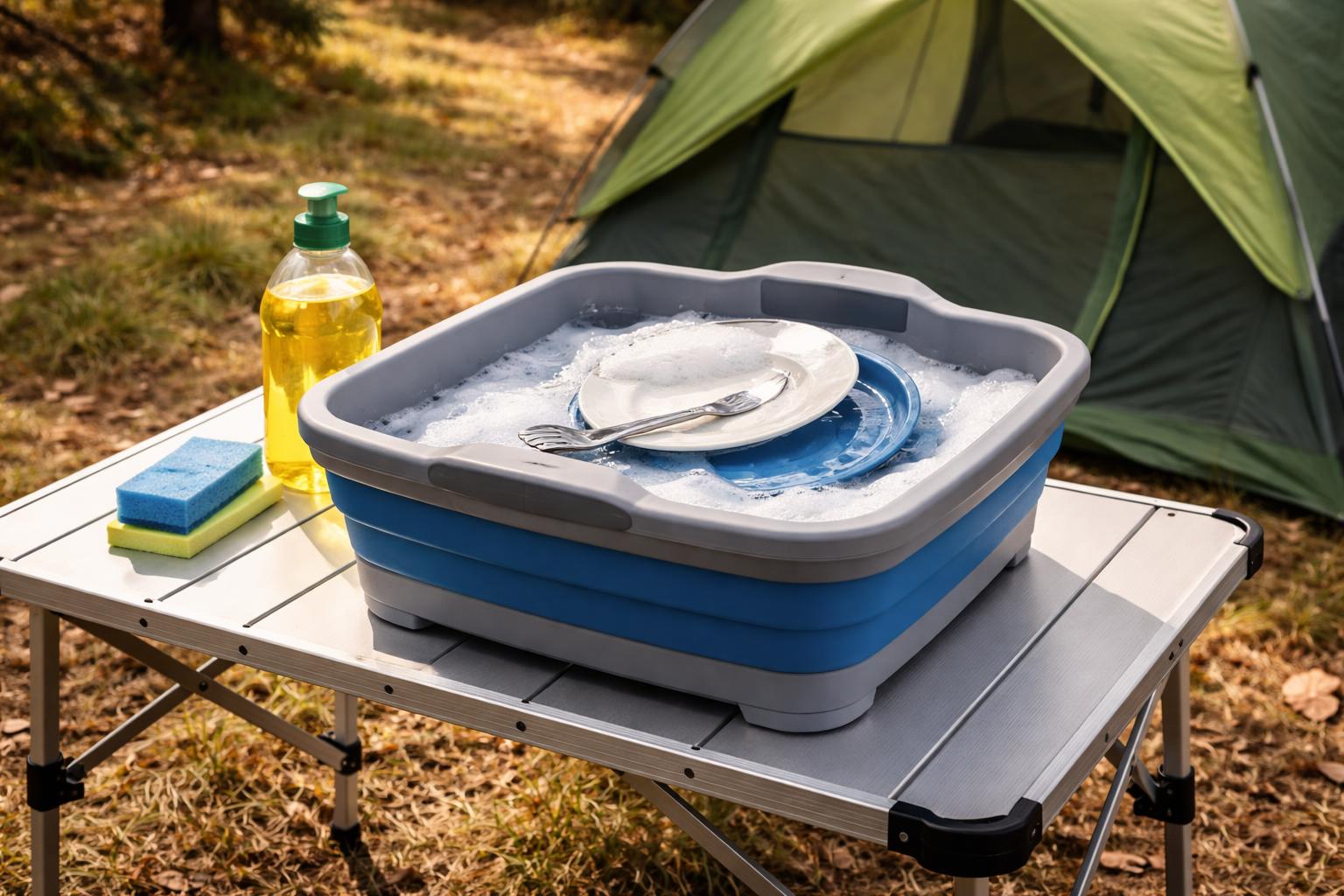
Fifteen years of guiding people through the outdoors taught me one thing early: a messy camp kitchen can wear on a trip faster than bad weather does. Dishes pile up, grease sits in a pan overnight, and your campsite starts to smell like a dumpster. A dedicated camp sink usually fixes that it gets water where you need it and greywater where it belongs.
This guide breaks down 7 real, currently available camping sinks, from $17 collapsible basins to full wheeled hand-wash stations, with verified specs so you can pick the one that actually fits how you camp.
Quick Verdict: Top Picks for Best Camping Sinks
After evaluating these camping sinks for capacity, portability, setup, drainage, durability, and overall campsite practicality, these are the standout options:
🏆 Best Overall SereneLife Portable Camping Sink (19L)
⭐ Rating: 9.3/10
The strongest all-around choice for campers who want a dedicated washing station with a foot pump, fresh-water tank, drainage hose, and integrated soap dispenser. It offers substantially more convenience than a basic basin and is particularly well suited to car camping and weekend trips.
💰 Best Budget FOSJGO Collapsible Dish Basin (9L)
⭐ Rating: 8.8/10
A practical, space-saving option for campers who need a simple basin for washing dishes, rinsing gear, and general campsite cleanup. Its collapsible design packs down easily, making it a good choice for occasional campers and anyone prioritizing affordability.
👨👩👧👦 Best for Groups SereneLife Portable Camping Sink (30L)
⭐ Rating: 9.1/10
The best fit for families and larger groups that need additional water capacity and a more complete washing setup. Its larger tank, foot pump, wheels, and integrated soap dispenser make it better suited to extended trips and higher-volume campsite cleanup.
🏕️ Best Portable Camping Sinks Find the right best portable camping sinks for easier campsite cleanup.
🎯 Our Bottom Line
Choose the SereneLife 19L for the best overall balance of convenience and portability.
Choose the FOSJGO if affordability and compact storage are your priorities.
Choose the SereneLife 30L when you need more capacity and a full-featured campsite washing station.
Choosing the Right Camping Sink for Your Camp Setup
Whether you call it a portable sink, an outdoor sink, or just “the thing that keeps the campsite from turning into a mess,” the right camping sink depends on your camp setup. A solo backpacker filling a water container or jug at a picnic table needs something different from a family running a full camp kitchen with a cast iron skillet and a stack of dishes after every meal.
Some campers want warm water on tap so they can wash your hands after a hike without a fuss; others just need a basin big enough to keep the campsite clean between meals without hauling another piece of gear. On a longer family camping trip or a group camping trip, camping dishwashing adds up fast, so sink setups that work fine for one weekend rarely hold up for a week straight.
If you’ve searched for the best portable camping sink and come away confused by how different the options are, that’s normal tank-and-pump sink stations and simple collapsible basins solve two different problems. Below, we break down sink options by camp style so you can find the right portable pick for your next trip.
🍽️ Best Camping Mess Kits Explore the best camping mess kits for simple, organized outdoor meals.
What Makes the Best Portable Camping Sink?
It comes down to matching capacity and setup to your trip, not chasing the highest-rated single product. A tank sink with a faucet wins for a group weekend; a lightweight collapsible basin wins for a backpacker. The comparison and choice tables below sort our 7 picks by exactly that.
Comparison of the Best Camping Sinks: Basin, Faucet & Setup at a Glance
| Product | Capacity | Weight | Packed/Folded Size | Material | Price Tier |
|---|---|---|---|---|---|
| SereneLife 19L Foot Pump Sink | 19L / 5+ gal | Not published by manufacturer | ~40.1″ x 19.9″ assembled footprint | HDPE plastic | $$–$$$ |
| SereneLife 30L Wheeled Sink | 30L / 7+ gal | Not published by manufacturer | Bulkiest in this lineup (wheeled tank) | HDPE plastic | $$$ |
| Sea to Summit 10L Kitchen Sink | 10L | 4.4 oz (125g) | Packs to ~5.5″ x 1.75″ pouch | 70D recycled nylon, steel stiffening ring | $$ |
| GSI Outdoors Crossover Sink Set | 12L | ~11 oz (10.8–11.8 oz depending on retailer listing) | 10.2″ x 10.2″ x 4.7″ | Polypropylene, TPR, polyethylene, nylon | $$ |
| FOSJGO Collapsible Dish Basin | 2.4 gal / 9L | Not published by manufacturer (very light one-handed lift when empty) | Unfolded 12″ x 12″ x 7.9″, folds to 2.7″ tall | BPA-free PP + TPR | $ |
| Coghlan’s 2082 Collapsible Sink | 9L | Not published by manufacturer | Folds to roughly 2″ tall | Molded plastic | $ |
| Camco Deluxe Camp Kitchen w/ Sink | Integrated fabric sink | Not verified check listing (multi-piece unit) | Folds into a carry bag | Water-impervious fabric + steel countertop | $$$$ |
Which Camping Sink Should You Choose? Sink Options for Every Camper
| Your Situation | Best Pick | Why |
|---|---|---|
| Weekend car camping, want an all-in-one station | SereneLife 19L Foot Pump Sink | Tank, pump, and soap dispenser in one unit no separate water source needed |
| Big family or group trips, multiple people washing up | SereneLife 30L Wheeled Sink | Largest capacity here, plus wheels so you’re not carrying it full |
| Backpacking or ultralight trips | Sea to Summit 10L Kitchen Sink | Lightest verified option here at 4.4 oz, and still holds real capacity |
| Tight budget, occasional camper | FOSJGO Collapsible Dish Basin | Full function for around the price of a campsite firewood bundle |
| Want a full outdoor kitchen, not just a sink | Camco Deluxe Camp Kitchen w/ Sink | Sink is part of a complete prep table with storage and counter space |
| Minimalist, just need something to rinse gear | Coghlan’s 2082 Collapsible Sink | No frills, folds flat, does the one job it’s built for |
| Want a complete clean-up kit out of the box | GSI Outdoors Crossover Sink Set | Comes with soap, sponge, and cloth included |
Top Camping Sinks Picks
1. SereneLife Portable Camping Sink / Faucet Station (19L / 5+ Gallon, Foot Pump) Best Overall
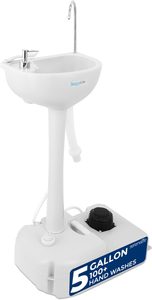
This is one of the closer approximations to a real sink you’ll find at a campsite without RV plumbing. SereneLife actually lists this model as a Portable Faucet Station, and the name fits the foot pump feeds a real faucet spout rather than a spray nozzle. The built-in tank holds 19 liters, the foot pump delivers 180ml of water per press so your hands can stay free while soaped up, and it comes with an integrated soap dispenser and a stainless towel holder. A 2.7-foot flexible drainage hose lets you direct greywater away from your cook area instead of letting it pool underfoot.
Specs
- Water capacity: 19L (5+ gallons)
- Water delivery: hands-free foot pump, 180ml per step
- Material: high-density polyethylene (HDPE)
- Drainage hose length: 2.7 ft
- Includes: soap dispenser, towel holder, carry handle, wheels on some listings
- Weight: not published by the manufacturer
Pros
- Fully self-contained no external water hookup required
- Hands-free operation keeps things more hygienic mid-wash
- HDPE build holds up to repeated outdoor use
Cons
- No published weight, so you’re estimating heft from photos and reviews until it arrives
- Foot pump is a mechanical part that can wear out over years of use
Best for: Car campers and RV campers who want a complete wash station without assembling one from parts.
Who should skip it: Backpackers or anyone hiking in gear this isn’t built for a pack.
Bottom line: The most complete standalone sink experience on this list, if you don’t mind not knowing the exact shipped weight ahead of time.

- 5+ GALLON FRESH WATER CAPACITY: Built-in bottom water tank holds 5+ gallons (19L) to ensure ample water supply for outdo…
- HANDS-FREE FOOT PUMP OPERATION: Delivers 180ml of water per step, ensuring hygienic, contact-free handwashing for conven…
- INTEGRATED SOAP DISPENSER AND TOWEL HOLDER: Comes with a 3-liter liquid soap dispenser and stainless stell towel holder …
2. FOSJGO Collapsible Dish Basin Best Budget
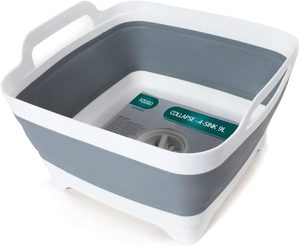
At around $17, this is the cheapest legitimate option on the list, and it does what a camp sink needs to do. It’s a 2.4-gallon basin made from BPA-free, FDA-approved polypropylene and TPR that unfolds to 7.9 inches high (with a 12″ x 12″ footprint) and collapses down to just 2.7 inches flat. A twist drain plug lets you empty it without tipping the basin over, and dual carry handles help move it around camp even full.
Specs
- Water capacity: 2.4 gallons (9L)
- Unfolded size: 12″ x 12″ x 7.9″ / collapsed: 2.7″ tall
- Material: BPA-free PP and TPR
- Weight: not published by the manufacturer, but light enough to lift one-handed when empty based on its size and materials
Pros
- Genuinely inexpensive without feeling flimsy
- Close to 10,000 Amazon reviews at a 4.6-star average, a strong trust signal for a low-cost product
- Doubles as an ice bucket or produce-rinsing tub
Cons
- No pump, faucet, or tank you’re pouring water in and out manually
- No stand, so it sits directly on a table or the ground
Best for: Budget-conscious campers, backpackers packing light, or anyone who wants a backup basin.
Who should skip it: Anyone wanting hands-free operation or a built-in water reservoir.
Bottom line: Hard to beat at this price point if you just need a basin that folds flat and drains cleanly.

- Space-Saving Collapsible Design – The FOSJGO collapsible dish basin folds down from 7.9″ to just 2.7″ high for easy, com…
- Built-In Drain Plug for Easy Emptying – The FOSJGO wash basin features a bottom drain plug for quick water release witho…
- Versatile Multi-Purpose Basin – Designed for everyday use, the FOSJGO collapsible basin is great for washing dishes, rin…
3. SereneLife Portable Camping Sink (30L / 7+ Gallon, Wheeled) Best for Groups
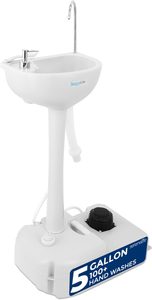
This is the bigger sibling of our Best Overall pick, built for when one small tank isn’t enough. The 30-liter (7+ gallon) reservoir is rated for over 100 hand washes per fill, the foot pump delivers a continuous 220ml per press, and large wheels mean you can roll a full unit across the campsite instead of hauling it.
Specs
- Water capacity: 30L (7+ gallons)
- Water delivery: foot pump, 220ml continuous flow per press, rated for 100+ washes per fill
- Material: high-density polyethylene (HDPE)
- Includes: large wheels, foldable handle, 5L soap dispenser
- Weight: not published by the manufacturer
Pros
- Largest capacity on this list built for real group demand
- Wheels solve the “how do I move a full tank” problem
- HDPE construction is built for repeated outdoor use across seasons
Cons
- Bulkiest packed item here this isn’t a backseat item
- Likely overkill for solo or couple trips
Best for: Family campgrounds, group cookouts, or extended stays where several people are washing up daily.
Who should skip it: Solo campers or anyone with limited vehicle space.
Bottom line: If your group is regularly washing dishes for more than 2–3 people, the added capacity and wheels are worth the extra bulk.

- HANDS-FREE FOOT PUMP OPERATION: Just step on the foot pump to activate a 220ml continuous water flow per press. The 7+ g…
- PORTABLE DESIGN WITH WHEELS: Foldable handle and rugged wheels make it easy to move the sink anywhere. Set up a mobile w…
- DURABLE WEATHER-RESISTANT CONSTRUCTION: Made from high-density polyethylene for long-term use. This camping sink resists…
4. Sea to Summit 10L Kitchen Sink Best for Backpacking
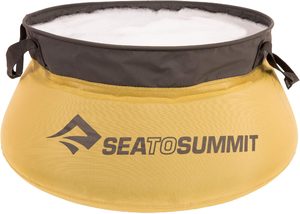
Sea to Summit built this for people who count grams, and the numbers back it up. It’s a folding sink made from certified recycled 70D nylon with a stainless-steel stiffening ring that holds the basin’s shape when full, and it packs into a zippered stuff sack roughly 5.5 x 1.75 inches small enough to disappear into a backpack’s side pocket.
Specs
- Water capacity: 10L (2.6 gallons)
- Weight: 4.4 oz (125g)
- Unfolded size: approximately 14″ diameter x 5″ high
- Packed size: approximately 5.5″ x 1.75″ in included pouch
- Material: 70D recycled nylon with stainless steel stiffening ring, fully taped seams
Pros
- By far the lightest and most packable option here genuinely backpacking-friendly at 4.4 oz
- Reinforced rim keeps the basin’s shape better than basic collapsible plastics
- Rated safe for hot water and detergent up to 140°F
Cons
- No drain plug or hose you tip it out by hand
- Fabric construction is more puncture-prone over the long term than rigid plastic
Best for: Backpackers and minimalist campers who need every ounce to count.
Who should skip it: Group campers needing high capacity or a built-in drain system.
Bottom line: The clear pick if pack weight is your main constraint nothing else here comes close to 4.4 oz.

- Collapsible sink for hauling water, meal prep, dishwashing, and personal hygiene when backpacking, camping, or bike pack…
- Made from bluesign APPROVED 70D waterproof nylon with fully taped seams; safe to use with mild soaps and hot water up to…
- Free-standing when filled; wide base and stainless steel stiffening ring prevents the sink from collapsing when full
5. GSI Outdoors Crossover Sink & Clean-Up Set Best Complete Kit
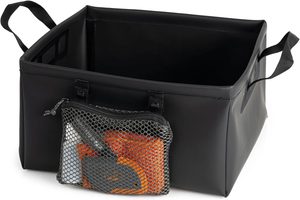
GSI Outdoors has been making camp cookware since 1985, and this set reflects that focus it’s a full clean-up kit, not just a basin. The collapsible, 12-liter sink measures 10.2 x 10.2 x 4.7 inches and weighs roughly 11 ounces (listings vary between 10.8 and 11.8 oz). It comes bundled with a refillable BPA-free soap bottle, a scouring sponge, and a quick-drying microfiber cloth, all of which pack into a mesh pocket on the sink itself.
Specs
- Water capacity: 12L
- Weight: approximately 11 oz (10.8–11.8 oz depending on retailer listing)
- Folded size: 10.2″ x 10.2″ x 4.7″
- Material: polypropylene, TPR, polyethylene, polyester, nylon, rubber
- Includes: soap bottle, sponge, microfiber cloth
- Warranty: covered by GSI Outdoors’ lifetime warranty against material and workmanship defects
Pros
- Most of what you need for dishwashing comes in one box
- Backed by a legacy outdoor brand with a genuine lifetime warranty
- Smooth interior makes it easy to wipe clean between uses
Cons
- Smaller basin capacity than the SereneLife tanks better suited to individual dishes than a full group’s cookware
- No pump or hose, so it’s manual fill-and-dump like the other basin-only options
Best for: Campers who want a grab-and-go clean-up kit without assembling pieces themselves.
Who should skip it: Anyone needing high water volume for group cooking cleanup.
Bottom line: The lifetime warranty and complete kit make this worth the small premium over a basic basin.

- COMPACT & PORTABLE CAMP SINK: The GSI Outdoors Crossover Sink is lightweight, collapsible, and measures 10.2″ x 10.2″ x …
- COMPLETE CLEAN-UP SET: Includes a collapsible sink, refillable BPA-free soap bottle, scouring sponge, and quick-drying m…
- DURABLE & EASY TO CLEAN: Constructed from tough, abrasion-resistant materials for reliable, long-lasting use. The smooth…
6. Coghlan’s 2082 Collapsible Sink Most Basic
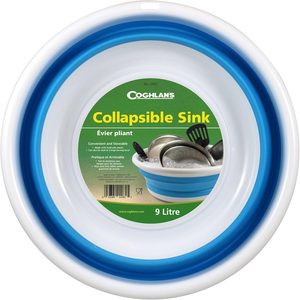
Coghlan’s has been making budget camping gear for decades, and this sink is about as no-frills as the category gets. It’s a 9-liter basin that folds to roughly 2 inches thick for storage, with no pump, faucet, or drain plug essentially a well-built folding bucket shaped like a sink.
Specs
- Water capacity: 9L
- Folded height: roughly 2″
- Material: molded plastic
- Weight: not published by the manufacturer
Pros
- Very simple little to break or malfunction
- Compact when collapsed, easy to store in a bin or drawer
- Doubles easily as a general-purpose basin for laundry, produce, or ice
Cons
- No drain plug, so emptying means tipping the whole basin
- Fewer features than most other options here at a similar price
Best for: Campers who want a secondary basin or the simplest possible backup option.
Who should skip it: Anyone who wants a drain plug, hose, or hands-free operation.
Bottom line: A reasonable no-frills backup basin, not a primary camp kitchen solution.

- Spacious 9L Capacity: Easily holds water for washing dishes, cleaning gear, or other campsite tasks; perfect for group c…
- Collapsible Design for Easy Storage: Folds flat to just 1.96 in. (5 cm), making it a breeze to pack into backpacks or ca…
- Durable and Lightweight Construction: Made with food-safe TPR and PP plastics, offering reliable performance for outdoor…
7. Camco Deluxe Camp Kitchen with Sink Best Full Camp Kitchen Setup
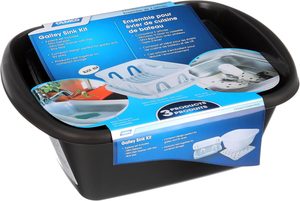
This one isn’t just a sink it’s a full camp kitchen table with a collapsible fabric sink built into the design, alongside a stainless steel countertop, a side table, and a covered storage cabinet. It folds into a black nylon carry bag and uses water-impervious materials so a spill or splash doesn’t ruin the unit.
Specs
- Type: folding camp kitchen table with integrated collapsible fabric sink
- Materials: stainless steel countertop, water-impervious fabric sink, covered cabinet
- Packs into: black nylon carry bag
- Weight and packed dimensions: not independently verified for this review check the current Amazon listing, as this is a larger multi-piece unit where specs can vary by revision
Pros
- Solves camp kitchen organization and sink needs in a single purchase
- Stainless counter and covered cabinet add functionality beyond washing
- Relatively low packed weight for what it sets up into, based on owner reports
Cons
- Significantly pricier than a standalone sink
- The windbreak doesn’t fully cover the countertop, and the secondary table sits at a different height than the main one worth knowing before buying
Best for: Campers who want to upgrade their entire kitchen setup, not just add a wash basin.
Who should skip it: Anyone who only needs a sink and already has a table or counter space.
Bottom line: The right call if you’re outfitting a camp kitchen from scratch, not if you just need a basin.
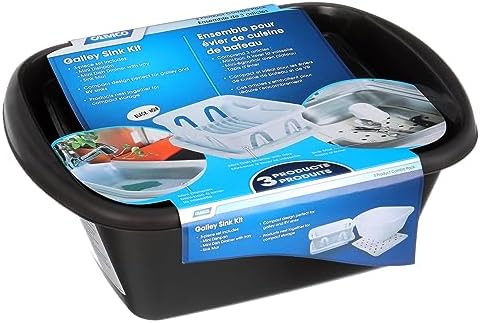
- 3-piece set includes dishpan, dish drainer with tray and sink mat
- Miniature size perfect for galley sinks
- Products nest together for compact storage
Other Sink Options: SereneLife Portable vs. Alpcour Portable Camping Sink
Our 7 picks above cover the range from ultralight backpacking to full group camp setups, but they’re not the only sink options on Amazon. The Alpcour Portable Camping Sink uses a similar tank-and-pump design to the SereneLife models and comes up often when campers compare sink stations side by side. If none of our picks fit your exact setup, it’s worth a look as an alternative we simply haven’t verified its current specs closely enough to include it as a primary recommendation here.
🔥 Best Camping Dutch Oven Discover the best camping Dutch oven for hearty meals around the fire.
How We Scored These Sinks
Each product was scored on five criteria, on a 1–5 scale, based on verified manufacturer specs, listed materials and warranty terms, and patterns found across a large sample of real Amazon owner reviews:
- Water capacity relative to category (does it hold enough for its intended use case?)
- Portability (weight and packed size where published, or unfolded footprint where weight isn’t listed)
- Setup complexity (basin fill-and-dump vs. tank-and-pump assembly)
- Drainage and greywater handling (drain plug, hose, or manual pour)
- Durability signals (material construction, warranty coverage, and review consistency over time)
This isn’t a substitute for hands-on lab testing of every SKU, and we say so plainly in the methodology note below. It’s a transparent, repeatable way to compare products with genuinely different designs against the same criteria.
How These Sinks Were Evaluated
This roundup is built from fifteen years of hands-on camp kitchen experience combined with a close read of each product’s verified Amazon specs, manufacturer data, and real owner reviews not a single unboxing session covering all seven exact SKUs. That distinction matters: a sink can look great in product photos and still fall apart on uneven ground or in cold weather, and the honest limitations noted in each review above (drain plug availability, wheeled vs. carried, fabric vs. rigid basin) came from cross-checking listing details against how these categories of gear tend to perform outdoors, including patterns that show up repeatedly in verified buyer reviews.
If you buy one of these and it performs differently than described here, or Amazon’s listing has changed since this was published, let us know specs and availability shift over time and this guide gets updated accordingly.
🍳 Best Portable Camping Grills Fire up your next trip with the best portable camping grills.
Basin Size and Water Capacity Guidance
- Solo or couple, short trip (1–2 nights): 9–10L is usually plenty. The FOSJGO, Coghlan’s, or Sea to Summit basins cover this.
- Couple or small family, weekend trip: 15–20L gives enough water for a full round of dishes without refilling constantly. The SereneLife 19L sink fits here.
- Group camping or extended stays (4+ people, 3+ nights): 25L or more can help avoid frequent refill trips. The SereneLife 30L wheeled sink is built for this range.
- Backpacking: Weight typically matters more than capacity a 10L packable basin like the Sea to Summit is usually the better call than a tank-based system.
A rough rule of thumb some campers use: budget about 1–2 liters of wash water per person per meal for basic dishwashing, then add a buffer for hand-washing and rinsing gear.
Buying Guide: What Every Camper Should Know
Choosing a camping sink is less about finding the biggest basin or the cheapest option and more about matching the sink to how, where, and how often you camp. A lightweight collapsible basin can be perfect for backpacking, while a freestanding sink with a foot pump makes much more sense at a family campsite.
Before buying, consider these factors.
1. Choose the Right Water Capacity 💧
Capacity is one of the first things to consider because a sink that is too small can become frustrating during meal preparation and cleanup.
For most campers, a 9–10L camping sink works well for basic washing, rinsing dishes, and general cleanup. Couples or small families may prefer 15–20L, while larger groups and longer trips can benefit from 25L or more.
A useful starting point is approximately 1–2 liters of wash water per person per meal, plus some extra capacity for rinsing and unexpected cleanup.
| Camping Situation | Recommended Capacity |
|---|---|
| Solo camping | 5–10L |
| Couple / 1–2 nights | 9–10L |
| Small family / weekend | 15–20L |
| Larger group / extended trip | 25L+ |
| Backpacking | 5–10L |
Expert tip: Don’t automatically choose the largest sink. More capacity usually means more weight, more storage space, and more water to carry. Choose the smallest capacity that comfortably handles your typical cleanup.
🥘 Best Camping Cookware Sets Cook smarter outdoors with the best camping cookware sets.
2. Collapsible vs. Freestanding: Which Is Better? 🏕️
Your camping style should determine the type of sink you buy.
Collapsible camping sinks are best when storage space and portability are priorities. They fold down significantly smaller than rigid basins and are particularly useful for backpacking, compact car-camping setups, and campers who already have limited storage.
Freestanding camping sinks are better when convenience is more important than packed size. Many include a fresh-water tank, foot pump, soap dispenser, drainage hose, wheels, or a dedicated washing station.
Choose a collapsible basin if you:
- Have limited vehicle or storage space
- Want something lightweight
- Mainly wash dishes and small cooking items
- Camp occasionally
- Prefer a simple setup
Choose a freestanding sink if you:
- Camp with a family or group
- Wash dishes frequently
- Want hands-free water from a foot pump
- Need separate fresh and waste-water storage
- Prefer a more organized camp kitchen
3. Consider Packed Size and Weight 🎒
A sink’s advertised capacity doesn’t tell you how easy it will be to transport.
Look at both its empty weight and packed dimensions. A large sink may be excellent at a campsite but impractical if you have to carry it any significant distance.
For backpacking, every ounce matters, so a lightweight fabric sink is usually more appropriate. For car camping, a heavier freestanding model can be worthwhile if it provides substantially more convenience.
Also consider where you’ll store it when you’re not camping. A sink that folds to a few inches can be much easier to keep in a garage, trunk, or camping storage box.
4. Pay Attention to Materials and Construction 🛠️
The material affects durability, weight, flexibility, and how easy the sink is to clean.
Common materials include:
- HDPE: Rigid, durable, and commonly used in freestanding camping stations.
- PP (polypropylene): Lightweight and suitable for rigid or collapsible basins.
- TPR: Flexible rubber-like material commonly used in collapsible sections and seals.
- Nylon: Lightweight and packable, particularly in fabric camping sinks.
- Steel: Often used for support rings, frames, or structural components.
For occasional car camping, a quality plastic basin may be all you need. If you’re packing and unpacking frequently, pay closer attention to hinges, folding joints, seams, handles, and drain fittings, since these components often experience more stress than the basin itself.
🥩 Best Cast Iron Skillets for Camping Make campfire cooking easier with the best cast iron skillets for camping.
5. Don’t Overlook Drainage 🚰
Drainage is one of the biggest differences between a simple camping basin and a dedicated washing station.
A basic basin may require you to manually empty the dirty water. Some collapsible models include a drain plug, while larger freestanding sinks may use a hose to direct wastewater into a separate container.
Think about where the dirty water will go before buying.
A drain is especially useful when:
- You’re washing greasy dishes
- You’re camping with several people
- You want to reuse or contain greywater
- You’re using the sink at a fixed campsite
- You want easier cleanup at the end of the meal
However, a drain does not eliminate the need for responsible greywater disposal. Follow the rules of your campground and local land-management agency, strain food particles from wastewater, and avoid dumping wash water directly into lakes, streams, or other natural water sources.
6. Look at the Pump System ⚙️
If you’re buying a portable camping sink with a foot pump, check how much water the pump delivers per press and how easy it is to operate.
A foot pump allows you to operate the water without touching a faucet with dirty hands, which can be particularly useful while washing dishes.
Before choosing a pump-equipped model, consider:
- Pump output: More water per press means faster washing.
- Pedal design: It should be stable and easy to operate.
- Fresh-water capacity: A good pump is less useful if the tank is too small.
- Waste-water management: Check whether wastewater drains into a separate tank or through a hose.
- Replacement parts: A repairable or serviceable system can be more useful over the long term.
For simple trips, a gravity-fed or pour-over basin can be perfectly adequate. You don’t necessarily need a pump if your camping routine doesn’t require running water.
7. Check Stability Before Buying ⚖️
A camping sink needs to remain stable while you’re filling it, washing dishes, or pressing the pump.
This is particularly important with freestanding models. A tall sink with a narrow base can be less stable on uneven ground than a lower, wider design.
Look for:
- A broad base
- Stable legs or feet
- Secure water tanks
- A well-supported basin
- Wheels that lock or remain stable when stationary
- A pump pedal that doesn’t slide around
If you regularly camp on uneven ground, prioritize stability over a few extra liters of capacity.
8. Think About Cleaning and Maintenance 🧽
A camping sink itself needs cleaning, especially when it’s used for food preparation and dishwashing.
Look for smooth interior surfaces without unnecessary crevices where food particles can collect. Removable drain components are also helpful because they make it easier to clean buildup.
After each trip:
- Empty all fresh and wastewater tanks.
- Remove food particles and debris.
- Wash the basin with mild soap and clean water.
- Rinse thoroughly.
- Allow the sink to dry completely before folding or storing it.
- Store hoses, plugs, and accessories together so they’re ready for the next trip.
Avoid storing a collapsible sink while it is damp. Trapped moisture can lead to unpleasant odors and potentially encourage mold growth.
9. Consider Your Cooking Style 🍳
The right sink also depends on what you cook.
If your campsite meals consist mostly of dehydrated food, sandwiches, or simple one-pot meals, a small basin may be enough.
If you regularly cook steaks, pasta, bacon, cast-iron meals, or large family dinners, you’ll produce more dishes and greasy cookware. In that situation, a larger sink with better drainage and more water capacity can save considerable time during cleanup.
For heavy cleanup, prioritize:
- Larger water capacity
- A sturdy basin
- Convenient drainage
- Easy-to-clean surfaces
- Stable construction
- A separate wastewater solution
10. Check What Comes in the Box 📦
Two camping sinks with similar prices can provide very different value depending on their included accessories.
Before purchasing, check whether the package includes items such as:
- Drain hose
- Soap dispenser
- Foot pump
- Carry bag
- Storage pouch
- Dishcloth
- Scraper
- Sponge
- Separate wastewater tank
Accessories aren’t necessarily essential, but they can reduce the number of additional items you need to pack.
11. Consider Warranty and Long-Term Durability 🛡️
A camping sink is exposed to water, dirt, food residue, repeated folding, transportation, and temperature changes. A warranty can therefore provide useful protection against manufacturing defects.
Don’t judge durability solely by the warranty length, though. Pay attention to the construction of the basin, seams, folding joints, drain fittings, pump, hose connections, and frame.
For frequent campers, spending a little more on a well-built sink can be more economical than repeatedly replacing inexpensive basins.
12. Match the Sink to Your Camping Style 🎯
Ultimately, there isn’t one perfect camping sink for everyone.
For backpackers:
Prioritize low weight, compact packed size, and simple construction.
For solo and couple campers:
A 9–10L collapsible basin is often enough for basic meal cleanup.
For families:
Look for approximately 15–20L of capacity and convenient drainage.
For larger groups:
A 25L+ freestanding system can reduce the need for repeated refills.
For car campers:
Weight matters less, so features such as foot pumps, soap dispensers, wheels, and separate wastewater storage become more attractive.
For organized camp kitchens:
Consider a full washing station that integrates with your cooking and food-preparation area.
🔥 Best Backpacking Stoves Go lighter and cook faster with the best backpacking stoves.
Quick Buying Checklist ✅
Before adding a camping sink to your cart, ask yourself:
- Capacity: Is it large enough for the number of people I camp with?
- Weight: Can I comfortably transport it?
- Packed size: Will it fit in my vehicle or camping storage?
- Setup: Can I get it ready quickly?
- Drainage: How will I collect or dispose of wastewater?
- Durability: Can it handle repeated camping trips?
- Cleaning: Is the basin easy to wash and dry?
- Stability: Will it remain secure on uneven ground?
- Accessories: Does it include the equipment I actually need?
- Warranty: Is there reasonable protection against defects?
Bottom line: The best camping sink is the one that fits your actual camping routine. For minimalist trips, keep it simple and lightweight. For family and car camping, spending more on capacity, drainage, and running-water features can make campsite cleanup considerably easier.
Campsite Setup, Washing Dishes, and Greywater Basics
Setup: Collapsible basins pop open in seconds unfold and fill. Tank-based sinks like the SereneLife models take a few minutes longer: fill the reservoir, attach the pump or hose if it ships disassembled, and you’re ready.
Cleaning between uses: Rinse basins with clean water after each use and let them air dry fully before folding trapped moisture in a folded basin is a common cause of mildew smell. For tank sinks, periodically flushing the reservoir with a diluted vinegar solution can help keep the internal lines from developing buildup.
Greywater disposal: Dumping dishwater directly into a lake, stream, or other natural water source goes against Leave No Trace principles and is restricted in most public camping areas. A more responsible approach:
- Strain food particles out of the water first (a mesh strainer or even a bandana works).
- Carry the greywater at least 200 feet from any water source.
- Scatter it widely over a large area rather than dumping it in one spot, so it disperses into the soil instead of pooling.
- If your sink includes a drain hose, direct it into a dedicated greywater container you can empty properly at a dump station or designated disposal area.
FAQ: Choosing a Sink for Camping
Do I need a camping sink?
Not strictly, but it can make a real difference. For quick weekend trips, a simple collapsible basin is often enough. For family camping, group cookouts, or multi-day trips, a dedicated sink with a drain system tends to keep your site cleaner and reduces greywater pooling near your cook area.
How do you drain a camp sink?
Tank-based sinks with a hose let you direct water into a separate greywater container for proper disposal. Basin-only sinks without a drain plug need to be carried to an approved disposal spot and poured out, spreading the water widely and at least 200 feet from any natural water source.
Are collapsible sinks durable enough for regular camping?
Generally, yes, for their intended use. Rigid plastic and TPR basins like the FOSJGO and Coghlan’s models tend to hold up well over repeated trips, though fabric-based options like the Sea to Summit are lighter but somewhat more puncture-prone with heavy long-term use.
What’s the difference between a collapsible basin and a full sink station?
A collapsible basin is a fold-flat container you fill and empty manually. A sink station like the SereneLife models includes a water tank, a pump for running water, and often a soap dispenser, functioning closer to an actual kitchen sink.
Can a camping sink handle greasy dishes and cast iron?
Basin-only sinks can, but drainage is manual, so grease-heavy water needs extra care when disposing of it. Tank sinks with a drain hose make this easier since you can direct the water into a greywater container rather than handling a full basin by hand.
How long do camping sinks typically last?
It depends heavily on material and use frequency. Rigid HDPE tanks and GSI’s warrantied set tend to hold up across multiple seasons with normal care. Lighter fabric or TPR basins can last just as long if they’re rinsed and dried between trips, but are more vulnerable to a single sharp puncture ending their lifespan early.
Can I use soap directly in a collapsible camp sink?
Yes, most of the materials used here (PP, TPR, HDPE, coated nylon) are fine with standard biodegradable camp soap. Avoid bleach on fabric-based sinks like the Sea to Summit specifically, since it can damage the seam tape and coating over time.
Do camping sinks work in cold weather?
Rigid plastic and HDPE tank sinks generally hold up fine in cold conditions. Some flexible collapsible materials can stiffen and become harder to fold or unfold in freezing temperatures, which is worth considering if you camp in shoulder seasons or winter.
Is a foot-pump sink better than a gravity or pour sink?
“Better” depends on your setup. A foot pump gives you hands-free, pressurized water flow, which is more convenient for group hand-washing. A basic basin gives you fewer moving parts to maintain and a lower price, which some campers prefer for simplicity and long-term reliability.
Is a sink for camping worth the extra weight or cost?
For most trips longer than a single night, yes. A dedicated sink for camping saves time on dishwashing, keeps greywater from pooling near your tent, and makes it easier to wash your hands than crouching over a water jug. For a single overnight trip, a basic basin usually covers it.
What’s the best sink setup for everyday camp life?
For most weekend campers, a mid-capacity basin or a compact tank sink covers everyday camp life without adding much bulk. Save the largest tank sinks for group trips where the extra water capacity actually gets used.
Final Verdict
If you only take one thing from this guide: match the sink to your trip, not the other way around. For most car campers, the SereneLife 19L Foot Pump Sink hits the best balance of function and portability. If you’re watching your budget or just need a backup basin, the FOSJGO Collapsible Dish Basin does the job for around the price of a bundle of firewood. Backpackers should look at the Sea to Summit 10L first, given its 4.4 oz weight, and anyone hosting a group camp should size up to the SereneLife 30L Wheeled Sink. Whichever you choose, prioritizing a model with proper drainage tends to make the biggest difference in how clean your actual campsite stays.
| Product | Best For | Capacity | Price Tier |
|---|---|---|---|
| SereneLife 19L Foot Pump Sink | Overall / car camping | 19L | $$–$$$ |
| FOSJGO Collapsible Dish Basin | Budget | 9L | $ |
| SereneLife 30L Wheeled Sink | Groups | 30L | $$$ |
| Sea to Summit 10L Kitchen Sink | Backpacking | 10L | $$ |
| GSI Outdoors Crossover Sink Set | Complete kit | 12L | $$ |
| Coghlan’s 2082 Collapsible Sink | Basic backup | 9L | $ |
| Camco Deluxe Camp Kitchen w/ Sink | Full kitchen setup | N/A | $$$$ |
About the Author
Ricky Thorne has spent 15+ years guiding camping trips across a range of terrain and group sizes, from solo backcountry expeditions to large family campground gatherings. Camp kitchen setup and cleanup including sink and water-management systems is a recurring focus of that experience. This guide reflects that background combined with verified product research; individual product specs are sourced from manufacturer listings and cross-checked against real owner reviews, as detailed in the methodology section above.