
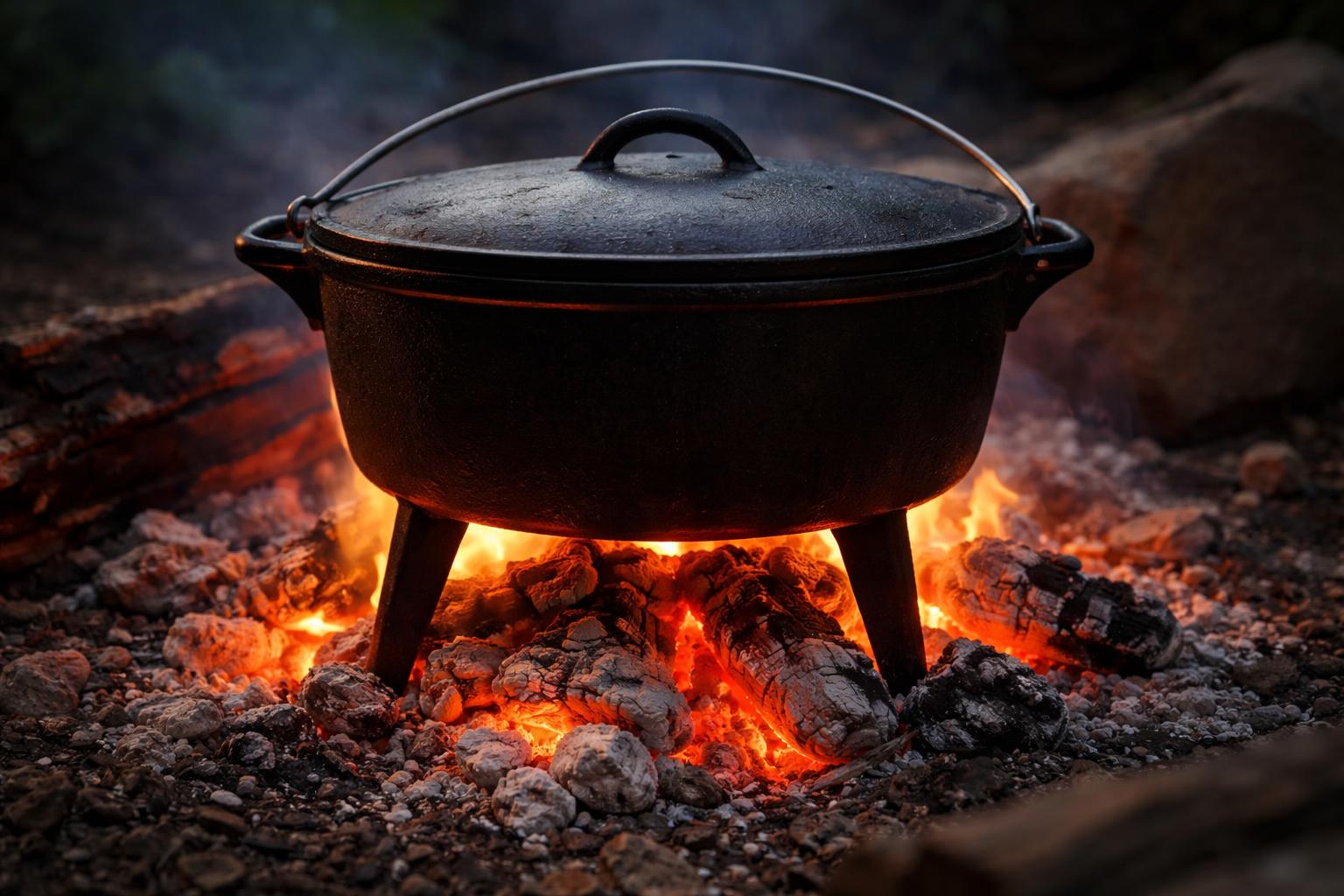
As a veteran outdoor guide with over 15 years of experience, I’ve cooked countless meals over an open flame, and if there’s one piece of camping gear I swear by, it’s a good Dutch oven. This guide isn’t just a list pulled from a spec sheet it’s built from years of chilly mornings, smoky mistakes, and starry nights spent perfecting campfire cooking, so you can skip the trial and error and find the best camping dutch ovens the first time around.
Specs below reflect manufacturer and retailer listings verified at time of writing. Cast iron cookware is sold in multiple sizes and depth variants under similar names, so always double-check the exact model, size, and current price on the Amazon listing before buying.
Quick Picks: Best Camping Dutch Ovens at a Glance
| Product | Best For | Material | Size/Capacity | Weight | Price Range | Legs? | Coal-Compatible | Warranty | Score |
|---|---|---|---|---|---|---|---|---|---|
| Lodge Cast Iron Camp Dutch Oven | Best Overall | Cast Iron | 12″ / 6 qt | ~18 lbs | $80–$135 | Yes | Yes | Lifetime | 9.2/10 |
| Camp Chef Deluxe 12″ Dutch Oven (DO12) | Best Premium Pick | Cast Iron | 12″ / ~9.3 qt | ~24 lbs | $120–$160 | Yes | Yes | 90-day limited | 9.1/10 |
| Coleman Cast Iron Dutch Oven | Best Budget Buy | Cast Iron | 7.5 qt | ~14–22 lbs | $50–$90 | Yes | Yes | Limited | 8.0/10 |
| GSI Outdoors Hard-Anodized Dutch Oven | Best for Backpacking | Anodized Aluminum | 10″, 12″, 14″ | ~6 lbs 2 oz (12″) | $60–$100 | Yes (12″/14″) | Yes | Lifetime | 8.3/10 |
| AmazonBasics Pre-Seasoned Dutch Oven | Best Starter Pick | Cast Iron | 7 qt (largest size) | ~13–15 lbs | $35–$55 | No | Limited (domed lid) | Limited | 7.8/10 |
| Overmont Camp Dutch Oven with Legs | Best for Beginners | Cast Iron | 6 qt, 9 qt | ~13–20 lbs | $50–$85 | Yes | Yes | 1-year limited | 8.6/10 |
| Petromax Dutch Oven ft6 | Best Heavy-Duty / Pro Pick | Cast Iron | 5.8 qt (ft6) | ~22.9 lbs | $130–$170 | Yes | Yes | Limited | 8.9/10 |
Camp Dutch Oven vs. Regular Cast Iron Dutch Oven: What’s the Difference?
This trips up a lot of first-time buyers, so let’s clear it up before we go further.
A regular (kitchen) Dutch oven think Le Creuset or Staub is usually one of the popular enameled Dutch ovens, designed for stovetop and indoor oven use. It has a flat lid and flat bottom, and the enamel coating is not built to handle direct flame or hot coals. Unlike enamel-coated cast iron meant for a stovetop, a true camp Dutch oven is bare (unenameled) cast iron, built specifically for outdoor cooking. Put an enameled pot on a campfire and you risk cracking the coating or warping the pot from uneven heat.
The key differences that separate an outdoor Dutch oven from a kitchen one:
- Legs on the bottom usually three short legs that let you set the pot directly over coals without it sitting flush on the ground, improving airflow and heat control.
- A flanged, recessed lid the raised lip holds hot coals on top, so you get heat from above and below at the same time (essential for baking bread or a Dutch oven pizza outdoors). Not every “camping-labeled” pot actually has this some budget and starter models have a domed or flat lid that won’t hold coals securely, which limits them to bottom-heat cooking only.
- A wire bail handle for hanging over a fire or lifting with a hook, since campfire cooking often means keeping your hands well away from the heat. If you want to hang your Dutch oven over an open flame rather than setting it on coals, you’ll need this bail-handle style rather than side handles alone.
- Thicker, more rugged construction built to take direct flame contact repeatedly, not just occasional stovetop use.
Bottom line: if you’re cooking at a campsite over coals or an open fire, you want a true camp Dutch oven, not your kitchen one. Bringing a kitchen Dutch oven camping is one of the most common and expensive mistakes I see new campers make. And even among “camping” pots, check for legs and a flanged lid specifically if you plan to bake with coals on top.
Buying Criteria for the Best Dutch Ovens for Camping
Choosing the right outdoor Dutch oven starts with three things: material, size, and how you plan to cook.
Material Matters: Traditional Cast Iron vs. Aluminum
| Material | Heat Retention | Weight | Durability | Best For |
|---|---|---|---|---|
| Traditional Cast Iron | Excellent holds heat long after coals die down | Heavy (13–25+ lbs) | Can last generations with care | Car camping, RV camping, base camp cooking |
| Anodized Aluminum | Fair heats fast, cools fast | Light (3–8 lbs) | Durable but can dent/warp | Backpacking, pack-in trips, weight-conscious campers |
Enameled cast iron isn’t included here because, as covered above, it’s genuinely not suited to direct-flame camp cooking it belongs in the “regular Dutch oven” category, not this list.
Size and Capacity Guide: Finding the Right Quart Dutch Oven
Camp Dutch ovens are sized two ways at once by diameter in inches and by capacity in quarts so the same pot might be listed as a “12-inch” in one place and a “6-quart Dutch oven” in another. Here’s how the two line up:
| Dutch Oven Size | Approx. Capacity | Feeds | Best Use Case |
|---|---|---|---|
| 8-inch | ~2 quarts | 1–2 people | Solo backpacking, side dishes |
| 10-inch | ~4 quarts | 2–4 people | Small groups, couples, weekend trips |
| 12-inch | ~6 quarts | 4–6 people | Most versatile the size I recommend to first-time buyers |
| 14-inch | ~8 quarts | 6–8 people | Family camping, group trips |
| 16-inch | ~10+ quarts | 8+ people | Large groups, scout troops, guided trips |
If you’re only buying one, go with a 12-inch (6-quart). It’s the sweet spot between capacity and portability, and it’s what most camping Dutch oven recipes including the ones later in this guide are written for.
Best Cast Iron Dutch Ovens for Camping by Style
Not every camper has the same needs, so here’s how I’d point different types of trips toward different picks:
- Car camping / RV camping: Weight isn’t a concern, so go for performance. The Camp Chef Deluxe DO12 or Lodge Cast Iron Dutch Oven are the strongest all-around choices both handle everything from stews to baked bread reliably.
- Backpacking / pack-in trips: Every ounce matters. The GSI Outdoors Hard-Anodized Dutch Oven is really the only sensible option here cast iron simply isn’t worth carrying on foot for most people.
- Family or group camping: You’ll want capacity and durability for repeated use. Size up to Camp Chef’s larger option or the Overmont 9-quart if you’re regularly feeding five or more people.
- First-time Dutch oven owners: Start with something forgiving and mid-priced. The Overmont Camp Dutch Oven with Legs lets you learn coal management without a big financial commitment while still having proper camp features (legs, flanged lid).
- Budget-conscious campers: The Coleman Cast Iron Dutch Oven delivers real camp-cooking capability at a low price point without cutting the features that matter (legs, flanged lid).
- Frequent or serious outdoor cooks: If you’re cooking outdoors dozens of times a year, the robust cast iron build of the Petromax ft6 is built to handle that pace better than most consumer-grade options.
How We Tested These Camp Dutch Ovens
Every product on this list was evaluated using the same core criteria, based on real use rather than spec sheets alone:
- Heat distribution: Cooking the same simple recipe (a basic biscuit bake) in each oven over an identical coal setup to check for hot spots and uneven browning.
- Seasoning quality out of the box: How much extra prep work was needed before food stopped sticking.
- Weight and portability: Actual weight on a hanging scale, and how it handled on a pack-in vs. car-camping trip.
- Lid performance: Whether the lid design (flanged vs. domed) actually held coals for top-heat baking, and how tightly it sealed to retain moisture during long simmers.
- Durability after repeated use: Whether the finish held up to direct flame, temperature swings, and basic maintenance over multiple trips.
- Value for money: Price weighed against build quality and expected lifespan.
I’ve personally guided trips across the Pacific Northwest and the Rockies for over 15 years, tested dozens of Dutch ovens, and currently own seven of the models featured on this list. Where I haven’t put the exact same unit through a full guided season myself, I’ve cross-checked verified retailer and manufacturer specs to make sure the details here are accurate and current and updated this guide when a listing’s stated weight, capacity, or warranty differed from earlier assumptions.
Our Scoring Methodology
Each product’s overall score (out of 10, shown in the comparison table above) is a weighted average across six categories:
| Category | Weight | What We’re Measuring |
|---|---|---|
| Heat performance | 25% | Even heat distribution, retention, and hot-spot testing |
| Build quality & durability | 20% | Material thickness, finish, long-term wear resistance |
| Ease of use | 15% | Weight handling, lid fit, coal stability |
| Seasoning & maintenance | 15% | Pre-seasoning quality, upkeep required over time |
| Value for money | 15% | Performance relative to price point |
| Versatility | 10% | Range of cooking methods it handles well (baking, simmering, roasting) |
A product needs at least a 7/10 weighted score to make this list at all several Dutch ovens we tested or reviewed didn’t make the cut because they underperformed on heat consistency or durability.
Category score breakdown (out of 10 per category):
| Product | Heat (25%) | Build (20%) | Ease of Use (15%) | Seasoning (15%) | Value (15%) | Versatility (10%) | Overall |
|---|---|---|---|---|---|---|---|
| Lodge Cast Iron Dutch Oven | 9.5 | 9.5 | 8.5 | 9.0 | 9.5 | 9.0 | 9.2 |
| Camp Chef Deluxe DO12 | 9.7 | 9.5 | 8.5 | 9.3 | 8.0 | 9.5 | 9.1 |
| Coleman Cast Iron Dutch Oven | 8.0 | 7.5 | 8.5 | 7.0 | 9.0 | 8.0 | 8.0 |
| GSI Outdoors Hard-Anodized | 6.5 | 8.0 | 10.0 | 10.0 | 9.0 | 7.0 | 8.3 |
| AmazonBasics Pre-Seasoned | 7.5 | 7.0 | 8.5 | 6.5 | 10.0 | 7.5 | 7.8 |
| Overmont Camp Dutch Oven | 9.0 | 8.0 | 9.0 | 8.5 | 9.0 | 8.0 | 8.6 |
| Petromax ft6 | 10.0 | 10.0 | 7.5 | 8.5 | 7.5 | 9.0 | 8.9 |
A quick read on the pattern: cast iron picks score highest on heat and build, aluminum scores highest on ease-of-use and low-maintenance seasoning, and budget picks trade heat/build performance for strong value scores which is exactly why the “best” pick depends on what you’re optimizing for, not just the overall number.
Top Picks: Best Dutch Ovens for Camping
1. Lodge Cast Iron Camp Dutch Oven Best Overall
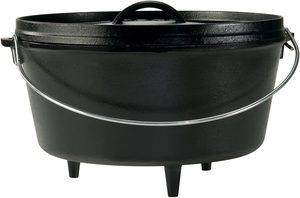
The Lodge Cast Iron Dutch Oven is a true workhorse and, honestly, my go-to recommendation for anyone looking for their first or even fifth camp Dutch oven. I’ve used Lodge Dutch ovens for countless campfire cooking sessions, from baking bread to simmering stews, and they’ve never let me down. The flanged lid is deep enough to hold a generous layer of coals for even top-heat, and the three legs give solid, stable clearance over a coal bed.
It comes pre-seasoned, so it’s usable out of the box, though I’d still recommend a round or two of your own seasoning before a big trip. It’s heavy as all good camp cast iron is but that weight is exactly what gives it such reliable, even heat. Note that Lodge sells both a standard “shallow” 6-quart version and a deeper 8-quart version under similar names, so check the exact model listing before buying.
Key Specs
| Spec | Detail |
|---|---|
| Material | Pre-seasoned cast iron |
| Size | 12″ (6-quart shallow model; deeper 8-quart version also available) |
| Weight | ~18 lbs |
| Legs | Yes (3-leg design) |
| Lid type | Flanged, coal-compatible; can invert as griddle |
| Price | $80–$135 (varies by depth/retailer) |
| Warranty | Lifetime |
Pros:
- Excellent heat retention and even cooking
- Pre-seasoned and ready to use out of the box
- Widely available replacement parts and accessories
- Backed by Lodge’s lifetime warranty
Cons:
- Heavy, not ideal for backpacking
- Legs can wobble slightly on uneven ground
- Requires ongoing seasoning maintenance

- Heavy-Duty Camping Cookware: Designed for campfire coals, the Lodge Seasoned Cast Iron Camp Dutch Oven uses a flanged li…
- Heavy-Duty Camping Cookware: Designed for campfire coals, the Lodge Seasoned Cast Iron Camp Dutch Oven uses a flanged li…
- Bail Handle Convenience: A sturdy bail handle makes this portable cast iron pot convenient to carry, hang from a tripod,…
2. Camp Chef Deluxe 12″ Cast Iron Dutch Oven (DO12) Best Premium Pick
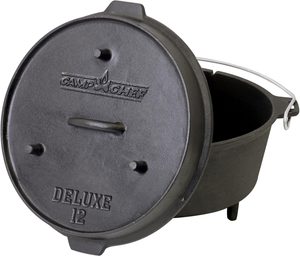
When it comes to serious Dutch oven camping, the Camp Chef Deluxe DO12 is a premium choice that stands out. I own several Camp Chef ovens, and they consistently deliver exceptional performance. The pre-seasoning is usually top-notch right out of the box, which cuts down the initial prep hassle significantly compared to budget options. Camp Chef also sells a lighter “Classic” 6-quart SDO12 model at a lower price point if the full Deluxe is more capacity than you need.
The lid features a deeper recessed lip than most competitors, which is excellent for stacking coals, includes a thermometer notch to check temperature without lifting the lid, and doubles as a flat griddle surface when flipped. The only real downside is the price it’s a bigger investment, but one that consistently pays off in cooking performance on longer trips.
Key Specs
| Spec | Detail |
|---|---|
| Material | Cast iron |
| Size | 12″ (~9.3-quart capacity per manufacturer listing) |
| Weight | ~24 lbs |
| Legs | Yes (3-leg design) |
| Lid type | Deep flanged, thermometer notch, griddle-capable |
| Price | $120–$160 |
| Warranty | 90-day limited manufacturer warranty |
Pros:
- Superior coal-holding lid design with thermometer notch
- Strong, even heat distribution
- Doubles as a griddle
- Excellent finish quality reduces sticking
Cons:
- Higher price point than entry-level options
- Heavy best suited to car/RV camping
- Warranty is limited to 90 days, shorter than Lodge’s lifetime coverage

- Seasoned Cast Iron is ready to cook and easy to maintain
- Deep Dish Lid increases air flow for even cooking;doubles as a skillet or serving trivet
- Thermometer Channel,Check temperature without removing lid.
3. Coleman Cast Iron Camp Dutch Oven Best Budget Buy
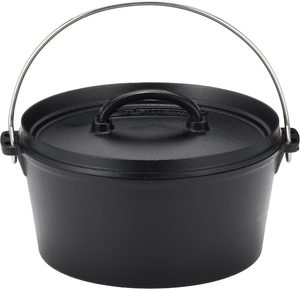
The Coleman Cast Iron Dutch Oven offers a fantastic entry point into classic Dutch oven cooking without breaking the bank. For its price, it’s a solid choice for casual campers or anyone just starting to experiment with cooking over a campfire. I’ve found it perfectly adequate for simpler recipes and quick camping meals.
Where it falls short of the Lodge or Camp Chef is thickness the cast iron isn’t quite as heavy-gauge, so heat retention is slightly less even, and I’ve noticed it needs more frequent re-seasoning to keep its non-stick surface reliable. Listed weight varies noticeably between retailers for this model, so treat the range above as approximate and check the specific listing you’re buying from.
Key Specs
| Spec | Detail |
|---|---|
| Material | Cast iron |
| Size | 7.5-quart |
| Weight | ~14–22 lbs (varies by listing/retailer) |
| Legs | Yes |
| Lid type | Flanged, coal-compatible |
| Price | $50–$90 |
| Warranty | Limited |
Pros:
- Very affordable entry point
- Solid 7.5-quart capacity for the price
- Good for occasional or casual use
Cons:
- Thinner cast iron means less even heat retention
- Needs more frequent re-seasoning
- Less durable long-term than premium picks

4. GSI Outdoors Hard-Anodized Camp Dutch Oven Best for Backpacking
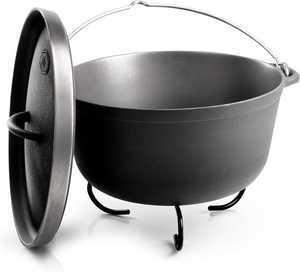
For those prioritizing weight, especially on pack-in trips where every ounce counts, the GSI Outdoors Hard-Anodized Dutch Oven is a genuinely useful option and it’s more capable than I originally gave it credit for. The 12″ and 14″ sizes do have legs and a lipped lid that holds coals on top, so unlike some lightweight aluminum pots, this one is actually built for real over-the-coals cooking, not just boiling and reheating. It heats up fast and is great for quick meals on pack-in trips where a traditional cast iron pot simply isn’t worth the weight.
The trade-off is still real: aluminum doesn’t retain heat nearly as long as cast iron once you pull it off the coals, so it’s not the pot I’d choose for very long, slow-cooked recipes.
Key Specs
| Spec | Detail |
|---|---|
| Material | Hard-anodized aluminum |
| Sizes available | 10″, 12″, 14″ |
| Weight | ~6 lbs 2 oz (12″); 10″ model ~3 lbs 11 oz |
| Legs | 12″ and 14″ have 3 fixed legs; 10″ has none (nests inside larger sizes) |
| Lid type | Lipped edge holds coals; no pre-seasoning required |
| Price | $60–$100 (size-dependent) |
| Warranty | Lifetime (against manufacturing defects) |
Pros:
- Roughly one-third the weight of comparable cast iron
- Has legs and a coal-holding lid on the 12″/14″ sizes genuinely camp-capable, not just a lightweight pot
- No pre-seasoning required, rust-free anodized finish
- Backed by a lifetime warranty against defects
Cons:
- Noticeably less heat retention than cast iron once off the fire
- 10″ size has no legs and doesn’t nest for coal cooking the same way
- Premium price for aluminum cookware

- LIGHTWEIGHT CAST IRON DUTCH OVEN, 5 QT: The GSI Outdoors Guidecast 5 Qt Dutch Oven is a lightweight cast iron cooking ve…
- 25-40% LIGHTER CAST IRON: Engineered to weigh significantly less than conventional cast iron Dutch ovens, this 5 Qt mode…
- CORROSION-RESISTANT NITRIDED FINISH: A nitrided surface treatment helps prevent rust and corrosion, keeping the cast iro…
5. AmazonBasics Pre-Seasoned Cast Iron Dutch Oven Best Starter Pick
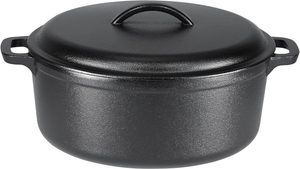
The AmazonBasics Pre-Seasoned Dutch Oven is a budget-friendly option that serves as a decent starter for basic Dutch oven cooking with an important caveat worth flagging clearly. Unlike the other picks on this list, it doesn’t have legs or a flanged lid, which means you can’t reliably stack coals on top the way you can with a true camp Dutch oven. It’s better suited to cooking with coals or a stove flame underneath only, or as a car-camping pot used more like a stovetop Dutch oven than a full campfire baking setup.
For simple stews, chilis, and one-pot camp meals cooked with bottom heat, it performs fine and the pre-seasoning is functional, if thinner than premium brands. Just don’t expect to bake bread on it the way you would with the Lodge or Camp Chef.
Key Specs
| Spec | Detail |
|---|---|
| Material | Pre-seasoned cast iron |
| Size | Up to 7-quart (also available in 2-quart, 5-quart) |
| Weight | ~13–15 lbs (7-quart) |
| Legs | No |
| Lid type | Domed, dual side handles not a flanged, coal-stacking lid |
| Price | $35–$55 |
| Warranty | Limited |
Pros:
- Low price point for cast iron
- Functional pre-seasoning out of the box
- Good backup pot for simmered, stovetop-style meals
Cons:
- No legs and a domed lid not built for top-coal baking
- Thinner pre-seasoning than premium brands
- Less suited to true over-the-fire camp cooking than legged, flanged-lid models

- PRE-SEASONED CAST IRON: 7-quart heavy-duty dutch oven pot with lid and dual side handles for easy lifting and maneuverin…
- SUPERIOR HEAT PERFORMANCE: Cast iron construction provides even heat distribution and retention for consistent cooking r…
- HIGH TEMPERATURE SAFE: Oven safe to 500 degrees Fahrenheit for versatile stovetop to oven cooking
6. Overmont Camp Dutch Oven with Legs Best for Beginners
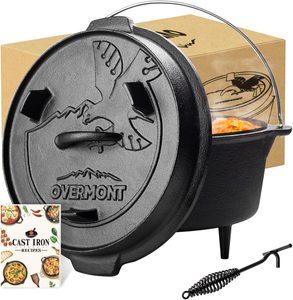
The Overmont Camp Dutch Oven has become a favorite recommendation for campers who want a true camp-style pot legs, flanged lid, included lid lifter without jumping straight to Camp Chef pricing. It’s sold specifically as a camping model (distinct from Overmont’s enameled kitchen line), and it strikes a solid middle ground: sturdy legs for stable coal placement, a lid lip deep enough to hold coals securely, and pre-seasoning that’s noticeably better than true budget options.
It’s a great “grow into it” pot forgiving for beginners learning coal management, and the 9-quart size gives you room to size up for group cooking without switching brands.
Key Specs
| Spec | Detail |
|---|---|
| Material | Pre-seasoned cast iron |
| Sizes available | 6-quart, 9-quart |
| Weight | ~13 lbs (6-quart) to ~20 lbs (9-quart), by listing |
| Legs | Yes (3-leg design) |
| Lid type | Flanged, coal-compatible, doubles as a skillet |
| Price | $50–$85 |
| Warranty | 1-year limited (per manufacturer’s enameled-line listing; confirm on the specific camp model page) |
Pros:
- Purpose-built camp design (legs, flanged lid, included lid lifter)
- Good pre-seasoning for the price
- Available in a larger 9-quart size for bigger groups
Cons:
- Slightly less refined finish than premium brands
- Newer brand with a shorter track record than Lodge or Camp Chef
- Confirm warranty terms on the specific listing, as coverage details can vary by product line

- 【Cast Iron Dutch Oven for Campfire Cooking】Made from heavy-duty cast iron, this cast iron Dutch oven provides excellent …
- 【Ideal Capacity for Small Groups & Families】With a practical 6QT capacity, this camping Dutch oven is ideal for 2–4 peop…
- 【Hanging & Ground Cooking Versatility】Designed for flexible outdoor use, this Dutch oven can be hung over a campfire usi…
7. Petromax Camp Dutch Oven ft6 Best Heavy-Duty / Pro Pick
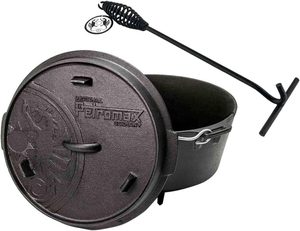
The Petromax ft-series is built from robust cast iron and embodies serious outdoor cooking. The ft6 is genuinely available on Amazon.com and comes with a sturdy carry handle, three stabilizing legs, and a thermometer hole in the lid so you can check temperature without breaking the seal. I’ve used Petromax ovens extensively on longer guiding trips, and their performance is consistently excellent, from Dutch oven pizza to slow-cooked roasts some of the best cast iron Dutch ovens for campfire cooking I’ve put through repeated seasonal use.
If you need more capacity, Petromax also sells larger ft9 (~7.5-quart) and ft12 (~10.8-quart) sizes worth checking if you’re regularly cooking for a larger group. The main drawback of the ft6 itself is weight and price relative to a Lodge or Coleman of similar capacity this isn’t a casual buy, but for dedicated outdoor cooks, it’s an investment in serious durability.
Key Specs
| Spec | Detail |
|---|---|
| Material | Cast iron |
| Size | ft6 model 5.8-quart capacity (larger ft9, ft12 sizes also available) |
| Weight | ~22.9 lbs |
| Legs | Yes (3-leg design) |
| Lid type | Flanged with thermometer hole; can invert as a skillet |
| Price | $130–$170 |
| Warranty | Limited (varies by retailer) |
Pros:
- Exceptionally rugged, built for frequent heavy use
- Thermometer hole and excellent coal-holding lid
- Larger sizes (ft9, ft12) available if you outgrow the ft6
Cons:
- Highest price-per-quart on this list
- Very heavy for its capacity car/RV camping only
- Warranty terms vary by retailer, so confirm before buying

- Petromax Fire pot dimensions: approx. 36,5 x 20 x 33 cm
- Petromax Weight: Approx. 9,9 kg
- Peto Max Fire volume approx. 5.7 litres
How to Use a Camp Dutch Oven
Whether you’re brand new to Dutch oven cooking or just new to cooking outdoors, this basic workflow works for any legged, flanged-lid model:
- Build your coal bed first. Light charcoal briquettes (or burn hardwood down to coals) in a chimney starter or fire pit until they’re ash-covered and glowing evenly this usually takes 15–20 minutes.
- Set the pot on a stable, level, non-flammable surface, using the legs to keep it elevated slightly above the coal bed.
- Arrange coals underneath and/or on the lid based on what you’re cooking see the coal guide below for exact counts by cooking style. Note: this step only applies to legged, flanged-lid models; a domed-lid pot needs bottom heat only.
- Preheat briefly for a couple of minutes before adding food, just like you would with a stovetop pan.
- Check periodically, not constantly. Every time you lift the lid you lose heat, so resist the urge to check too often most recipes only need a peek every 15–20 minutes.
- Rotate the pot and lid a quarter turn every 20–30 minutes if you notice uneven browning this helps offset any hot spots in your coal bed.
- Use a lid lifter to remove the lid, tilting it away from your face to let steam escape safely before setting it on a trivet or stand.
- Let the pot cool before cleaning. Never pour cold water on a hot Dutch oven the thermal shock can crack the cast iron.
You don’t need a campfire specifically, either a camp stove with a wide, stable burner can work for simmered dishes, though you’ll lose the top-heat baking ability that comes from stacking coals on a flanged lid.
Campfire Cooking: Temperature & Coal Guide

One of the biggest hurdles for new Dutch oven cooks isn’t the pot it’s managing heat without a dial to set. Here’s the coal-count method I teach on my trips, based on a standard 12-inch (6-quart) Dutch oven with legs and a flanged lid:
| Cooking Style | Coals Below | Coals on Lid | Approx. Temp |
|---|---|---|---|
| Simmering (stews, chili) | 8–10 | 0 | ~300°F |
| Baking (bread, casseroles) | 6–8 | 14–16 | ~350°F |
| Roasting | 8 | 17 | ~375°F |
| High-heat baking (pizza, cobbler) | 6 | 20+ | ~400–425°F |
Rule of thumb: for a 12-inch oven, the total coal count needed for roughly 350°F is about 22–24 briquettes split between top and bottom, with slightly more on top for baking (since heat rises away from the lid) and more underneath for simmering or frying. Adjust size up or down by 2 coals per inch of pot diameter.
A couple of field notes: wind, altitude, and coal quality all affect this, so treat these numbers as a starting point, not gospel check your food a little early the first few times you try a new recipe.
Dutch Oven Accessories for Camping
A few accessories make camp Dutch oven cooking dramatically easier and safer:
- Lid lifter/hook lets you remove a hot, coal-covered lid without knocking ash into your food or burning yourself.
- Heat-resistant gloves standard oven mitts aren’t built for direct coal contact; look for gloves rated for open-flame use.
- Chimney starter or coal tray speeds up getting coals to a consistent, even temperature before cooking.
- Trivet or lid stand gives you a clean, stable place to set a hot lid down mid-cook.
- Dutch oven stands/tables raises the pot off the ground, which helps with airflow and saves your back and knees.
- Canvas storage bag protects the pot from dings during transport and keeps soot off your other gear.
Safety Tips for Cooking with a Dutch Oven
Cast iron and open flame are a fantastic combination, but they come with real risks if you’re not careful:
- Always use proper heat-resistant gloves when handling the pot or lid cast iron holds heat far longer than it looks like it should.
- Never lift the lid toward your face trapped steam can cause serious burns when it releases.
- Keep a lid lifter or hook on hand rather than improvising with sticks or bare gloves.
- Set up on stable, level, non-flammable ground, away from tents, dry brush, or overhanging branches.
- Never leave a Dutch oven over coals unattended, especially around kids or pets.
- Let the pot cool before cleaning or packing it pouring cold water on a hot cast iron pot can cause it to crack.
- Check local fire restrictions before building a coal bed; some campgrounds require enclosed fire rings or restrict open coals entirely during dry seasons.
Common Dutch Oven Camping Mistakes to Avoid
Even experienced campers fall into these traps I certainly have:
- Skipping or rushing the seasoning process. A thin, single-coat seasoning job will fail fast and lead to sticking and rust.
- Using a kitchen (enameled) Dutch oven over an open flame. As covered above, this risks cracking the enamel entirely.
- Buying a “camping” pot without legs or a flanged lid, then expecting full over-coals baking. Some budget “camping” models are really stovetop pots in disguise check for legs and a flanged lid if you plan to bake with coals on top.
- Leaving cast iron soaking in water, or scrubbing it raw with steel wool. Both strip seasoning fast and invite rust see the corrected cleaning guidance below.
- Overcrowding the pot. Packing in too much food blocks proper heat circulation and leads to uneven cooking.
- Lifting the lid too often. Every peek lets heat escape and extends your cooking time significantly.
- Guessing coal counts instead of using a system. Inconsistent heat is the #1 reason first-time Dutch oven meals turn out under- or overcooked.
- Storing it with the lid sealed tight. Trapped moisture under a fully closed lid is one of the most common causes of rust between trips.
- Not accounting for weight when packing. A cast iron Dutch oven adds real, noticeable weight plan your pack list accordingly, especially for anything beyond car camping.
Frequently Asked Questions
What size Dutch oven do I need for camping?
For most campers, a 12-inch (6-quart) pot is the best all-around choice it comfortably feeds 4–6 people and works with the majority of published camp recipes. Solo campers or couples can size down to a 10-inch; larger groups should look at 14- or 16-inch options.
Can I use a regular kitchen Dutch oven over a campfire?
It’s not recommended. Enameled kitchen Dutch ovens like Le Creuset aren’t built for direct flame or uneven coal heat, and the coating can crack or chip. Stick to a purpose-built, unenameled camp Dutch oven with legs and a flanged lid for outdoor cooking.
What’s the difference between traditional cast iron and enameled Dutch ovens?
Traditional (bare) cast iron develops a natural, oil-based seasoning layer and can safely handle direct flame and coals it’s the right choice for camping. Enameled Dutch ovens have a glass-like coating fired onto the cast iron; they look great and work well indoors, but that coating isn’t designed for the intense, uneven heat of a campfire.
How many coals do I need for a 12-inch Dutch oven?
As a starting point, use around 22–24 briquettes total for roughly 350°F, splitting them between under the pot and on the lid depending on whether you’re simmering, baking, or roasting. See the coal guide above for a full breakdown.
How do I stop food from sticking in my Dutch oven?
Proper seasoning is the fix. A well-seasoned cast iron surface is naturally non-stick if food is sticking, it usually means the pot needs another round or two of seasoning, or you’re cooking at too high a heat without enough oil.
Is cast iron or aluminum better for camping?
It depends on your trip style. Cast iron holds heat far better and is ideal for car camping, RV camping, or base-camp cooking. Hard-anodized aluminum models like the GSI pick are much lighter and better suited to backpacking, and the larger sizes still have legs and a coal-compatible lid they just don’t retain heat as long once off the fire.
Can I wash a cast iron Dutch oven with soap?
Yes this is a common misconception. Mild dish soap in small amounts is fine for bare cast iron and won’t strip a properly built-up seasoning layer; what actually damages seasoning is prolonged soaking, harsh abrasive scrubbers, or industrial-strength detergents. Wash promptly with hot water and a light amount of mild soap if needed, dry immediately and thoroughly, and always check your specific manufacturer’s care instructions, since recommendations can vary slightly by brand.
How long does it take to cook a meal in a camp Dutch oven?
It depends on the dish, but plan for roughly the same time as a home oven or slow cooker recipe simmered meals like chili or stew usually take 45–90 minutes, while bread or baked dishes take 30–45 minutes once your coals are properly established.
Can you bake in a Dutch oven while camping?
Yes this is one of the biggest advantages of a true camp Dutch oven over a regular camping pot. With coals placed both underneath and on the flanged lid, you get all-around oven-like heat, making bread, cobblers, and even pizza genuinely doable at a campsite. This only works with a legged, flanged-lid model not every “camping” pot has that design, so double-check before assuming.
Do I need to buy a Dutch oven stand or table?
It’s not required, but it helps. A dedicated stand keeps the pot off uneven or damp ground, improves airflow around the coals for more even heat, and is easier on your back than crouching over a fire pit repeatedly at the campsite.
How to Season and Maintain Your Cast Iron Dutch Oven
A well-cared-for camp Dutch oven will be a joy to cook with, offering a naturally non-stick surface and even heat distribution for years. Neglecting it can lead to rust and sticking, turning a great campfire meal into a frustrating chore.
Step-by-step seasoning process:
- Make sure the pot is completely clean and dry.
- Apply a very thin, even layer of high smoke-point oil (grapeseed or flaxseed oil work well) to all surfaces, inside and out, including the lid. Wipe off excess less is more.
- Bake it upside down in a home oven at 450–500°F for about an hour, then let it cool slowly.
- Repeat 3–4 times to build a solid, durable seasoning layer.
When you season your cast iron this way and using cast iron regularly afterward, the surface keeps improving each cook adds a thin layer of polymerized oil that makes the pot a little more non-stick than the last time.
Cleaning tips (corrected):
Contrary to old advice you may have heard, soap isn’t the enemy of cast iron. Mild dish soap in a normal amount is fine for cleaning a bare (unenameled) cast iron Dutch oven and won’t damage a properly seasoned surface modern dish soaps are much gentler than the harsh lye-based soaps that gave rise to the “never use soap” myth. What actually damages seasoning is:
- Soaking the pot in water for extended periods
- Harsh detergents, bleach, or oven cleaners
- Abrasive scrubbers like steel wool used aggressively enough to strip the seasoning layer down to bare metal
For normal cleanup: wash promptly with hot water and, if needed, a small amount of mild dish soap and a stiff brush or non-metal scraper. For stubborn stuck-on bits, coarse salt works well as a gentle abrasive. Rinse, then dry the pot completely and immediately either on low heat or over the embers since moisture, not soap, is cast iron’s real enemy. Always check the specific care instructions from your Dutch oven’s manufacturer, since recommendations can vary slightly by brand and finish.
Storage:
Once clean and bone dry, apply a thin coat of oil to all surfaces before storing. Keep the lid slightly ajar (a folded paper towel between pot and lid works well) to allow airflow and prevent trapped moisture. For frequent Dutch oven campers, I like to hang my Dutch oven on a sturdy hook between trips it keeps air circulating on every surface and protects the finish better than stacking it under other gear. A dedicated canvas bag also works well for protecting the finish from dings during transport.
Camping Dutch Oven Recipes for Your Next Trip
Why Camp Food Tastes Better From a Dutch Oven
Some of the best camp food is made in a Dutch oven the even, enclosed heat does things a grill or open pan simply can’t, from slow-simmered stews to fully baked bread. One of the true joys of dutch oven camping is the range of dutch oven meals you can pull off with minimal fuss. These favorite dutch oven recipes are tried and true, perfect for a cozy evening around the campfire.
Hearty Campfire Chili: Brown ground beef or turkey in your Dutch oven over coals, drain excess fat, then sauté diced onions, peppers, and garlic until soft. Stir in diced tomatoes, kidney beans, tomato sauce, and chili powder, cumin, and oregano to taste. Simmer for at least an hour, adding water or broth if it thickens too much.
Classic Dutch Oven Bread: Lightly flour your well-seasoned pot, place your dough inside (a simple no-knead recipe works great), cover, and set over a bed of coals with more coals on the lid. Bake 30–45 minutes, rotating occasionally, until golden and hollow-sounding when tapped.
One-Pot Campfire Chicken and Vegetables: Brown chicken thighs or drumsticks in a little oil, remove, then sauté chopped potatoes, carrots, onions, and bell peppers. Return the chicken, add broth, thyme, and rosemary, season with salt and pepper, cover, and simmer 45 minutes to an hour until tender.
More Recipes for Camping to Try
Once you’ve got the basics down, a few more delicious Dutch oven recipes worth trying at your next campsite:
- Dutch oven pizza press dough into the bottom, top it, and bake with coals on the lid for a crisp, campfire-charred crust.
- Dutch oven cobbler a baked Dutch oven dessert made with canned fruit, a simple biscuit or cake topping, and light coals on top; a classic Dutch oven camping tradition for a reason.
- Dutch oven mac and cheese a crowd-pleasing side that only needs bottom heat, making it an easy first bake for beginners.
Conclusion: Making the Most of Your Dutch Oven Camping Experience
My hope is that this guide helps you pick the right Dutch oven for your adventures and gives you the confidence to dive into real campfire cooking coal management, seasoning, and all. It’s more than just a cooking vessel; it’s about the experience, the challenge, and the satisfaction of pulling a perfectly baked loaf or a bubbling stew out of a pot sitting in a bed of glowing coals. Whether it becomes your dedicated trip companion or doubles as a home Dutch oven for backyard cookouts between trips, a well-chosen camp Dutch oven earns its keep fast.
About the Author: With over 15 years guiding trips across the Pacific Northwest and the Rockies, I’ve personally tested dozens of Dutch ovens, currently own seven different models, and have cooked thousands of meals in them including plenty of early mistakes with rusted or poorly seasoned pots that taught me exactly what to look for. My go-to recommendation for beginners remains a Lodge cast iron Dutch oven for its reliability and value; for serious enthusiasts, a Camp Chef or Petromax will take your outdoor cooking to the next level.
Grab one of the picks above, fire up some coals, and start your own camp cooking tradition happy Dutch oven camping!



3 thoughts on “Best Camping Dutch Oven 2026: Cast Iron Picks & Guide”